5-Month-Old Baby Development - Motor Skills, Sleep, and Nutrition

This article is approved by Çiğdem İrem İleri
Published: 11 March, 2026
Updated: 30 July, 2026

At a Glance
Five-month-old babies typically stay awake for 1.5 to 2.5 hours at a time during the day and need a total of 12-15 hours of sleep per day.
With advancing motor skills, most babies successfully roll from their tummy to their back between 4 and 6 months.
Although interest in solids may begin, breast milk or formula remains the primary source of nutrition until the end of the sixth month.
For parents considering sleep training, 4 to 6 months can be a suitable developmental window, as the baby's self-soothing skills develop.
The fifth month is a transitional period where your baby leaves the newborn stage behind and interacts much more actively with their surroundings. During the 5-month-old baby development process, parents are most curious about wake windows and motor skills. If you are experiencing tired nights, it is important to remember that you are not alone and that this period progresses at every baby's own pace. In this guide, you will learn about your five-month-old baby's wake windows, leaps in motor skills, feeding expectations, and tips for establishing a sleep routine, all completely evidence-based.


5-Month-Old Baby Milestones and Motor Skills
Five-month-old baby milestones and motor skills generally include unassisted sitting attempts, reaching for objects, and lifting the chest while on their tummy. Physical development accelerates significantly during this time. You may notice that your baby no longer just wants to watch the world around them, but physically participate in it. Every baby's developmental path is unique; some are more eager to move, while others prefer to observe their environment.
Gross Motor: Rolling and Supported Sitting
As part of gross motor skills, rolling and supported sitting are abilities most babies display between 4 and 7 months by rolling from back to front and balancing with the help of pillows. Rolling is one of the clearest signs that your baby's abdominal and back muscles are getting stronger. According to American Academy of Pediatrics (AAP) guidelines, it is highly important for babies to have supervised tummy time several times a day while awake to strengthen neck muscles.
To practice this safely, you can place your baby face down on a flat, firm surface (such as a clean play mat) when they are awake and in a good mood. You can make this process fun by getting in front of them, talking to them, or holding a favorite toy at eye level, and take immediate breaks when you feel they are getting tired.

Fine Motor and Hand-Eye Coordination
The development of fine motor and hand-eye coordination becomes apparent around the fifth month when babies grasp objects they see with both hands and bring them directly to their mouths. Your baby's vision has now improved significantly. The desire to reach, grab, and explore peaks during this period. Shaking rattles and trying to transfer soft toys between their hands are among their favorite games at this age. Since bringing everything to their mouths is their way of getting to know the world, it is extremely important to remove small objects from the environment that could pose a choking hazard.
5-Month-Old Baby Sleep Schedule and Wake Windows
The 5-month-old baby sleep schedule and wake windows typically organize into longer uninterrupted blocks at night and daytime wake windows of 1.5 to 2.5 hours. While the effects of the fourth-month sleep regression gradually decrease, guided by a month-by-month baby sleep schedule, you might notice your baby starting to find a more predictable rhythm. However, teething symptoms, illnesses, or newly learned physical skills can occasionally cause night wakings, and this is a natural part of the developmental process.
Wake Windows and Daytime Naps
Wake windows and daytime naps for five-month-old babies generally consist of three to four short naps a day, following active periods of 90 to 150 minutes. Observing your baby according to these intervals helps you put them to bed before they get overtired, which can make it difficult for them to fall asleep. Sleep needs can vary slightly for every baby.
Baby's Age | Wake Window | Number of Daytime Naps | Total Daily Sleep Need |
|---|---|---|---|
4-5 Months | 1.5 - 2 hours | 3 - 4 naps | 12 - 15 hours |
5-6 Months | 2 - 2.5 hours | 3 naps | 12 - 15 hours |
These ranges in the table reflect general averages. If your baby is yawning, rubbing their eyes, or getting fussy, you can tell that you have reached the end of the wake window and need to start sleep preparations.
The Ferber Method and Sleep Training Process
The Ferber method and sleep training process use graduated waiting steps to encourage the baby to fall asleep on their own between 4 and 6 months, with the pediatrician's approval. Baby sleep training is not a strict rule for everyone; however, if sleepless nights are making the family's daily functioning difficult, it can be gently considered.
The Ferber method involves putting the baby in bed awake and entering the room at specific intervals (e.g., 3 minutes, then 5 minutes) to soothe them only verbally or with light touches without picking them up from the bed. If this method does not suit you or your baby's temperament, you can also explore different approaches that involve the parent staying in the room and providing more physical contact by discussing them with your doctor.
5-Month-Old Feeding and Preparing for Solids
The 5-month-old baby feeding and preparation for solids process is a period where main meals continue to be breast milk or formula, but a slow interest in solids begins. According to World Health Organization (WHO) data, it is ideal for babies to be fed exclusively with breast milk or formula for the first 6 months of life.
In the fifth month, the feeding schedule is still entirely liquid-based. However, some readiness signs indicating that your baby is getting ready for solids may gradually appear:
Being able to hold their head and neck up well and steadily without support.
Showing a clear interest in the food you eat and trying to reach for it.
A significant decrease in the extrusion reflex, which is pushing food out of the mouth with their tongue.
Leaning forward and opening their mouth while in a supported sitting position.
Unless your doctor suggests otherwise, there is no need to rush to start solids until the sixth month.
Sample 5-Month-Old Baby Daily Schedule
A sample 5-month-old baby daily schedule should contain a balanced mix of roughly two-hour wake windows, regular feeding sessions, and plenty of free play time. Following your baby's fatigue and hunger cues rather than a strict timetable is generally less stressful for parents.
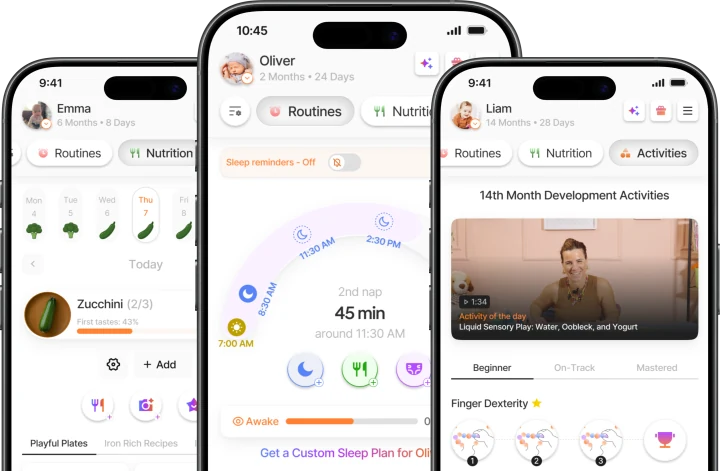
After waking up in the morning, feeding, a diaper change, tummy time, and the subsequent first daytime nap help determine the flow of the day. Keeping regular track of wake windows and sleep times makes it easier to establish a routine; at this point, to track your baby's developmental milestones, you can use the temperament-based personalization and daily tracking tools offered by the Yuppo app to adapt the daily schedule to their natural rhythm.

Summary and Next Steps
Sleep needs: Try to prevent overtiredness and catch sleep cues by carefully observing your baby's 1.5 - 2.5 hour wake windows this week.
Motor development: Support the development of neck muscles and rolling skills by adding short but frequent tummy time sessions to your daily routine.
Readiness signs for solids: Start monitoring your baby's interest in you at the table, their extrusion reflex, and their head control.
Safety check: Since the ability to roll increases significantly between 4 and 6 months, pay extra attention to not leaving your baby alone for even a second on the changing table or the parents' bed.
When to Consult a Specialist for 5-Month-Old Baby Development?
Babies develop at different rates, and every child has their own pace. However, if you observe that your five-month-old baby is struggling to reach some basic developmental steps, it is recommended to consult your pediatrician to support the process. The following conditions are concrete signs that generally require a medical evaluation:
Even though the baby is in the 5-6 month range, they cannot hold their head up at all when in your arms or in a sitting position, and their neck constantly drops.
They do not track moving objects with their eyes, do not make eye contact with you, or do not react to bright lights or loud noises.
Their hands are constantly in a tight fist, and by the end of the 5th month, they do not use their arms or hands to reach for objects at all.
Their muscles feel very stiff (rigid) or constantly excessively loose (floppy) like a rag doll.
They constantly face a choking hazard during feeding, have difficulty swallowing liquids, or their weight gain has stopped.
This content is for informational purposes only; always consult your pediatrician for diagnosis and treatment.
Every new skill your baby acquires during this rapid growth period is an exciting process that requires just as much tracking. Balancing wake windows, establishing healthy sleep routines, and finding the right games to support motor development can sometimes feel complicated.
By trying the Yuppo app for free, you can track your baby's 5th month developmental steps weekly, save their growth curve with the percentile calculator tool, and instantly access expert-approved activity recommendations suitable for their age. You can also gain detailed information about the next steps of your baby’s development checking out our 6-month-old baby development article.
Frequently Asked Questions
How long should a 5-month-old wake window be?
The ideal wake window for a five-month-old baby is usually between 1.5 and 2.5 hours (90-150 minutes). This is the time from when the baby wakes up in the morning or from their previous nap until they get tired again and show sleep cues (like yawning or eye rubbing).
How many hours should a 5-month-old sleep at night?
Five-month-old babies need an average of 9 to 11 hours of sleep in total at night. Although most babies increase their blocks of uninterrupted sleep at night during this period, it is very common and normal for them to wake up 1-2 times for reasons such as feeding or teething.
Is the Ferber method appropriate for a 5-month-old baby?
The Ferber method is generally considered appropriate between 4 and 6 months, when the baby's self-soothing skills begin to develop, provided the pediatrician approves. However, since every baby's temperament and family dynamics are different, this method may not suit everyone.
Can a 5-month-old sit up with support?
Many five-month-old babies can sit for short periods with pillows placed on their backs or sides, or with the support of an adult. Independent, unassisted sitting skills usually fully develop between the 6th and 7th months.
Can I start my 5-month-old on solids?
A five-month-old baby's primary and most important food is breast milk or formula; fully transitioning to solids is ideally recommended around 6 months. If the baby has full head control and shows strong interest in food, early tastes can be started only with a doctor's advice.
What are the signs of the 5-month sleep regression?
Sleep regression signs that can be seen around the fifth month typically manifest as waking up more often at night, resisting daytime naps, and increased fussiness while falling asleep. This temporary situation is a normal process caused by increased physical mobility and mental developmental leaps.
References
American Academy of Pediatrics. (2024). Movement: 4 to 7 Months. HealthyChildren.org. https://www.healthychildren.org/English/ages-stages/baby/Pages/Movement-4-to-7-Months.aspx
World Health Organization. (2024). Breastfeeding. https://www.who.int/news-room/fact-sheets/detail/breastfeeding

Dr. Çiğdem İrem İleri
Developmental Psychologist
After graduating from Koç University in 2019 with a double major in Psychology and Media and Visual Arts, alongside track programs in Design, Gender Studies, and Media and Management, Çiğdem İrem İleri began her integrated doctoral studies in Developmental Psychology at the same institution that same year.