1-Month-Old Baby Development Guide: Sleep and Feeding Schedule

This article is approved by Çiğdem İrem İleri
Published: 09 March, 2026
Updated: 05 August, 2026

At a Glance
During the 1-month-old baby development stage, newborns typically need between 14 to 17 hours of sleep per day.
Babies at this age usually want to feed every 2 to 3 hours and are not yet on a fixed schedule.
By the end of the first month, your baby may be ready to focus on human faces for longer periods and do a few minutes of tummy time each day.
1-month-old baby development is an adaptation period characterized by frequent feeding and intense sleep cycles as your little one tries to adjust to the outside world. In these first weeks of life, while your baby acts on basic reflexes, you also learn to read their unique cues. It is completely normal to feel tired or anxious at times during sleepless nights, and it takes time to get used to this brand new routine. In this guide prepared for newborn parents, you will learn about the sleep rhythm, nursing frequency, vaccination schedule, and safe care practices you can easily apply at home during the first month.


1-month-old baby feeding schedule and nursing frequency
The 1-month-old baby feeding schedule generally consists of frequent nursing sessions occurring every two to three hours, shaped by the baby's hunger cues. In these early weeks, instead of watching the clock, it is easier to follow early signs of hunger such as your baby bringing their hands to their mouth, rooting, or smacking their lips.
The World Health Organization (WHO) recommends that babies be exclusively breastfed for the first 6 months and that feeding be left to the baby's demand. Since every baby's stomach capacity and appetite are different, feeding times can vary between 15 and 40 minutes. Sometimes your baby might refuse to nurse; this can be a temporary reaction due to growth spurts, gas pains, or simply their comfort level at that moment.
Newborn feeding chart and meal intervals
The newborn feeding chart and meal intervals can vary, averaging 8 to 12 times a day for breastfed babies, and generally every 3 to 4 hours for formula-fed babies.
You can review the table below to get a general idea of your baby's feeding needs:
Feeding Method | Average Meal Interval | Daily Average Frequency |
|---|---|---|
Breast milk | Every 2 - 3 hours | 8 - 12 times |
Formula | Every 3 - 4 hours | 6 - 8 times |
It is important to remember that these values are average references. On days when growth spurts occur, babies may want to stay at the breast much more frequently; this is a completely natural behavior aimed at increasing milk production.
When can babies have water?
Giving water to babies is usually postponed until around the sixth month, which is the transition period to solids. In the first months of life, breast milk or formula contains all the fluids and nutrients your baby needs.
According to the WHO guidelines, exclusively offering breast milk (or formula when necessary) is sufficient for the first 6 months; giving extra water during this period can lead to water intoxication or malnutrition since the baby's stomach will get full.
Newborn sleep patterns and wake windows
Newborn sleep patterns consist of a total of 14 to 17 hours of sleep blocks distributed evenly throughout the day, as the distinction between day and night has not yet formed. During this period, babies wake up only for feeding, diaper changes, and short interactions, and then quickly fall back to sleep.
It is still quite early to expect a specific sleep routine or long stretches of nighttime sleep from your baby. To establish a more predictable schedule when the time comes, you can prepare yourself for the upcoming months by learning about month-by-month baby sleep schedules.

How to swaddle a baby for safe sleep
For babies to be swaddled safely, it is recommended to use the half-swaddle method, where the hips and legs are left free and the chest area is gently wrapped. The Moro reflex, which is frequently seen in the first months and causes the baby to wake up with a start, can be alleviated with the help of a swaddle.
The American Academy of Pediatrics (AAP) emphasizes that for safe sleep, babies should always be placed on their backs on a firm surface, there should be no loose blankets in the crib, and the swaddle should be flexible enough not to cause hip dysplasia. Swaddling should be discontinued when your baby shows signs of rolling over.
1-month-old baby wake windows and sleep routine
The wake windows for a 1-month-old baby mostly range between 45 and 60 minutes, and the baby is expected to transition back to sleep at the end of this period. This fairly short timeframe is just enough for feeding, burping, and whispering a few loving words.
Exceeding the wake window can cause the baby to become overtired and their nervous system to be overstimulated, making it difficult for them to fall asleep. When you notice the first sleep cues, such as your baby yawning, rubbing their eyes, or staring blankly, taking them to their sleep environment will make your job easier.
Tummy time and motor development in 1-month-old babies
Tummy time activities for 1-month-old babies can be practiced for a few minutes a day while the baby is awake and happy to strengthen the neck, shoulder, and back muscles. These exercises lay the physical foundation necessary for the baby to hold their head up, roll over, and crawl in the coming months.
In the beginning, you can do tummy time by laying your baby on your own chest, accompanied by skin-to-skin contact. Many babies may not like this position at first; starting with just one or two minutes and gradually increasing the time helps your baby get used to it without pressure. To support your baby's motor skills with fun and age-appropriate methods, you can check out the activity suggestions tailored to developmental milestones in Yuppo.

Developmental milestones and social skills of 1-month-old babies
Developmental milestones for 1-month-old babies include focusing on human faces for brief periods, reacting to sudden noises by startling, and communicating their needs through crying. At this age, your baby cannot yet see the world clearly; their vision is limited to 20-30 cm (8-12 in), which is roughly the distance of your face when close to them.
In terms of social development, your baby begins to respond to your voice and touch by calming down. The first conscious social smiles, which most parents eagerly await, usually appear between 6 and 8 weeks; smiles seen in the first month are mostly reflex movements during sleep.
When to consult a doctor regarding 1-month-old baby development
In 1-month-old baby development, it is a general practice to consult a pediatrician in the last week of the first month for routine check-ups and vaccination tracking. In this first comprehensive check-up, your doctor will measure your baby's height, weight, and head circumference to evaluate their growth trend. Also these routine visits are the perfect time to safely share any concerns you might have about feeding and sleep with your physician.
Summary and Next Steps
Sleep cycles: Your baby cannot differentiate between day and night yet; try to prevent them from becoming overtired by keeping track of their short 45-60 minute wake windows this week.
Feeding routine: Nursing or offering formula frequently is completely normal; feed your baby by paying attention to their hunger cues rather than watching the clock.
Tummy time: For the development of your baby's neck muscles, you can start a 2-3 minute tummy time practice on your chest daily when they are awake and cheerful.
Health tracking: Plan to make an appointment with your pediatrician for your baby's general health check-up and the completion of schedule vaccines like Hepatitis B at the end of the first month.

When to Seek Medical Attention
During the newborn period, mild sneezing, irregular breathing, or small amounts of spit-up are mostly part of the normal adaptation process. However, some symptoms indicate things are out of the norm and require prompt medical evaluation:
A fever reaching 38°C (100.4°F) or higher in babies under 3 months (fever should not be monitored at home in this age group).
The baby completely refusing to feed for several consecutive meals or having extreme difficulty waking up.
Having fewer than 5-6 wet diapers a day (could be a sign of inadequate feeding or dehydration).
Noticing a progressively distinct yellowing of the skin, the whites of the eyes, or the body overall.
Seeing retractions between the ribs while breathing or hearing constant grunting sounds.
This content is for informational purposes only; always consult your pediatrician for diagnosis and treatment.
While the intense pace of the first months might feel exhausting at times, this period where your little baby gets a bit more accustomed to you and the world every day is incredibly precious. During this adaptation phase, it is your most natural right to trust your parenting instincts and seek support when needed. You can also gain detailed information about the following of this process by checking out our 2-month-old baby development article.
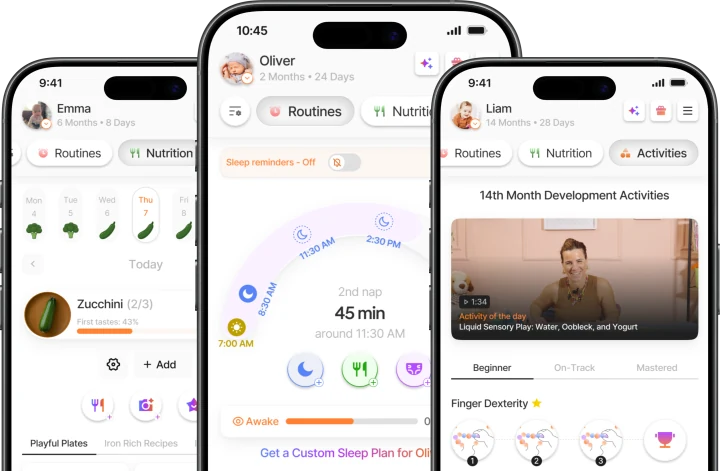
With the Yuppo app, you can track your baby's developmental steps on a weekly basis and get age-appropriate activity and content suggestions. You can also try the Yuppo app for free to record the growth process with the percentile calculator and gain peace of mind.
Frequently Asked Questions
How many hours does a 1-month-old baby sleep?
1-month-old babies typically spend most of their day sleeping, averaging around 14 to 17 hours. This sleep doesn't happen all at once; it is broken up into 2 to 3-hour blocks throughout the day due to their frequent need to feed.
What is the wake window for a 1-month-old?
The wake window for a 1-month-old baby generally ranges from 45 to 60 minutes. Within this brief period, the goal is to feed the baby, burp them, change their diaper, and prepare them for sleep again before they become overtired.
Why shouldn't a 1-month-old drink water?
Giving water to babies in their first months is unsafe because it can take the place of breast milk or formula, causing the baby to miss out on necessary calories. Furthermore, since newborn kidneys are not fully developed yet, offering water before the sixth month carries a risk of water intoxication.
What is the average height and weight of a 1-month-old?
While a 1-month-old baby's height and weight vary based on genetics, it is generally considered a sign of healthy development if they gain 600 to 800 g (1.3 to 1.8 lb) over their birth weight and grow 3 to 5 cm (1 to 2 in) in length during the first month.
When do babies smile for the first time?
Babies' first conscious social smiles usually emerge between the 6th and 8th weeks when they see their parents' faces or hear their voices. Smiles seen during sleep in the first month are mostly caused by natural reflexes of the nervous system.
References
World Health Organization. (2025). Breastfeeding. https://www.who.int/health-topics/breastfeeding
Moon, R. Y., & Carlin, R. F. (2022). Sleep-Related Infant Deaths: Updated 2022 Recommendations for Reducing Infant Deaths in the Sleep Environment. Pediatrics, 150(1). https://publications.aap.org/pediatrics/article/150/1/e2022058845/188304/Sleep-Related-Infant-Deaths-Updated-2022

Dr. Çiğdem İrem İleri
Developmental Psychologist
After graduating from Koç University in 2019 with a double major in Psychology and Media and Visual Arts, alongside track programs in Design, Gender Studies, and Media and Management, Çiğdem İrem İleri began her integrated doctoral studies in Developmental Psychology at the same institution that same year.