9 Month Old Developmental Red Flags: Signs of Delay

This article is approved by Çiğdem İrem İleri
Published: 30 July, 2026
Updated: 30 July, 2026

At a Glance
Inability to sit unsupported, lack of eye contact, or absence of babbling in 9-month-old babies can be signs of potential developmental delays.
The American Academy of Pediatrics (AAP) recommends comprehensive screening of gross motor, fine motor, and communication skills during the 9-month well-child checkup.
Early intervention when 9 month old developmental red flags are identified significantly supports long-term neurological and motor progress.
Most babies grasp object permanence between 6 and 9 months and show clear social responses to familiar faces.
Identifying 9 month old developmental red flags involves recognizing potential warning signs across gross motor, fine motor, speech, and social milestones. The ninth month marks a crucial stage in a baby's ability to communicate with their environment and improve physical mobility. This guide details key developmental warning signs and concrete steps to help parents monitor progress without unnecessary worry. Every infant develops at their own biological pace; however, recognizing critical signals in a timely manner provides valuable guidance.


What Are the Signs of Motor Delay in a 9-Month-Old?
Signs of motor delay in 9-month-olds typically include poor trunk control, inability to sit unsupported, excessive muscle stiffness or floppiness, and difficulty manipulating objects with both hands.
Physical mobility evolves rapidly during this period. Most infants sitting between 6 and 9 months can stay upright without support and bear some body weight on their legs. If you observe extreme stiffness or, conversely, ragdoll-like floppiness (hypotonia), a professional evaluation is essential.
The table below contrasts expected motor and social milestones with potential warning signs at 9 months:
Developmental Area | Expected Skill (6–9 Months) | Warning Sign (Red Flag) |
|---|---|---|
Gross Motor | Sitting without support, bearing weight on legs | Lacking trunk control even when supported, no weight bearing on legs |
Fine Motor | Passing objects hand to hand, pincer grasp | Not using one hand, inability to grasp objects |
Social / Communication | Responding to name, reciprocal smiling | Avoiding eye contact, lack of interest in surrounding sounds |
If one or more of these warning signs persist, a specialist should evaluate the baby's motor and muscle development.
Warning Signs in Gross Motor Skills
Gross motor warning signs include a 9-month-old struggling to sit without help, being unable to roll side-to-side from a back position, or failing to bear any weight on their legs when stood upright.
Individual variation in gross motor progress is broad. Some infants move through the crawling stage at a unique pace; however, an inability to maintain core balance indicates a different issue. As detailed in resources on baby sitting stages, a complete lack of trunk balance between 6 and 9 months requires clinical follow-up. According to the Centers for Disease Control and Prevention (CDC), the vast majority of 9-month-olds actively use their legs when supported upright.
Fine Motor and Object Manipulation Difficulties
Fine motor delays manifest as an inability to pick up toys with one hand, transfer items between hands, or coordinate the thumb and index finger.
Hand and finger muscle coordination becomes clearer at this age. Between 7 and 9 months, infants typically develop a pincer grasp, allowing them to pick up small pieces of food or toys using their thumb and index finger. For example, if a baby struggles to pick up a soft slice of cooked carrot or keeps one hand clenched into a persistent fist while using the other, an evaluation is warranted. Parents can easily follow developmental progress during daily play using the milestone tracking feature in the Yuppo app.
What Are the 9-Month Social and Emotional Red Flags?
Social and emotional red flags at 9 months include not smiling at familiar people, showing no interest in interactive games like peek-a-boo, and failing to show social responses upon separation from a primary caregiver.
During this stage, emotional range expands and object permanence develops. The World Health Organization (WHO) notes that infants form strong social bonds between 6 and 9 months, actively seeking out familiar caregivers. Appearing completely unconcerned with one's surroundings or failing to respond to social interaction indicates a need for emotional developmental support.

Lack of Eye Contact and Name Response
Inability to make eye contact or respond to one's name occurs when a 9-month-old does not turn toward the sound of a voice or has noticeable difficulty focusing on a parent's eyes.
Mutual gaze and auditory response form the foundation of communication. If a baby with normal hearing results consistently fails to turn when called or focuses exclusively on inanimate objects rather than human faces, an evaluation should be scheduled. These behaviors can sometimes align with social-communication differences observed as early signs of autism. When observing your baby's social responses, remain patient and avoid premature assumptions.
How to Recognize Speech and Communication Delays at 9 Months
Speech and communication delays at 9 months become apparent when a baby does not babble repetitive syllables like "ba-ba" or "ma-ma," avoids imitating sounds, and makes no effort to use gestures.
Language acquisition begins with pre-verbal vocalizations and babbling. Most infants mimic sounds and convey emotions through vocal pitch between 6 and 9 months. Complete silence, lack of response to vocalizations, or an absence of body language (such as pointing) are key signs of developmental delay in 9-month-olds.

Talking and singing frequently to your baby helps build early language skills. Throughout standard 9-month-old baby development, rich auditory stimulation directly nurtures babbling. If your baby shows no response to auditory cues, the first step is to verify that their hearing is functioning properly.
When to See a Doctor for Suspected Developmental Delay?
If a 9-month-old demonstrates persistent difficulties in motor, language, or social domains, or if they lose a previously acquired skill, consult a pediatrician promptly.
The American Academy of Pediatrics (AAP) recommends routine developmental screening at 9, 18, and 30 months. Combining parent observations with professional evaluations ensures the best support for your child's growth. Seeking timely guidance upon noticing marked asymmetry in movement, muscle flaccidity, lack of eye contact, or unresponsiveness to sound improves the effectiveness of early intervention.
Summary and Next Steps
Gross motor monitoring: Observe your baby's ability to sit unsupported and bear weight on their legs during daily play.
Fine motor and pincer grasp: Encourage efforts to grasp soft finger foods using the thumb and index finger.
Communication and speech: Speak face-to-face to encourage repetitive babbling like "ba-ba" or "da-da."
Social interaction: Check naturally whether your baby looks at you when called by name and establishes eye contact.
Routine checkup: Keep your baby's 9-month well-child visit to review developmental milestones with your pediatrician.
When to Consult a Pediatrician
The baby cannot sit without support at 9 months or collapses forward/sideways due to lack of trunk balance.
They show no weight-bearing ability on their legs when held upright and their legs remain entirely limp.
They do not turn toward sounds or voice cues when their name is called.
They avoid eye contact and do not respond with smiles to familiar faces.
They make no babbling sounds (such as "ba-ba" or "ma-ma") and remain completely quiet.
They show no pincer grasp, cannot pass objects hand-to-hand, or exclusively use only one hand.
They lose previously acquired skills, such as rolling over, vocalizing, or reaching for objects.
This content is for informational purposes only; always consult your pediatrician for diagnosis and treatment.
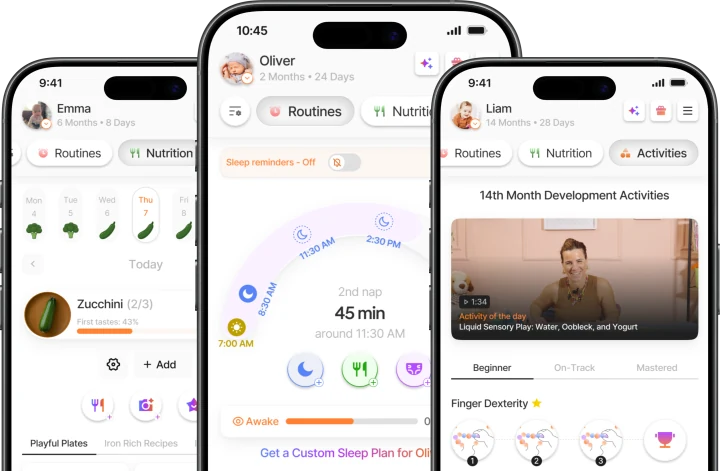
Tracking your baby's 9-month milestones guides your parenting journey. With the Yuppo app, you can log motor, speech, and social progress weekly and support development at home with expert-approved activities.
Frequently Asked Questions
Is it a red flag if a 9-month-old cannot sit unsupported?
Yes, an inability to sit without support or maintain core control by 9 months is a potential developmental red flag. Most infants learn independent sitting between 6 and 8 months. Consult your pediatrician if your 9-month-old consistently falls over when placed in a sitting position.
My 9-month-old does not respond to their name, what should I do?
First, schedule an evaluation with a pediatrician or ENT specialist to assess your baby's hearing. If hearing is normal, a pediatrician will assess social and communication development. Early evaluation ensures appropriate developmental guidance.
Is a baby not crawling at 9 months a sign of developmental delay?
No, a baby not crawling at 9 months is not automatically a sign of developmental delay or a red flag. Many healthy infants crawl using alternative styles between 6 and 10 months or transition straight to standing. Symmetric use of both arms and legs is the primary milestone to monitor.
What is the first step when developmental red flags are noticed in babies?
When you notice a potential red flag, note your specific observations and schedule an appointment with your pediatrician. If necessary, your doctor can refer you to a developmental pediatrician or pediatric neurologist to initiate early intervention services.
Can signs of autism be detected in 9-month-old babies?
While 9 months is early for a formal diagnosis, limited eye contact, lack of response to name, and absence of social smiling can be early indicators. These signs do not confirm autism, but they indicate that social communication skills should be monitored by a professional.
References
American Academy of Pediatrics. (2024). 9 Month Well Visit. AAP Publications. https://publications.aap.org/first1000days/module/29392/9-Month-Well-Visit

Dr. Çiğdem İrem İleri
Developmental Psychologist
After graduating from Koç University in 2019 with a double major in Psychology and Media and Visual Arts, alongside track programs in Design, Gender Studies, and Media and Management, Çiğdem İrem İleri began her integrated doctoral studies in Developmental Psychology at the same institution that same year.