Early Signs of Autism in Babies: Key Indicators for Early Detection

This article is approved by Yuppo Lab Developmental Psychologist
Published: 25 May, 2026
Updated: 06 August, 2026

At a Glance
Early signs of autism in babies typically present between 12 and 24 months through differences in social communication.
Avoiding eye contact and not responding to their name are among the earliest indicators parents might notice.
Autism is diagnosed by medical specialists through clinical observation and validated tools like M-CHAT-R screening.
Remember that every child develops at their own pace; if you have concerns, consult a specialist without feeling guilt.
Recognizing the early signs of autism in babies involves looking for developmental differences in social interaction, communication, and behavior between 12 and 24 months. On this parenting journey, seeking to understand how your baby perceives the world and interacts with their surroundings is completely natural. This guide helps parents learn what is autism spectrum disorder, identify key developmental milestones, and understand the importance of early intervention in a compassionate, non-judgmental way.


Early Signs of Autism in Babies: What Are They?
Early signs of autism in babies generally manifest as subtle differences across three main areas: social interaction, communication challenges, and repetitive behavior patterns.
These signs do not appear in the same way or with the same intensity in every child. Some infants may seem engaged with the world yet show heightened sensitivity to specific sounds, while others may prefer spending time in their own inner world. The American Academy of Pediatrics (AAP) recommends evaluating developmental milestones across a broad spectrum. If you notice autism symptoms in toddlers or infants that differ from their peers, knowing that development varies widely can offer reassurance.
Lack of Social Interaction and Eye Contact
A reduction in social interaction and eye contact often becomes noticeable between 6 and 9 months, when infants may avoid looking at faces or responding to smiles.
Human faces are typically among the most fascinating sights for infants. However, some babies on the autism spectrum may show greater interest in inanimate objects. For example, during play, they may find it challenging to engage in joint attention—looking at the same object together with you. This does not mean they lack affection or connection; it simply reflects a unique way of processing their environment.
Repetitive (Stereotyped) Behaviors
Repetitive behaviors involve actions such as hand-flapping, spinning in circles, or lining up objects repeatedly, which often become clearer after 12 months.
While many babies throw toys or wave their hands as they explore, these movements become notable when they occupy a large portion of the day and hinder interaction. For instance, a child might prefer spinning the wheels of a toy car for extended periods rather than pushing it across the floor.

Early Signs of Autism by Age
Developmental signs of autism can emerge as reduced social responsiveness starting around 6 months and become clearer by 24 months through differences in language and play skills.
Child development is rarely a straight line; the pace at which milestones are achieved varies. When considering how to tell if baby has autism, it is more helpful to look at broad developmental windows rather than rigid ages. According to the World Health Organization (WHO), while traits often appear early in childhood, they may not become fully apparent until social demands exceed the child's capacity.
Signs Before 12 Months
Before 12 months, subtle signs may include not responding to their name between 6 and 9 months, limited back-and-forth vocalizations, and a lack of interest in social games like peek-a-boo.
During these early months, infants typically begin reacting to their caregivers' voices and expressions. If a baby between 9 and 12 months does not reach out to be held or use a pointing finger to indicate what they want, developmental monitoring is recommended. Keep in mind that tired or distracted babies may also temporarily delay responding to their name.
Critical Developmental Differences Between 18–24 Months
Between 18 and 24 months, critical differences often center around a lack of pretend play, limited two-word combinations, and reduced interest in interacting with peers.
During this stage, toddlers learn rapidly by imitating the world around them. While most children pretend to talk on a toy phone, children on the spectrum may use objects in non-functional ways.

Speech and Communication in Autism Spectrum Disorder
Speech and communication differences in autism spectrum disorder often involve difficulties expanding vocabulary between 18 and 24 months, regression in spoken words, or repeating phrases out of context (echolalia).
Speech delay is one of the most common concerns for parents. However, a speech delay alone does not automatically indicate autism. The defining characteristic in autism is the challenge in using non-verbal communication—such as body language, facial expressions, and eye contact—alongside speech. Losing previously acquired words (loss of skills) is an important indicator that warrants professional evaluation alongside seeking specialist guidance for speech delay.
How Is Autism Diagnosed and What Is M-CHAT-R Screening?
Autism is diagnosed by pediatric neurologists, developmental pediatricians, or child psychiatrists through comprehensive clinical observation and standardized screening tools like the M-CHAT-R screening (Modified Checklist for Autism in Toddlers, Revised) for children aged 16 to 30 months.
The M-CHAT-R screening is a parent-reported questionnaire designed to assess developmental risk. It is not a diagnostic tool on its own, but rather a screening method to identify children who may benefit from a formal clinical evaluation. The AAP recommends screening all children for autism during routine 18- and 24-month well-child visits.
When to Consult a Specialist for Developmental Differences
The best time to consult a specialist is whenever you notice a pause or regression in your child's social, communication, or motor skills at any point between 6 and 24 months.
Your parental intuition is invaluable. If you feel something is not progressing as expected, seeking a professional opinion is always more reassuring than taking a "wait-and-see" approach. Early intervention is crucial because it supports brain development during the highly adaptable 0-3 age window.
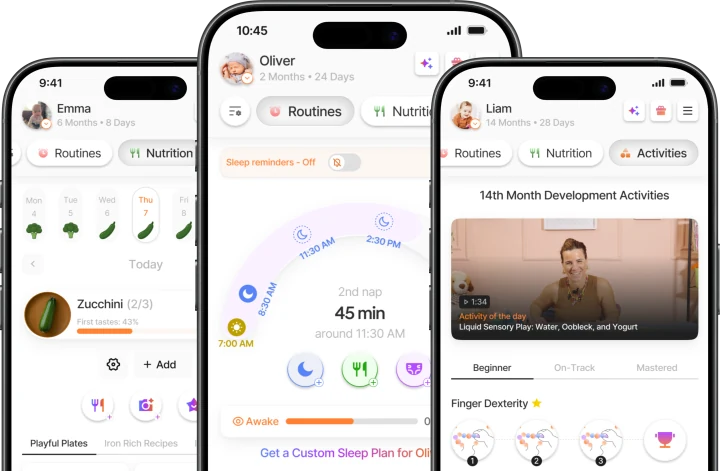
Understanding which specific skills your child needs support with can make this process much smoother. With Yuppo's developmental tracking, you can evaluate not just whether your child performs a skill, but at what mastery level. You then receive expert-designed activity plans tailored to that exact level, easily implemented with everyday household items.
Summary and Next Steps
Developmental flexibility: Social and language milestones unfold in ranges; focus on your baby's overall trajectory rather than strict dates.
Early observations: If you notice persistent signs like not responding to their name or avoiding eye contact around 12–24 months, keep a daily journal of these behaviors.
Professional guidance: Screening tools like the M-CHAT-R are preliminary assessments; discuss any findings with your pediatrician.
Supportive environment: Embrace your child's unique way of experiencing the world and create safe, low-pressure spaces for play.
When to See a Doctor
While every child develops at their own rhythm, consider consulting your pediatrician if you notice any of these red flags for autism:
Not responding with smiles or distinctly avoiding eye contact by 6–9 months.
Not pointing to show interest or not responding to their name by 12 months.
Not using single words by 16 months.
Not using spontaneous two-word phrases by 24 months.
Any loss of previously acquired speech, babbling, or social skills at any age.
This content is for informational purposes only; always consult your pediatrician for diagnosis and medical guidance.
Tracking your baby's developmental milestones can sometimes feel overwhelming. Understanding what is typical and when additional support might be helpful provides clarity and peace of mind.
Try Yuppo for free to track your baby's cognitive, physical, and social-emotional milestones on a weekly, skill-based level. Receive expert-approved activity recommendations tailored to your child's current development to support them naturally at home.

Frequently Asked Questions
My baby does not respond to their name. Is this a sign of autism?
Not responding to their name can be an indicator of autism, especially if it persists past 9 to 12 months, but it is not a diagnosis on its own. Infants may also be unresponsive due to tiredness, deep focus on an activity, or underlying hearing issues.
How to tell if baby has autism at 6 months old?
It is rare to diagnose autism with certainty at 6 months old. Early signs usually become clearer between 12 and 24 months as social interactions evolve. However, persistent lack of eye contact or unresponsiveness to smiles around 6 months should be monitored closely with your pediatrician.
Is lack of eye contact in babies always a sign of autism?
No, avoiding eye contact is not always due to autism. It can stem from shyness, fatigue, or vision issues. However, if lack of eye contact is persistent and combined with a lack of joint attention, consulting a healthcare professional is recommended.
What is the importance of early diagnosis in autism?
Early diagnosis allows families to access targeted therapies during the 0–3 age window, when brain plasticity is highest. Early support significantly improves communication, social integration, and play skills over time.
Are there specific red flags for autism like toe walking?
Toe walking is common in toddlers learning to walk between 12 and 24 months and is not, by itself, definitive proof of autism. However, if toe walking persists continuously alongside social or communication delays, mention it to your pediatrician.
How reliable are autism screening tools?
Tools like the M-CHAT-R screening are scientifically validated and reliable for identifying potential risk in children aged 16 to 30 months. They are preliminary screeners, however, and must always be followed by a comprehensive clinical evaluation by a specialist.
References
https://www.who.int/news-room/fact-sheets/detail/autism-spectrum-disorders?utm
https://www.who.int/news-room/questions-and-answers/item/autism-spectrum-disorders-%28asd%29?utm
https://www.who.int/news-room/fact-sheets/detail/autism-spectrum-disorders?utm
https://www.cdc.gov/autism/treatment/accessing-services.html?utm
https://www.who.int/news-room/fact-sheets/detail/mental-disorders?utm
Yuppo Lab
Developmental Psychologist

Sleep
Learn 6 month sleep regression signs, likely duration, and practical ways to respond. Navigate your baby's changing sleep with Yuppo.

Sleep
Discover when sleep regressions strike and what to do at each stage, from 4 months to 2 years. Track your baby's sleep milestones with Yuppo.

Sleep
Learn why sleep regression strikes around 20 months and what you can do to help your toddler rest again. Track your toddler's sleep patterns with Yuppo.