12-Month Sleep Regression: Signs, Duration, and Practical Tips

This article is approved by Yuppo Lab Sleep Expert
Published: 15 October, 2026
Updated: 17 October, 2026

At a Glance
The 12 month sleep regression is a popular description for new bedtime, nap, or night-waking difficulties near your baby’s first birthday.
Separation anxiety commonly seen around 8 to 12 months can contribute to bedtime protests and waking to look for you.
Near the first birthday, one or two naps totaling about 2 to 2.5 hours may fit your baby’s daytime sleep pattern.
Steady routines, calm nighttime responses, careful schedule tracking, and safe sleep practices can make this unsettled period more manageable.
The 12 month sleep regression usually refers to a cluster of sleep changes near your baby’s first birthday. This popular parenting description names the pattern without identifying one definite cause or timeline. If your previously settled baby is suddenly resisting naps or waking more often, you have not caused the change. YIn this guide, you’ll learn what to look for, how to assess nap readiness, and what to adjust; and you can always explore our sleep resource library if you’d like more age-based guidance.


What is the 12 month sleep regression?
The 12 month sleep regression describes newly unsettled bedtime, nap, or overnight patterns during the months surrounding your baby’s first birthday. It may affect one part of sleep or several parts at once.
A descriptive term for a sleep pattern
The term '12-month sleep regression' simply gives you a practical way to talk about noticeable changes in your baby’s sleep, much like the shifts you may have navigated around the 8-month mark.
How sleep may temporarily change around age 1
Sleep near the first birthday may become less predictable at bedtime, overnight, or during naps. You might notice:
Longer settling at bedtime
More frequent night waking
Earlier morning waking
Shorter or refused naps
A baby who recently learned to pull to stand may repeatedly stand in the crib instead of settling. Supervised daytime practice returning to a seated position gives your baby another opportunity to explore that movement.

Why does the 12 month sleep regression happen?
The one year sleep regression may overlap with separation anxiety, visible skill practice, and changing nap timing. These factors can occur together, and sleep behavior alone may not reveal one clear explanation.
New motor and language skills
New motor and language skills may become especially noticeable during quiet bedtime periods, but their presence does not prove why sleep changed. Your baby might stand, babble, or repeat a newly practiced action when you expected settling.
Separation anxiety and object permanence
Separation anxiety can affect sleep, while hidden-object searching offers a separate clue to your baby’s changing awareness. The American Academy of Pediatrics (AAP) notes that babies in the 8-to-12-month period may resist bedtime and wake searching for you.
The Centers for Disease Control and Prevention (CDC) includes looking for a hidden object on its milestone page for the first birthday. That observation does not explain every waking, but it provides useful developmental context.
Changing sleep pressure and nap timing
Changing sleep pressure may be suspected when your baby seems alert after a later nap, although bedtime behavior cannot measure it directly. Watch for observable schedule clues:
A late second nap followed by longer bedtime settling
Earlier tiredness after an early morning
Morning-nap resistance that becomes more consistent
Some families group sleep shifts with baby growth spurts, but the label itself cannot identify the cause.

What are the signs of the 12 month sleep regression?
The main 12 month sleep regression signs are new patterns involving bedtime resistance, night waking, early rising, naps, or daytime behavior. Look at changes across several sleep periods rather than interpreting one isolated event.
Bedtime resistance
Bedtime resistance may involve standing, calling, crying when you leave, or taking longer to settle. Alert, playful behavior can also appear when a late nap overlaps with the usual bedtime.
Night waking and early rising
Night waking and early rising may appear after a steadier period of sleep. The AAP explains that separation-related disruption can involve repeated waking across many nights.
Nap refusal or shorter naps
Nap refusal may affect the morning nap, second nap, or both on different days. Wirral Community Health and Care NHS Foundation Trust describes one or two naps totaling about 2 to 2.5 hours at 12 months.
Daytime mood and behavior changes
Daytime behavior may change when your baby has not slept well. The CDC reports that insufficient sleep can affect children’s mood and behavior, although fussiness alone does not identify the reason.
Use this table to turn each sleep change into something concrete to observe.
Sleep change | Schedule clue | Routine response | What to track |
|---|---|---|---|
Bedtime resistance | Second nap ended late | Repeat the same short wind-down | Wind-down and sleep times |
Skipped naps | Refusal changes by day | Offer the usual nap opportunity | Accepted or refused nap |
Night waking | Baby searches for you | Respond calmly with familiar words | Waking time and duration |
Early waking | Morning starts keep shifting | Start bedtime routine consistently | Bedtime and morning wake time |
The notes column matters most because repeated observations can reveal whether timing or separation is the stronger pattern.

When does the 12 month sleep regression start, and how long does it last?
The 1 year sleep regression may be used for changes beginning around 11 months, near the first birthday, or in the following weeks. Its course depends on which sleep changes are involved and whether separation remains prominent.
Typical timing around the first birthday
Timing around the first birthday does not have to match the calendar exactly. For example, at 11 months you might record bedtime resistance first, followed by shorter naps and earlier mornings, then compare how the pattern develops.
Why duration varies from baby to baby
Duration varies because nap timing, bedtime resistance, and separation-related waking may settle on different schedules. The AAP notes that the separation-anxiety stage can disrupt sleep for several months, but this does not determine the length of every sleep change.
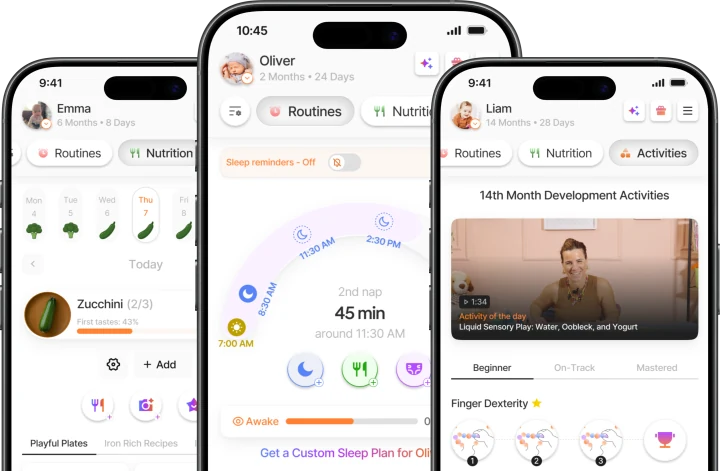
Track the pattern’s starting point, direction, and daytime effect. In Yuppo, you can record your baby’s sleep and review logged patterns when tired-night details become difficult to remember.
Is it a sleep regression or a transition to one nap?
A sleep disruption tends to vary, while one-nap readiness is more convincing when the same nap resistance becomes consistent. Avoid removing a nap based only on a brief change.
Signs the disruption is temporary
A changing pattern suggests that your baby may still need different nap support on different days. A baby might refuse the second nap twice, then need it after an early morning.
Signs one-nap readiness is becoming consistent
Consistent morning-nap resistance may suggest readiness for one longer afternoon nap. Derbyshire Family Health Service identifies repeated resistance to the morning nap as a possible sign.
How to observe the pattern before changing the schedule
Observing your baby’s schedule shows how daily nap choices affect the rest of their day. Keep track of:
Which nap your baby resists
Their mood before the next sleep period
Bedtime settling time
The following morning’s wake time
You can easily log all of these with Yuppo, using its smart analytics to spot emerging sleep patterns without the guesswork.
What can you do about 12-month nap problems and night waking?
Knowing what to do about the 12 month sleep regression starts with preserving familiar cues and changing only one schedule element at a time. This makes each adjustment easier to evaluate.
Keep wake time and bedtime anchors steady
Regular bedtime and nap times give your baby recognizable daily cues. The AAP recommends maintaining regular bedtimes and, when appropriate, regular nap times.
Adjust nap timing in small steps
Small timing changes are easier to assess than rebuilding the entire day. For babies in the months around their first birthday who go to bed late, the National Health Service (NHS) suggests moving bedtime earlier by 5 to 10 minutes each week.
Respond to night waking consistently
Nighttime responses should remain calm, quiet, and minimally stimulating. The AAP recommends avoiding unnecessary stimulation during nighttime care.
A baby who cries when you leave may gradually settle with the same brief check-in and bedtime phrase. If singing is already familiar, these baby lullaby ideas can help you preserve that cue.
Maintain safe sleep during setbacks
Safe sleep remains important when repeated waking leaves you exhausted. The AAP recommends back sleeping in a separate sleep space without another person.

Brief fluctuations may accompany this phase, but consider asking your pediatrician for help when:
Sleep disruption becomes progressively more frequent rather than beginning to settle.
Daytime sleepiness repeatedly interferes with your baby’s usual feeding or play.
Your exhaustion makes it difficult to maintain your baby’s separate safe sleep space.
For ongoing concerns, the AAP notes that your pediatrician may ask you to keep a sleep log. You can use Yuppo for reliable, easy-to-use sleep tracking.
Summary and Next Steps
Your next steps are to document the full sleep pattern, keep familiar cues, and make measured changes based on what you observe.
Track this week: Write down naps, bedtime settling, overnight waking, and morning wake time with Yuppo.
Separate patterns: Compare inconsistent nap refusal with repeated resistance to the same nap.
Keep nights quiet: Use a brief, calm response that does not turn nighttime into playtime.
Change bedtime gradually: If bedtime is late, move it earlier in small weekly steps.
Protect safe sleep: Continue using your baby’s separate sleep space during unsettled nights.
This content is for information only; always consult your pediatrician for diagnosis and treatment.
Nap changes and repeated waking are difficult to interpret when tired days blur together. In Yuppo, you can enter your child’s date of birth and follow expert-prepared developmental steps and milestones week by week.
Frequently Asked Questions
Can the 12 month sleep regression start at 11 months?
The 12 month sleep regression can describe changes that begin around 11 months. Compare bedtime, naps, overnight waking, and morning wake time as a connected pattern. Your baby’s experience does not need to begin on one particular date.
How long does the 12 month sleep regression last?
The 12 month sleep regression does not provide a fixed countdown for your baby’s sleep changes. Some patterns may ease as timing stabilizes, while separation-related waking can continue across several months. If disruption keeps intensifying, share your sleep record with your pediatrician.
How many naps should a 12-month-old take during a sleep regression?
One or two naps may both fit your baby near the first birthday. A daytime total of about 2 to 2.5 hours falls within one published nap range for 12 months. Consider nighttime sleep and the consistency of nap resistance rather than treating either schedule as required.
Should you switch to one nap during the 12 month sleep regression?
You should not switch to one nap solely because of a short run of refused naps. Look for repeated morning-nap resistance and observe how your baby manages the rest of the day. Needing two naps after an early morning suggests that the transition may still be inconsistent.
Can separation anxiety cause night waking at 12 months?
Separation anxiety can contribute to bedtime protests and night waking near 12 months. Your baby may cry when you leave or wake searching for you after previously easier nights. A calm, low-stimulation response can offer reassurance without adding playful nighttime activity.
Do you need to use cry it out for the 12 month sleep regression?
The 12 month sleep regression does not require you to use cry it out. You can choose a consistent response that fits your baby and household, including brief check-ins, calm verbal reassurance, or gradual support. Detailed sleep-training programs are a separate decision from managing this temporary pattern.
References
Centers for Disease Control and Prevention. (2026). Milestones in action: By 1 year. CDC.
Derbyshire Family Health Service. (n.d.). 1 year review. Derbyshire Family Health Service.
National Health Service. (2023). Sleep and young children. NHS.
American Academy of Pediatrics. (2024). Getting your baby to sleep. HealthyChildren.org.
American Academy of Pediatrics. (n.d.). Safe sleep. American Academy of Pediatrics.

Yuppo Lab
Sleep Expert

Sleep
Learn 6 month sleep regression signs, likely duration, and practical ways to respond. Navigate your baby's changing sleep with Yuppo.

Sleep
Discover when sleep regressions strike and what to do at each stage, from 4 months to 2 years. Track your baby's sleep milestones with Yuppo.

Sleep
Learn why sleep regression strikes around 20 months and what you can do to help your toddler rest again. Track your toddler's sleep patterns with Yuppo.