4 Month Sleep Regression: Recognize Signs and Support Better Sleep

This article is approved by Yuppo Lab Sleep Expert
Published: 11 October, 2026
Updated: 12 October, 2026

At a Glance
The 4 month sleep regression is a popular term for changing sleep patterns as your baby develops, not a loss of progress.
Circadian rhythms can begin emerging around 2 to 3 months, while renewed nighttime waking may appear around 4 to 5 months.
Possible signs include more night waking, shorter naps, and longer settling, although your baby’s pattern may be subtle.
Predictable cues, responsive feeding, calm nighttime care, and safe sleep practices can make this phase more manageable.
The 4 month sleep regression describes a period when your baby’s sleep may become less predictable as development continues. “Regression” is parent shorthand rather than a diagnosis. If your baby has started waking after previously calmer nights, you have not caused the change. You will learn what to notice, how timing varies, and which responses may help.
Your baby’s sleep needs may differ from another baby’s, so comparison rarely gives you a useful answer. For broader guidance beyond this specific phase, you can visit the Sleep section.


What is the 4 month sleep regression?
The 4 month sleep regression is a popular label for changing sleep patterns that often become noticeable during early infant development. It does not mean your baby has forgotten how to sleep or lost a developmental skill.
How infant sleep architecture changes
Infant sleep architecture describes the overall organization of sleep and waking across a sleep period. As your baby develops, you may notice that naps, nighttime sleep, and settling no longer follow the pattern you had recently come to expect.
Why “regression” can be a misleading label
The label “regression” can mislead because it suggests backward movement rather than ongoing development. As noted by the National Health Service (NHS) sleep needs vary not only from baby to baby but also across different ages, and this variability carries no negative meaning. On the contrary, it indicates that your baby is charting their own unique path forward on the long journey toward an adult sleep pattern. Therefore, changes or reductions in sleep duration signify progress rather than regression.
A more reassuring way to frame this period is:
Your baby’s sleep pattern is changing, not failing.
Nights and naps may not change in the same way.
The difference may be obvious, mild, or barely noticeable.
For example, your baby might suddenly take a much shorter nap and need a longer wind-down while continuing to feed and interact normally when awake.

Why does the 4 month sleep regression happen?
The 4 month sleep regression may coincide with developing circadian timing, changing sleep patterns, and greater awareness of people and surroundings. These changes do not appear identically in all babies.
Maturing sleep cycles
Maturing sleep cycles are a common explanation parents hear for suddenly less predictable sleep. However, a single short nap or difficult bedtime cannot confirm that sleep development is the only cause.
Developing circadian rhythms
Circadian rhythm development begins helping sleep and waking become more connected with day and night. A review hosted by the National Library of Medicine (NLM) reports that circadian rhythms start emerging around 2 to 3 months.
New skills and increased awareness
Greater social awareness may make your voice, face, and surroundings more engaging around sleep time. By around 4 months, the Centers for Disease Control and Prevention (CDC) lists looking, moving, or making sounds to gain or maintain attention as a common milestone.
You might notice:
More interest in your face during the bedtime routine
Increased alertness when the room is stimulating
Vocalizing or moving to keep your attention
If your baby wakes soon after bedtime, repeating the same quiet sequence may provide a familiar cue, even when settling takes longer than before.

What are the signs of the 4 month sleep regression?
Common 4 month sleep regression signs include renewed nighttime waking, shorter naps, and a noticeable change in settling. Look for a repeated pattern rather than judging one difficult day.
Changes in nighttime sleep
Nighttime changes may include waking after bedtime or waking more often than your baby recently did. Newcastle upon Tyne Hospitals NHS Foundation Trust notes that many babies begin nighttime waking again around 4 to 5 months.
Changes in daytime naps
Daytime nap changes may appear as naps ending earlier or varying more from day to day. Short naps alone do not establish that a 4 month old sleep regression is the cause.
Changes around falling asleep
Settling changes may include longer wind-downs, more vocalizing, or a stronger preference for familiar contact and sounds. Notice whether this happens repeatedly at naps, bedtime, or both.
Possible signs of 4 month sleep regression include:
More waking across several nights
Naps becoming shorter than your baby’s recent pattern
Longer settling despite familiar routines
Sleep varying noticeably across several days
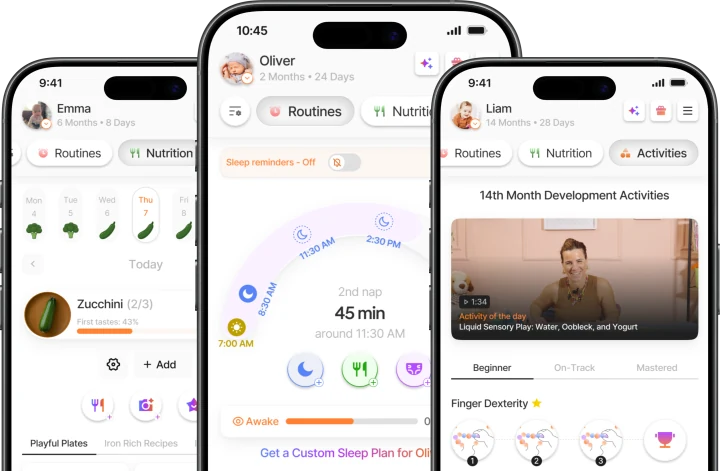
When tired nights make patterns difficult to remember, Yuppo lets you record your baby’s sleep so you can review several days together.

When does the 4 month sleep regression start, and how long does it last?
Timing varies: circadian changes emerge around 2 to 3 months, renewed waking around 4 to 5 months, and guidelines generally avoid specifying a fixed duration, offering instead a range of 2 to 6 weeks, as it varies from baby to baby.
The typical starting range
The starting window depends on what you are observing. The National Library of Medicine (NLM) places emerging circadian rhythm around 2 to 3 months, while Newcastle upon Tyne Hospitals NHS Foundation Trust describes renewed waking around 4 to 5 months.
Factors that can influence duration
The duration cannot be predicted reliably from one night, one nap, or your baby’s exact age. For the 4 month sleep regression, how long this unsettled phase persists varies from child to child, with clinical resources typically pointing to a flexible window of 2 to 6 weeks rather than a single fixed timeline.
What gradual improvement can look like
Gradual improvement may look like easier settling, fewer fully alert nighttime periods, or one part of the day becoming more predictable. Changes can remain uneven, so review the overall pattern rather than expecting every night to improve in sequence.
Watch for practical shifts:
Familiar sleep cues become easier to repeat.
Some wake-ups remain brief.
One nap or bedtime becomes steadier.
If you are looking for solution, a fellow mother's firsthand account of navigating this challenging phase and finding better sleep with Yuppo's support can offer comforting perspective.
Is it sleep regression, hunger, teething, or illness?
Sleep maturation, hunger, and temporary discomfort can overlap, so compare sleep with feeding cues and awake-time behavior. A sleep change alone cannot identify illness, teething, or another medical cause.
This table organizes observations across several wake-ups without attempting to diagnose the reason.
| Observation / Sign | Sleep Maturation (Regression) | Hunger or Growth Spurt | Teething or Discomfort |
|---|---|---|---|
| Nighttime Waking | Wakes fully alert between sleep cycles (every 45–90 mins) | Wakes driven by hunger at shorter, predictable intervals | Wakes crying abruptly or struggles to stay asleep due to discomfort |
| Feeding Behavior | Feeds briefly for comfort or comfort-sucks, but isn't ravenous | Feeds eagerly and takes full feeds each time | May resist feeding or pull away due to sore gums or sore throat |
| Daytime Behavior | Content, practicing new skills (rolling, vocalizing, eye contact) | Shows persistent hunger cues (rooting, hand-to-mouth) | Fussy while awake, excessive drooling, chewing on hands, or low energy |
| Duration | A developmental shift lasting 2 to 6 weeks | A temporary phase observed daily basis | Intermittent, usually resolving within a few days |
The most useful distinction comes from combining sleep observations with feeding and daytime behavior.
Clues that suggest sleep maturation
Sleep maturation may be a reasonable explanation when changing naps and renewed waking repeat without a clear feeding cue. Even then, treat the label as a description of the pattern rather than a diagnosis.
Clues that suggest hunger or a growth spurt
Hunger becomes more plausible when waking includes clear feeding cues. For babies from birth through 5 months, the CDC lists hand-to-mouth movements, turning toward the breast or bottle, and lip movements as hunger clues.
The NHS notes that cluster feeding may occur for a few days during a growth spurt. Information about baby growth spurts can help you place a temporary feeding change in context.
Clues that suggest teething or illness
Sleep disruption alone cannot show whether teething or illness is present; note new awake-time changes and discuss concerning symptoms with your pediatrician. Drooling or gum rubbing is an observation, but it is not enough by itself to explain changing sleep.

What can you do during the 4 month sleep regression?
During the 4 month sleep regression, keep sleep cues predictable, respond calmly, follow hunger signals, and maintain safe sleep practices. Choose manageable actions that you can repeat on a tiring night.
Keep bedtime and nap cues predictable
Predictable cues give your baby a familiar transition into sleep without requiring a rigid schedule. The NHS says a simple, soothing bedtime routine may help settling; an already familiar song can remain part of that sequence.
If music is part of your routine, these baby lullaby ideas can help you keep the cue simple and consistent.
Respond consistently to nighttime waking
Consistent nighttime responses keep the environment different from daytime interaction. Healthier Together NHS guidance recommends low light, soft voices, changing only when needed, and returning your baby to sleep after feeds.
Follow hunger cues during night waking
Hunger cues provide better context than assuming every nighttime waking requires feeding. The American Academy of Pediatrics (AAP) explains that crying or sucking does not always mean hunger because sucking can also provide comfort.
Follow American Academy of Pediatrics safe sleep guidance
Safe sleep practices remain important when exhaustion makes shortcuts tempting. For babies from birth through 6 months, the AAP recommends room-sharing without bed-sharing for at least the first 6 months.
Recognize when changes need pediatric guidance
Extra waking can fit a sleep-pattern change when your baby wakes readily and feeds normally, but difficulty waking or refusing feeds needs urgent guidance. The NHS identifies these specific signs:
Seek urgent medical guidance if your baby is difficult to wake.
Seek urgent medical guidance if your baby will not feed.
For a practical nighttime example, keep the lights low when your baby wakes, speak softly, and check for rooting or other hunger cues. Feed when those cues indicate hunger, then return to a calm sleep setting. If one settling cue has become difficult to manage, this guide to baby sleep associations can help you understand the pattern.

Summary and Next Steps
Your next steps can focus on observing patterns, meeting immediate needs, and keeping nighttime care simple.
Look across several days: Compare nights, naps, settling, feeding cues, and daytime comfort.
Repeat manageable cues: Use a short wind-down that still feels realistic when you are tired.
Respond to hunger signals: Check for rooting, hand-to-mouth movements, and active lip movements before assuming a feed is needed.
Keep sleep safe: Continue room-sharing without bed-sharing throughout your baby’s first 6 months.
Act this week: Record sleep changes for several days and look for small shifts rather than a perfect schedule.
This content is for information only; always consult your pediatrician for diagnosis and treatment.
Connecting fragmented sleep with your baby’s changing development can be difficult when you are exhausted. In Yuppo, you can enter your baby’s birth date, follow developmental steps week by week, and receive activity and content suggestions suited to their age.
Frequently Asked Questions
These answers address common timing, nap, feeding, and recovery questions about the four month sleep regression.
Can the 4 month sleep regression start at 3 months?
Sleep changes can become noticeable around 3 months, although that timing does not confirm a specific regression. The National Library of Medicine (NLM) reports that circadian rhythms begin emerging around 2 to 3 months, while renewed nighttime waking may become more apparent later.
Does every baby go through the 4 month sleep regression?
No, the four month sleep regression is not equally noticeable in every baby. The NHS notes that babies vary in how much sleep they need. Your baby may show obvious waking, subtle settling changes, or little disruption.
Does the 4 month sleep regression end on its own?
The unsettled pattern may ease gradually, but there is no supported week-based deadline that applies to all babies. Sleep patterns continue developing rather than returning to an earlier form. Watch for practical improvement, such as easier settling or one part of the day becoming more predictable.
Why is my 4-month-old suddenly taking short naps?
Short naps may appear alongside changing sleep patterns, but one nap does not reveal the cause. Compare several days of naps with settling, hunger cues, and your baby’s behavior while awake. A repeated pattern provides more useful context than the exact length of one sleep period.
Should I feed my baby at every nighttime waking?
No, every nighttime waking does not necessarily require feeding. The American Academy of Pediatrics (AAP) notes that crying and sucking can reflect comfort as well as hunger. Follow your baby’s feeding cues and your pediatrician’s individualized guidance.
References
National Library of Medicine. (n.d.). Behavioural sleep problems in children. PubMed Central.
Centers for Disease Control and Prevention. (2026). Milestones by 4 months. CDC.
Centers for Disease Control and Prevention. (2026). Signs your child is hungry or full. CDC.
NHS. (2026). When to get urgent medical help for babies and children under 5. NHS.

Yuppo Lab
Sleep Expert

Sleep
Learn the signs of the 8 month sleep regression, how long it lasts, how it differs from teething, and gentle tips for night wakings and shorter naps.

News
Learn how parallel play supports toddlers and find simple developmental activities for toddlers at home. Follow your child’s progress with Yuppo.

News
Learn why a child growth chart is more useful over time than one weight check—and how Yuppo helps you follow your child's growth. Track growth with Yuppo.