

Key Takeaways
- Newborns feed 8-12+ times in 24 hours, day and night. Follow hunger cues, not the clock.
- Diapers show whether baby is getting enough: by about day 5-6, expect 6 or more heavy wet diapers a day.
- Newborns sleep 14-17 hours a day in short stretches, always on the back, in their own crib, in your room.
- Crying usually peaks around 6-8 weeks, then eases. It's OK to put baby down safely and take a break.
- A temperature of 38 °C (100.4 °F) or higher in a baby under 3 months is an emergency.
The first weeks with a newborn are full of firsts, for both of you. Feeds that seem endless, diapers you didn't know were possible, and a tiny person who doesn't know day from night yet.
This newborn cheat sheet puts the essentials for the first 4 weeks in one place: feeding, sleep, crying, everyday care, what's normal and when to call the doctor. It's built on advice from the Yuppo expert team of pediatricians and baby-care specialists, checked against current NHS, AAP and WHO guidance.
Your newborn's first 4 weeks at a glance
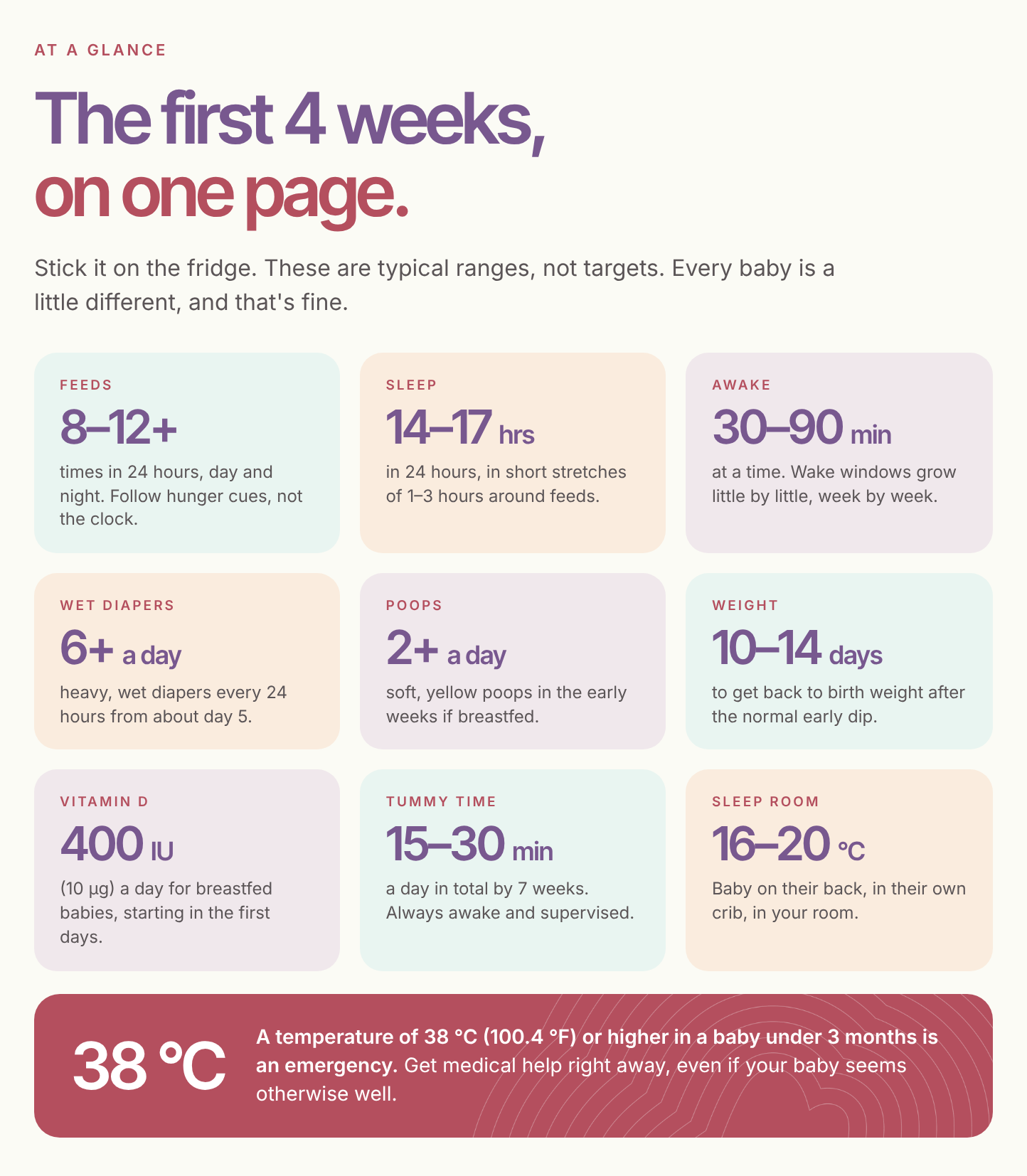
These are typical ranges, not targets. Every baby is a little different, and that's fine.
Typical in the first weeks | Good to know | |
Feeds | 8-12+ per 24 hours | Day and night, on cue |
Sleep | 14-17 hours per 24 hours | In stretches of 1–3 hours |
Awake time | 30-90 minutes at a time | Grows little by little |
Wet diapers | 6+ a day from about day 5-6 | Heavy, with pale pee |
Poops | 2+ a day | Soft and yellow if breastfed |
Weight | Back to birth weight by 10-14 days | After a normal early dip |
Vitamin D | 400 IU (10 µg) a day | For breastfed babies, from the first days |
Tummy time | Building to 15–30 minutes a day by 7 weeks | Awake and supervised |
Sleep room | 16-20 °C (61-68 °F) | On the back, own crib, your room |
What's normal for a newborn?
Newborns arrive looking a little different from what we expect. These are all common in the first weeks:
- A cone-shaped head from birth (molding). It rounds out within days.
- Fast, uneven breathing: 40-60 breaths a minute, sometimes with pauses of a few seconds.
- Jumpy arms: the startle (Moro) reflex, which fades over the first few months.
- Sneezes and hiccups, especially after feeds.
- Tiny white spots and baby acne from mom's hormones. They clear on their own.
- Peeling skin and birthmarks: pink patches on the eyelids or neck and blue-gray patches on the lower back are harmless.
- Swollen breasts or a little spotting in girls, also from mom's hormones.
- Small spit-ups, as long as baby is feeding well and gaining weight.
> Trust your gut. You know your baby best. If something seems "not like them," call your pediatrician. You are never wasting their time.
How to feed a newborn
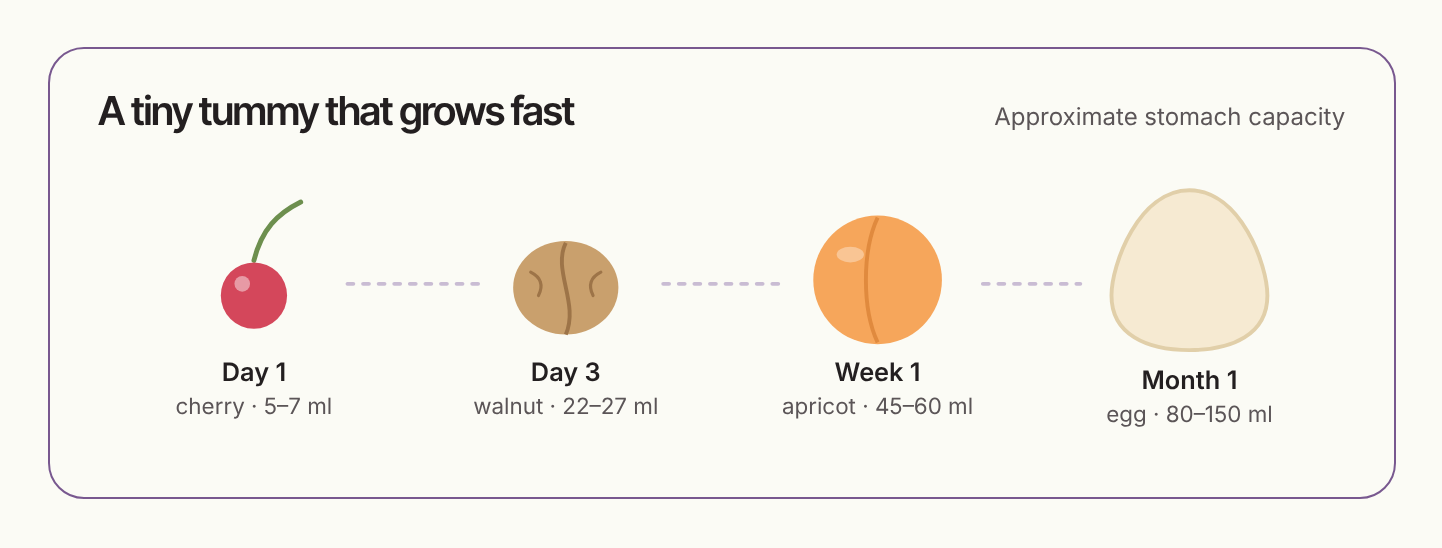
Newborns feed little and often, 8 to 12 times or more in 24 hours. Tiny tummies empty fast: on day 1 your baby's stomach is about the size of a cherry (5-7 ml), by day 3 a walnut (22-27 ml), by the end of week 1 an apricot (45-60 ml), and by one month an egg (80-150 ml).
Hunger and fullness cues
- Early, "I'm getting hungry": stirring, mouth opening, lip licking, rooting.
- Mid, "I'm really hungry": stretching, wriggling, hands to mouth, fussing.
- Late, "Calm me first": crying, agitated movements, going red in the face.
Crying is a late sign, so settle baby with skin-to-skin or rocking first, then feed. Baby has had enough when sucking slows, hands relax and open, and they turn away or drift off. Dozing mid-feed is normal; switch sides or change the diaper to wake them gently.
Is my baby getting enough milk?
You can't see how much a breastfed baby drinks, but you can see what comes out. Count diapers, not milliliters.
Baby's age | Wet diapers | Poop |
Days 1-2 | 2-3 in the first 48 hours | Meconium: black-green, sticky |
Days 3-4 | 3-4, getting heavier | Changing: greenish-brown, looser |
Day 5 on | 6+ heavy wet diapers a day, pale pee | 2+ soft yellow poops a day (breastfed) |
Most babies lose some weight in the first 3-4 days, often up to 7-10%, and are back to birth weight by 10-14 days. After that, they gain roughly 150-200 g (5-7 oz) a week. Your pediatrician tracks this on a growth chart, so follow your own baby's curve rather than comparing.
> Ask for help early if: there are fewer wet diapers than expected or dark pee after day 4, baby is very sleepy and hard to wake for feeds, feeds are painful, or baby isn't back to birth weight by 2 weeks.
For day-by-day amounts, see how much a newborn should eat in the first week and how much a 2- to 3-week-old should eat.
Breastfeeding: a good latch changes everything
Sore nipples usually mean the latch needs a small tweak, not that you should stop.
1. Tummy to tummy, with baby's head and body in a straight line.
2. Nose to nipple. Wait for a wide, yawning mouth.
3. Bring baby to the breast, chin first, not breast to baby.
4. Aim deep: more areola shows above the top lip than below, with lips turned out.
5. Check: round cheeks, rhythmic swallows, no pain after the first few seconds.
If it hurts, break the suction with a clean finger in the corner of baby's mouth and try again. Laid-back, cross-cradle, football hold (great after a C-section) and side-lying are all worth trying. Milk usually "comes in" around days 2–4, and supply follows demand: the more milk is removed, the more you make.
> Po's tip: Get support early. A lactation consultant (IBCLC) or midwife can fix most latch problems in one visit. Ongoing pain? Ask them to check for tongue-tie.
Pumping and storing breast milk
For healthy, full-term babies, expressed milk keeps for 4 hours at room temperature (up to 25 °C), 4 days in the fridge (4 °C or colder) and is best used within 6 months from the freezer. Use thawed milk within 24 hours, and leftovers from a feed within 2 hours. Never refreeze thawed milk or heat it in a microwave.
Label every bag with the date, time and amount. The time matters: night milk is richer in melatonin and daytime milk in cortisol, so offer it at a similar time of day. Freezing bags flat and checking that only your nipple moves in the pump tunnel also make life easier.
Bottle feeding, safe and calm
Making up formula: boil fresh tap water and let it cool for no more than 30 minutes, so it's still at least 70 °C. Pour the water in first, then add the exact number of level scoops. Swirl, don't shake: shaking whips up air bubbles that can cause gas, so make circles with your wrist or roll the bottle between your palms. Cool it under the tap, test on your wrist, and throw away leftovers after each feed.
Paced bottle feeding lets baby set the pace: hold them fairly upright, keep the bottle nearly level, pause for burps, and stop when they show they're full. Typical formula amounts are about 30-60 ml (1-2 oz) every 2-3 hours in the first weeks, rising to 90-120 ml (3-4 oz) by one month. Sterilize bottles and nipples, and remember that babies don't need water, juice or tea before 6 months.
Burping, spit-up and vitamin D
Burp during natural pauses, over your shoulder, sitting on your lap or tummy-down across your lap. Spit-up is common because the muscle at the top of the tummy is still developing; smaller, more frequent feeds and holding baby upright after feeds help.
> See your doctor if: vomiting is forceful or projectile, it's green or yellow or has blood in it, baby refuses feeds or isn't gaining weight, or seems in pain during feeds.
Vitamin D every day: breastfed and partly breastfed babies need 400 IU (10 µg) a day, starting in the first days. Formula is fortified, so ask your pediatrician whether a formula-fed baby needs drops too.
How newborns sleep
Newborns sleep 14-17 hours a day in 1-3 hour stretches. Sleep cycles last only about 50-60 minutes, and the body clock matures over the first 2-3 months, so day-night confusion is normal. Keep days bright and ordinary and nights dim, quiet and boring.
Watch for early sleepy cues: slowing down, staring, red eyebrows or eyelids, yawning and jerky movements. Crying, back arching and being hard to soothe mean baby is already overtired.
Good sleep starts with good awake time
Underfed or overfed babies can't sleep comfortably, and neither can under-tired or overtired ones. So watch for hunger, fullness and tiredness cues, and respond to them. A gentle feed, play, sleep rhythm can start from day one, and play can be tiny: chatting through a diaper change or skin-to-skin on your chest counts too.
Safe sleep, every single sleep
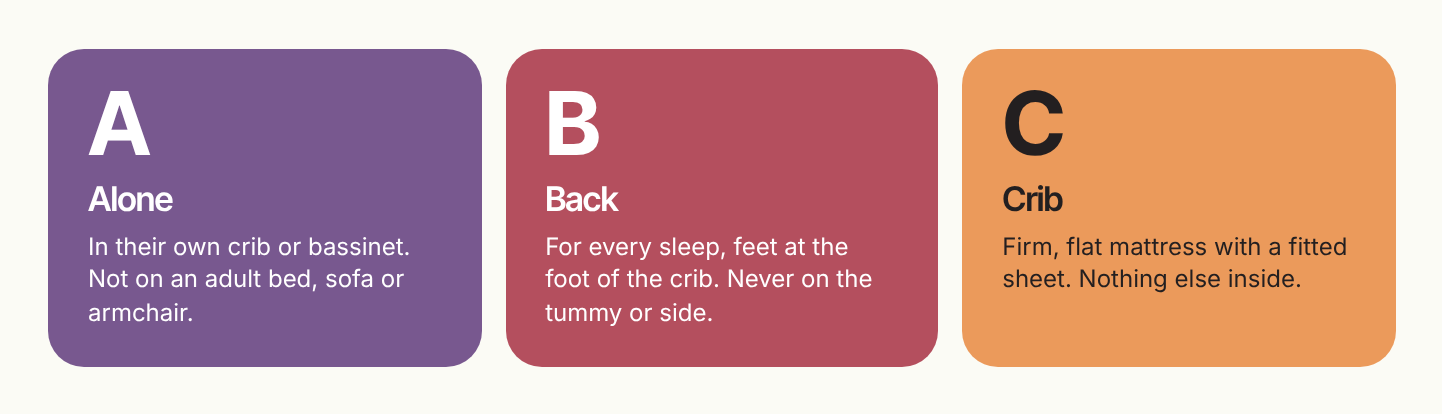
Remember your ABCs for every sleep, naps included:
- Alone in their own crib or bassinet, never on a sofa or armchair.
- On their Back, feet at the foot of the crib.
- In a Crib with a firm, flat mattress and a fitted sheet.
Share a room, not a bed, for at least the first 6 months. Keep the room at 16-20 °C (61-68 °F), use a sleep sack rather than loose bedding, and skip hats indoors. Once breastfeeding is going well (around 3-4 weeks), offering a pacifier at sleep time can help; there's no need to put it back if it falls out. Keep pillows, quilts, bumpers, nests and weighted products out of the crib.
> Never fall asleep with your baby on a sofa or armchair. It's the riskiest place of all. If you might doze off during a feed, do it in your bed with pillows and covers moved away, then put baby back in their crib.
The AAP advises against bed-sharing. The NHS says never share a bed if you or your partner smoke, have had alcohol, drugs or drowsy medicine, if baby was premature or under 2.5 kg, or if you're extremely tired. Car seats, swings and slings aren't for routine sleep either.
Swaddling and settling
A swaddle keeps the startle (Moro) reflex in check, which helps baby calm down and settle. Keep the arms snug but the hips loose: legs need room to bend up and out, like a frog, to protect against hip dysplasia. Always place a swaddled baby on their back, use thin fabric, and stop as soon as baby shows signs of trying to roll.
> The game-changer: Start the wrap at shoulder level, never higher. If fabric touches the chin or lips, it sets off the sucking reflex and baby roots instead of settling.
A few settling tips that work with newborns:
- Drowsy but awake, sometimes. It helps babies learn to fall asleep on their own. If they protest, pick them up and try another day.
- The transfer. Asleep in your arms? As you lay them down, a gentle nudge or a firmly closed door lets them stir for a moment. Babies who wake briefly and drift back off on their own sleep longer.
- White noise, low and far from the crib.
- Night feeds are normal. When to drop them depends on growth and age, so follow your pediatrician's advice.
Above all, help your baby find a routine: the same short wind-down and the same feed, play, sleep rhythm, day after day.
Why newborns cry and how to soothe them
Crying is your baby's main way to tell you something. It usually builds from about 2 weeks, peaks around 6-8 weeks, then eases.
Run the checklist: hungry, wet diaper, needs a burp, too hot or cold (feel the back of the neck), tired or overstimulated, wants to be held, or unwell? If nothing works, check fingers, toes and genitals for a tightly wrapped hair.
Then try the soothing toolkit, one thing at a time: hold baby close, gently fold their arms across their chest to calm the startle, shush close to the ear, sway with small movements, or offer the breast or a pacifier. Walking for 5 minutes, then sitting for 5-8 before laying baby down, can also help.
Crying for more than 3 hours a day, 3 days a week, for 3 weeks or more is called colic. It's exhausting, it's not your fault, and it usually passes by 3-4 months. Read more in our guide to colic in infants.
> When it's too much, remember ICON. Infant crying is normal. Comforting can help. It's OK to walk away: put baby safely on their back in the crib and take a few minutes. Never, ever shake a baby.
Call your doctor if the cry is weak, high-pitched or constant, comes with a fever or poor feeding, or if baby is floppy or unusually sleepy.
Everyday newborn care
Umbilical cord: the stump falls off on its own within 1-3 weeks, usually around 10-14 days. Keep it clean and dry with the diaper folded below it, and don't pull. Call your doctor if the skin around it is red or swollen, there's a bad smell or discharge, or it hasn't fallen off by 3 weeks.
Bath time: sponge baths are all baby needs until the cord falls off. After that, 2-3 baths a week is plenty: about 5 cm of water at around 37 °C, 5-10 minutes, and never leave baby alone, not even for a second.
> The bath-time handover: A wet baby is slippery. To avoid accidents on the way out of the bath, always confirm out loud before you let go: "Got her?" "Got her." Release only when you hear it.
Diaper changes:
- Girls: wipe front to back.
- Boys: undo the tabs but keep the front of the diaper over the penis like a lid, so any surprise spray lands in the diaper.
- Protect growing hips: don't lift baby by the ankles. Support the back and gently roll them to one side to clean.
- Let skin air-dry, and use a thin layer of barrier cream if it looks red.
Dressing and temperature: dress baby in one more layer than you're comfortable in, and check the back of the neck or chest. Cool hands and feet are normal: circulation is still maturing, so they don't mean baby is cold. If you're comfortable, baby probably is too. Overheating is a risk as well, so sweaty, hot skin means it's time to remove a layer.
Eyes, ears, nose and nails: wipe eyes with cooled boiled water from the inner corner out, clean only the outer ear, clear a stuffy nose with a drop of saline, and file or clip nails while baby sleeps.
Newborn poop and pee: what's normal?
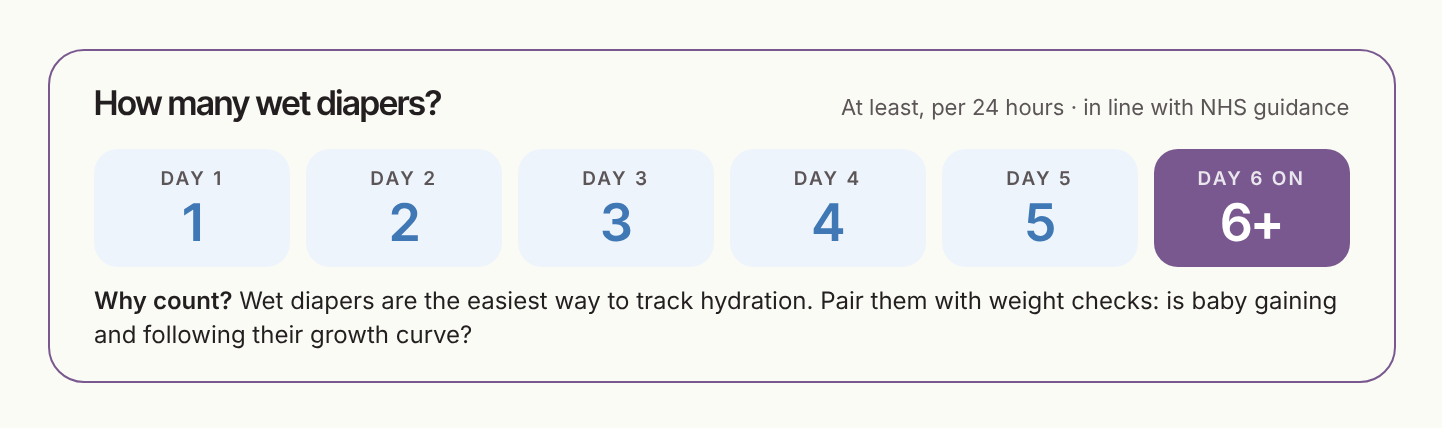
How many wet diapers? A simple rule of thumb in line with NHS guidance: at least 1 on day 1, 2 on day 2, 3 on day 3, 4 on day 4, 5 on day 5, and 6 or more every 24 hours from day 6 on. Wet diapers are the easiest way to track hydration. Pair them with weight checks: is baby gaining and following their growth curve?
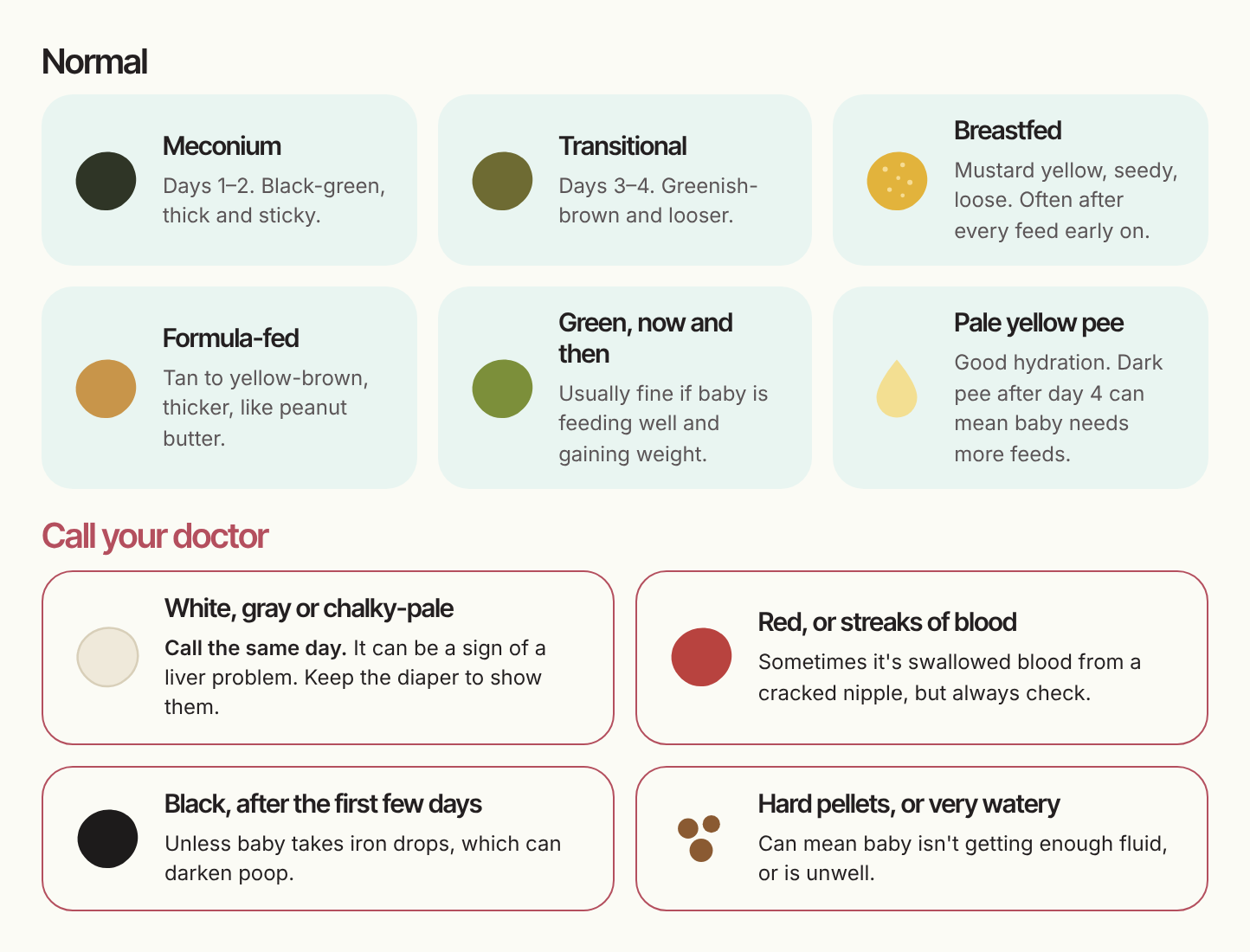
Poop changes a lot. Black-green meconium in the first days turns greenish-brown, then settles into mustard yellow and seedy (breastfed) or tan and thicker, like peanut butter (formula-fed). Green now and then is usually fine.
> Call your doctor about: white, gray or chalky-pale poop (call the same day), red poop or streaks of blood, black poop after the first few days, or hard pellets or very watery poop.
Awake time, tummy time and play
Start from day one. Early stimulation helps the brain build new connections, and every sensory experience counts: new textures, sounds, faces and gentle movement. Newborns see best at 20–30 cm, about the distance to your face during a feed, so talking, singing and making faces are perfect play.
Tummy time builds neck and shoulder strength. Start with a few minutes several times a day, on your chest or across your lap, and build up to 15–30 minutes a day in total by about 7 weeks. Always keep baby awake and supervised.
If baby turns away, arches, gets hiccups or suddenly fusses, they may be overstimulated. Switch to quiet cuddles in a dim room. For what comes next, see 1 month old milestones.
When to call the doctor
Young babies can get sick quickly and show only subtle signs. If you're worried, call.
Emergency: call your local emergency number now if your baby:
- Has a temperature of 38 °C (100.4 °F) or higher (under 3 months), or below 36 °C
- Is struggling to breathe: grunting, very fast breathing, skin sucking in under the ribs, long pauses
- Has blue, gray, pale or blotchy skin, lips or tongue
- Is floppy, very hard to wake, or not responding
- Has a seizure, or a rash that doesn't fade when you press a glass on it
- Has a weak, high-pitched or constant cry
- Has had no wet diaper for 12 hours, or has green vomit
Call your doctor today about very pale, chalky poop, fewer wet diapers or dark pee, feeding much less than usual, a red or oozing cord, or a red, swollen eye.
About jaundice: it's common and usually harmless. About 6 in 10 newborns turn a little yellow from around day 2, and it fades by about 2 weeks (3 weeks if born early), as the liver learns to clear bilirubin. Check with your doctor if it starts in the first 24 hours, spreads or deepens, lasts past 2 weeks, or baby is very sleepy or feeding poorly.
Taking a temperature: rectal readings are the most accurate for young babies, though less comfortable. Forehead thermometers come next, and underarm works as a quick check. Ear thermometers are reliable from about 6 months. Pick what suits you, and skip glass mercury ones.
If your baby is choking and can't cough, cry or breathe, call emergency services, then give up to 5 back blows (baby face-down along your forearm) and up to 5 chest thrusts (two fingers just below the nipple line), and repeat until help arrives. An infant first aid course is the best confidence boost there is.
Newborn essentials checklist
Babies need less than the stores suggest. Cover the basics for sleep (a crib or bassinet, firm mattress, fitted sheets, sleep sacks), feeding, diapering, clothes (6-8 cotton bodysuits and sleep suits) and health (a digital thermometer, saline drops and vitamin D drops), plus a rear-facing car seat fitted before the ride home.
Skip it: crib bumpers, pillows and quilts, weighted sleep sacks and swaddles, sleep nests and pods, products claiming to prevent SIDS, and cotton swabs for ears or nose.
In the near future, you'll also see amber teething necklaces and baby walkers marketed. Skip those too: necklaces are a choking and strangulation risk, and walkers lead to falls without helping babies walk.
Looking after yourself, too
Feeling teary, anxious or low in the first days after birth (the baby blues) is very common and usually lifts within 2 weeks. If low mood, anxiety or feeling unable to cope lasts longer or gets worse, it may be postpartum depression, which partners can get too. It's common and treatable: talk to your doctor or midwife.
> Thoughts of harming yourself or your baby? Get help right away. Call your doctor, a crisis line or your local emergency number.
Partners can make a big difference: do skin-to-skin, own diapers and bath time, bring water and snacks during night feeds, and be the gatekeeper for visitors. And for you: rest when you can, say yes to help, and remember that you don't have to enjoy every moment to be doing a great job.
Summary and Next Steps
- Feed on cue: 8-12+ feeds a day is normal, and diapers are your best gauge of whether baby is getting enough.
- Sleep safe, every sleep: alone, on the back, in a clear crib, in your room.
- Respond to crying: you can't spoil a newborn, and it's OK to take a break when you need one.
- Keep care simple: a clean, dry cord, a few baths a week and hip-friendly diaper changes.
- Know the red flags: 38 °C or higher under 3 months, breathing trouble or a floppy baby means emergency help.
In Yuppo, you can track feeds and sleep side by side to spot your baby's rhythm, and ask Po, Yuppo's AI parenting assistant, whenever a new question comes up at 3 a.m.
What's coming up
- 5 week old baby development: milestones, feeding, sleep and what to expect
- 6-week-old baby milestones: physical, social and sensory changes

Frequently Asked Questions
Most newborns feed 8-12 times or more in 24 hours, day and night. Follow early hunger cues like rooting and hands to mouth rather than a fixed schedule. When to drop night feeds depends on growth and age, so follow your pediatrician's advice.
A simple rule of thumb is at least 1 on day 1, 2 on day 2 and so on, reaching 6 or more heavy wet diapers every 24 hours by about day 5-6. Fewer wet diapers or dark pee after day 4 is a reason to call your pediatrician or midwife.
Newborns sleep 14-17 hours in 24 hours, in stretches of 1-3 hours around feeds. Longer night sleep often starts as the body clock matures over the first 2-3 months.
Usually within 1-3 weeks, most often around 10-14 days. Keep it clean and dry, and call your doctor if it hasn't come off by 3 weeks or the skin around it looks red, swollen or smells bad.
Any temperature of 38 °C (100.4 °F) or higher in a baby under 3 months needs medical help right away, even if your baby seems otherwise well.
1. American Academy of Pediatrics (2022). Sleep-Related Infant Deaths: Updated 2022 Recommendations for Reducing Infant Deaths in the Sleep Environment. Pediatrics.
2. American Academy of Pediatrics (n.d.). How Often and How Much Should Your Baby Eat?. HealthyChildren.org.
3. American Academy of Pediatrics (n.d.). Bathing Your Newborn. HealthyChildren.org.
4. American Academy of Pediatrics (n.d.). How to Take a Child's Temperature. HealthyChildren.org.
5. NHS (n.d.). Signs your baby is getting enough milk. NHS.
6. NHS (n.d.). How to make up a feed. NHS Best Start in Life.
7. NHS (n.d.). Vitamins for children. NHS.
8. NHS (n.d.). Reduce the risk of sudden infant death syndrome (SIDS). NHS.
9. NHS (n.d.). When to get urgent medical help for babies and children under 5. NHS.
10. NHS (n.d.). Post-natal depression. NHS.
11. NHS 111 Wales (n.d.). Jaundice (newborn). NHS Wales.
12. Centers for Disease Control and Prevention (n.d.). Breast Milk Storage and Preparation. CDC.
13. World Health Organization (2019). Guidelines on physical activity, sedentary behaviour and sleep for children under 5 years of age. WHO.
14. International Hip Dysplasia Institute (n.d.). Hip-Healthy Swaddling. IHDI.
15. Mid Yorkshire Teaching NHS Trust (n.d.). ICON: Babies cry, you can cope. NHS.
> This content is for information only and does not replace advice from your pediatrician, midwife or other health professional. Always consult your pediatrician for diagnosis and treatment.