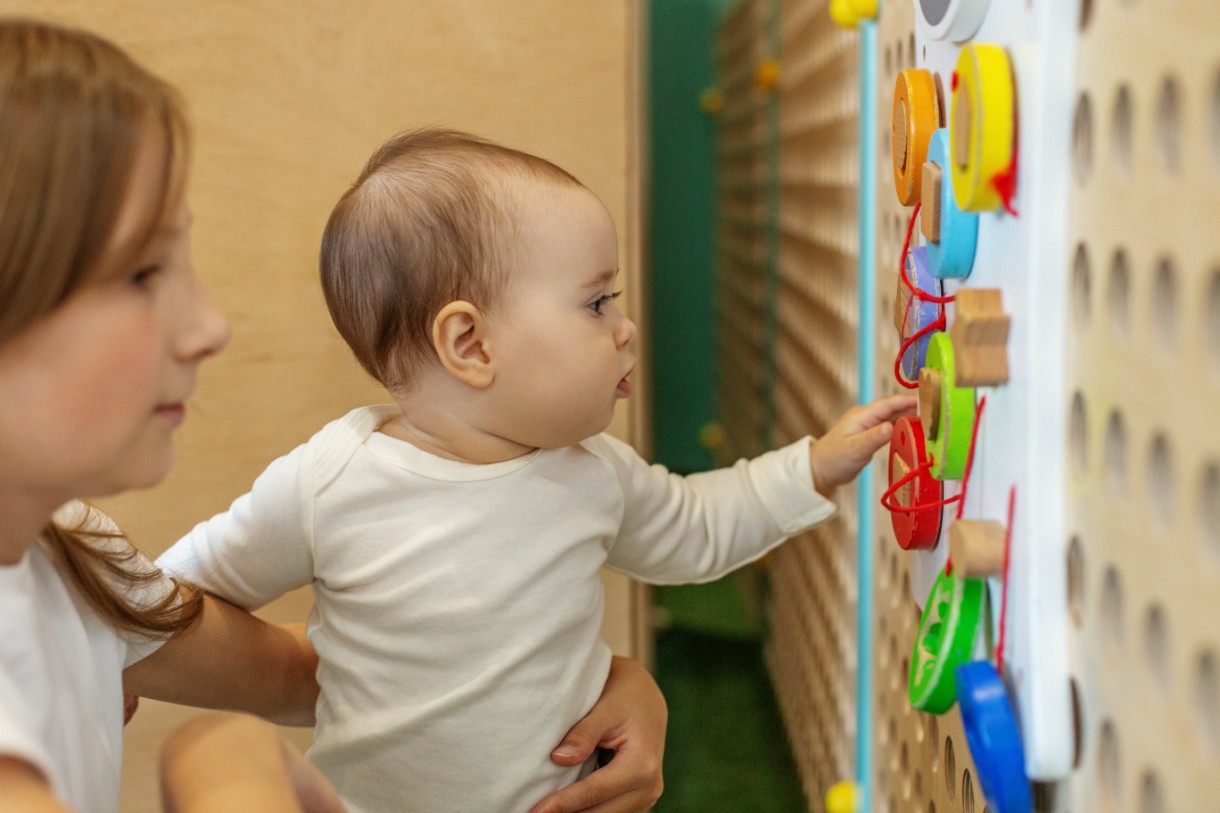
Key Takeaways
Your 6-week-old focuses best at about 20 to 30 cm (8 to 12 in) and already shows a clear preference for human faces.
Breastfed newborns typically nurse roughly 10 to 12 times in 24 hours; bottle-fed babies generally take at least 90 to 120 ml (3 to 4 oz) per session by the end of the first month.
Brief head lifts during tummy time and early vowel-like coos signal growing motor and sensory coordination.
A daily fussy stretch, often peaking in the early evening, is among the most common patterns at this age.
Your baby at 6 weeks is likely holding your gaze longer, reacting more actively to your voice, and may be on the verge of a first genuine smile. These 6-week-old baby milestones are small but meaningful, bridging the newborn stage and the two-month mark with shifts that can surface almost daily.
If you've caught your baby locking eyes during a feed or softening at the sound of your voice, that's typical development at this age. Below you'll find what to expect for your 6-week-old across growth, feeding, sleep, tummy time, and fussiness, a practical milestones checklist for the week ahead. As part of the broader week-by-week development journey, treat every range as a guide, not a deadline, because each baby sets their own pace.

What milestones does a 6-week-old baby typically reach?
Your 6-week-old is generally gaining steadier head control, tracking faces, and beginning to respond to familiar voices with quiet sounds. The Centers for Disease Control and Prevention (CDC) notes that developmental milestones give a general idea of changes to expect, yet every child develops at their own pace.
Physical and motor milestones
Around 6 weeks your baby can usually lift their head briefly during tummy time, showing early neck and shoulder strength. The American Academy of Pediatrics (AAP) notes that at about one month babies focus at 20 to 30 cm (8 to 12 in) and prefer high-contrast patterns, which lets your baby study your face during feeds.
Brief head lifts and cheek-to-cheek turns during tummy time
Smoother arm and leg movements compared to the first weeks
Eyes briefly tracking a face or object moving slowly side to side
You may notice your baby following a high-contrast card moved slowly across their line of sight, a small sign that eye muscles and brain are starting to coordinate.

Social and sensory milestones
Your baby's hearing is fully mature by this age, as the AAP confirms, and visual focus keeps sharpening week by week.
Between 1 and 3 months most babies smile at the sound of voices, turn toward sounds, and begin to babble, according to the AAP. Around two months many start repeating vowel sounds like "aah" and "ooh." At 6 weeks you may catch the earliest hints of cooing during calm, alert moments.
How much does a 6-week-old weigh and grow?
Your 6-week-old has likely gained steadily since birth, with healthy weights varying widely by birth size, sex, and feeding patterns. A consistent upward trend matters far more than any single number on the scale.
Average weight and length ranges
Most babies gain weight noticeably in these early weeks, and your pediatrician tracks the overall direction using standardized growth charts. The World Health Organization (WHO) publishes weight-for-age standards from birth through 13 weeks for boys and girls, and your baby's measurements are plotted on these curves at each visit. Because healthy babies come in many sizes, two babies born the same week can weigh quite differently and both be thriving.
If you'd like a snapshot between appointments, a percentile calculator can offer a general picture, though it never replaces professional assessment.
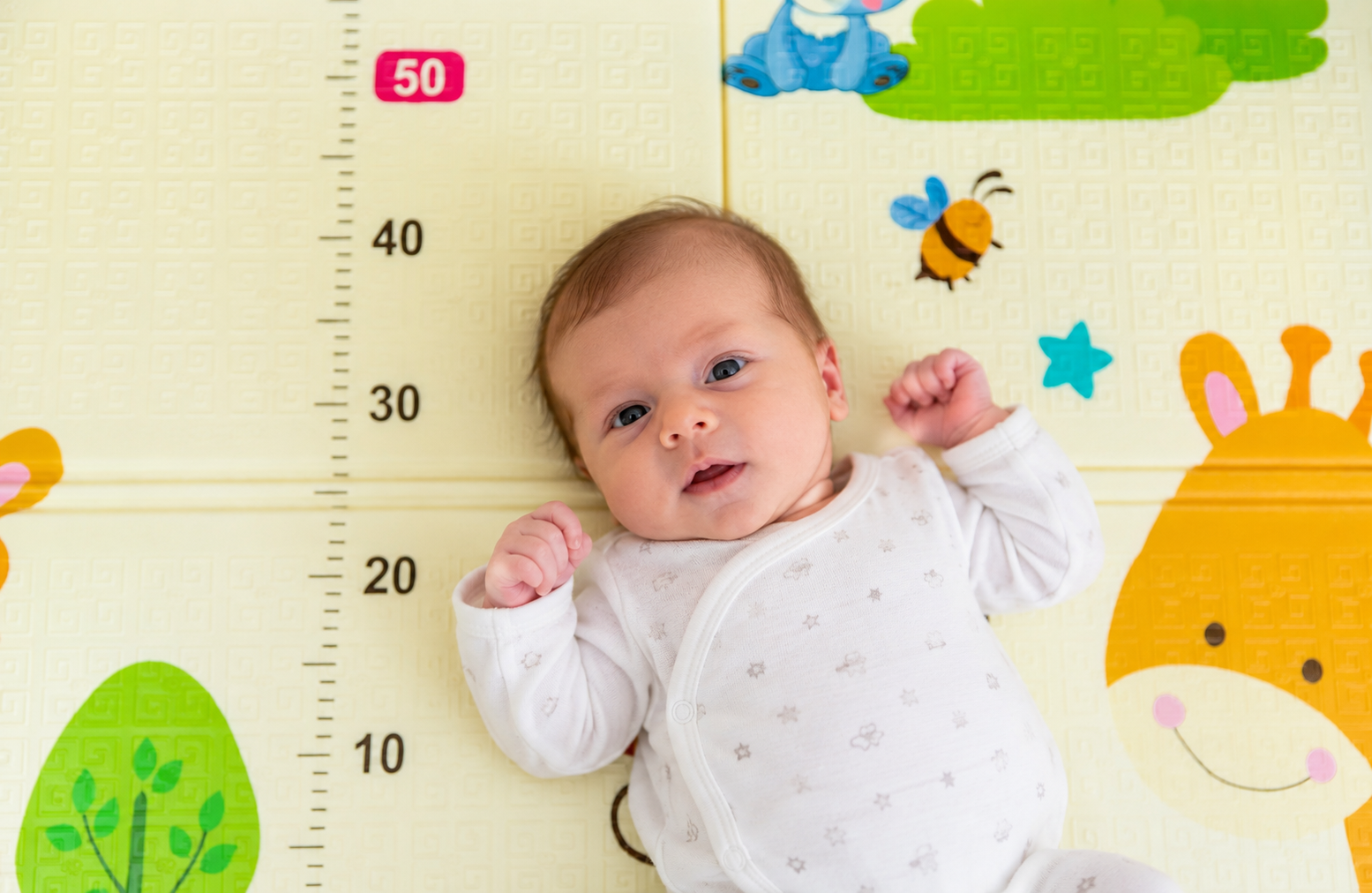
How to read growth percentiles
A growth percentile ranks your baby's size among babies of the same age and sex, and no position on the chart is inherently "better." Picture two babies born the same week: one weighed 3 kg (6 lb 10 oz) at birth and now tracks near the 15th percentile, while another started at 4 kg (8 lb 13 oz) and sits near the 75th. Both are thriving because each follows a steady upward curve.
The direction of the line across visits reveals far more than any single reading.
A sudden shift across two or more percentile bands is worth mentioning to your pediatrician.
When does the first social smile appear?
The first true social smile typically emerges somewhere between 4 and 8 weeks, placing week six right in the prime window. The AAP describes how early grins and grimaces gradually turn into genuine signals of pleasure and friendliness by the second month.
You'll notice the difference quickly: a reflex smile happens during sleep or at random with no eye contact, while a social smile is triggered by your face or voice. Picture a calm moment after a feed: your baby locks eyes with you and their whole face lifts into a brief but unmistakable grin.
Reflex smile: occurs during sleep or randomly, no eye contact
Social smile: triggered by your face, voice, or touch, with direct eye contact
This milestone reflects growing recognition of familiar people and early emotional connection. The AAP lists calming when spoken to, looking at your face, and smiling when you talk among social-emotional milestones typically present by 3 months. If your baby hasn't smiled yet at 6 weeks, that's well within the normal range. You can see what develops next in the 2-month-old baby development guide.

Feeding and sleep patterns at 6 weeks
Feeding sessions at this age remain frequent and sleep still comes in short stretches, but both are gradually settling into a loose daily rhythm.
| Area | Typical Range | Practical Tip |
|---|---|---|
| Breastfeeding sessions | About 10-12 in 24 hours | Follow hunger cues, not a rigid clock |
| Bottle volume per feed | At least 90-120 ml (3-4 oz) | Volume climbs gradually over weeks |
| Total sleep in 24 h | Roughly 14-17 hours, in short cycles | Not one continuous block |
| Longest night stretch | Often 2-4 hours, varies widely | May lengthen over the coming weeks |
| Awake window | Generally 45-90 minutes | Watch for yawning as a drowsy cue |
Your baby's rhythm fits best when you respond to cues rather than following a fixed timetable.
Feeding frequency and hunger cues
Breastfed babies at this age usually nurse about every 2 hours, totaling roughly 10 to 12 sessions in a day, according to the AAP. By the end of the first month, most bottle-fed babies take at least 90 to 120 ml (3 to 4 oz) every 3 to 4 hours, and amounts keep climbing. Hunger cues to watch for include rooting, lip-smacking, and hands reaching toward the mouth. Evening cluster feeding is common and not a sign of low supply.
Typical sleep and awake windows
Sleep at 6 weeks still arrives in short cycles, and frequent night waking is developmentally appropriate. The AAP explains that a good sleeper at this age is a baby who wakes often but can drift back to sleep, not one who sleeps undisturbed all night. Waking allows your baby to respond safely to breathing changes.
Some families notice a slightly longer stretch at night around 6 to 8 weeks, while others still wake every couple of hours. Both patterns are normal. Keeping the room dim and interactions quiet during night feeds helps reinforce the emerging day-night difference.

Simple activities to support your 6-week-old baby's milestones
Daily activities during calm, alert periods do more for your baby's development than any special equipment. The CDC highlights that playing, singing, reading, and talking with your child supports healthy development from the earliest weeks.
Tummy time basics
Tummy time at 6 weeks can start with about two to three minutes on a firm surface, repeated several times a day. Place a small black-and-white card at eye level to encourage head lifts. While on their tummy, your baby might push up just enough to turn their head from one cheek to the other before laying back down. If your baby protests, try chest-to-chest tummy time on a parent instead; the slight incline and closeness to your face often make the position easier.
Talking, singing, and eye contact
Your voice and eye contact during everyday routines build your baby's early language pathways. The National Health Service (NHS) recommends singing to help your baby tune in to the rhythm of language and repeating their sounds to teach listening and turn-taking.
Chat about what you're doing during bath time and diaper changes.
Hold your face within your baby's focal sweet spot so they see your expressions clearly.
When your baby coos, pause and "answer" to model a back-and-forth exchange.
In Yuppo, you can enter your baby's birth date and browse age-matched activity suggestions for the current week, from tummy-time games to sensory prompts suited to this stage. These early exchanges build toward the physical coordination developing around 9 months and the first words emerging closer to 11 months.

Normal fussiness vs. colic: how to tell the difference at 6 weeks
Almost every 6-week-old has a daily fussy stretch, and the key distinction from colic is how long and how intensely the crying lasts. Many families notice the fussy window in the early evening, lasting roughly one to two hours, then tapering off as the next feed approaches. Your baby typically calms after feeding, holding, rocking, or a diaper change.
Colic, by contrast, is commonly described as intense, hard-to-soothe crying that recurs regularly over several weeks with no clear trigger.
Crying lasts three or more hours on most days
Usual soothing strategies have little effect
No obvious cause like hunger or a wet diaper explains the episode
Gentle motion, skin-to-skin contact, swaddling, and a quiet room may help ease both everyday fussiness and colic. If the crying feels overwhelming for you, reaching out for support is always the right call.
When to contact your pediatrician:
Persistent feeding refusal alongside the crying
Unusual skin color during or after episodes
A noticeable drop in alertness between fussy periods
Hours of inconsolable crying that does not respond to any soothing
Summary and Next Steps
Smile watch: During quiet post-feed moments this week, hold your face close and talk softly; the response you see may surprise you.
Feeding rhythm: Breastfed babies commonly nurse about a dozen times a day; intervals and volumes adjust gradually over the coming weeks.
Tummy time this week: Two to three minutes per session, several times daily, builds the neck and shoulder strength your baby needs for the months ahead.
Growth trend: Ask about your baby's percentile curve at the next visit; the direction of the line reveals far more than a single measurement.
Self-care reminder: If evening fussiness is wearing you down, swapping shifts with a partner or trusted helper for even one cycle can make a real difference.
This content is for information only; always consult your pediatrician for diagnosis and treatment.
Sorting through which new sounds, looks, and feeding shifts matter at 6 weeks is easier when you can see them on a timeline. In Yuppo, you can follow your baby's development week by week on an expert-prepared milestone tracker, so each change lands in context.
Frequently Asked Questions
Your baby focuses best at roughly 20 to 30 cm (8 to 12 in), about the distance to your face during a feed. The AAP notes that babies at this stage prefer human faces over other patterns, so holding them close naturally supports visual development.
Two to three minutes per session, repeated several times a day, is a practical starting point. Increase gradually as your baby builds tolerance. Chest-to-chest tummy time on a parent counts too and works well if your baby resists the floor.
Nursing about every 2 hours is typical for breastfed babies, adding up to roughly 10 to 12 sessions in 24 hours, according to the AAP. That pace gradually spaces out over the coming weeks as your baby's stomach grows and feeding efficiency improves.
A slightly longer nighttime stretch may appear around 6 to 8 weeks for some babies, while others continue waking every couple of hours. The AAP emphasizes that frequent waking at this stage supports safe breathing and is developmentally healthy.
Most babies show a social smile somewhere between 4 and 8 weeks, but a few need additional time. A short wait on its own is not a concern. If you haven't seen a smile by around 3 months, mention it at your next well-child visit for a quick check.