Key Takeaways
By 4 weeks most babies briefly lift their head during tummy time, focus on faces within about 20 to 30 cm (8 to 12 in), and startle at loud sounds.
Your baby's hearing is fully mature at 4 weeks, and they can typically recognize your voice even from another room.
Newborn reflexes like the Moro (startle) and rooting reflex are active and reach peak strength during the first month.
Breastfed babies at 1 month typically nurse about 8 to 12 times in 24 hours, roughly every 2 to 4 hours.
Most 1 month old milestones center on close-range vision, brief head lifts, and growing sensitivity to your voice. The Centers for Disease Control and Prevention (CDC) defines developmental milestones as things 75 percent or more of children can do by a certain age, making them a guide rather than a fixed deadline. If your baby just turned four weeks, you are probably noticing tiny head lifts during tummy time, longer moments of eye contact at feeds, and quiet sounds that seemed to appear overnight. Below we cover the motor, sensory, and social-emotional changes to expect at this stage of baby development, along with easy ways to support 4 week old baby development at home.

What 1 month old milestones does your baby reach?
Your baby reaches developmental milestones across motor, sensory, and social-emotional areas in the first month, each at its own pace. The American Academy of Pediatrics (AAP) outlines specific markers for this age, and a variation of a few days or weeks is completely normal.
| Area | Milestone | Typical range |
|---|---|---|
| Motor | Briefly lifts head during tummy time | By ~1 month |
| Motor | Moro reflex at peak strength | Birth to ~2 months |
| Sensory | Focuses on faces within 20 to 30 cm (8 to 12 in) | From birth |
| Sensory | Turns toward familiar voices | By ~1 month |
| Social-emotional | Experiments with early grins | Birth to ~2 months |
| Communication | Soft vowel-like sounds | ~1 month onward |
Timing varies for each baby.
Motor and reflex milestones
Your 4 week old can likely lift their head briefly during supervised tummy time. According to the AAP, most babies are strong enough to raise their head by the time they turn one month old. You might see about 2 to 3 cm (roughly 1 in) of lift off the mat before your baby lowers back down.
Sensory milestones
Your baby's hearing is fully mature at 4 weeks, and the AAP notes they recognize and react to loud sounds and may turn toward familiar voices. Vision stays within close range, drawn to high-contrast patterns and the human face. Newborns also prefer sweet smells, avoid bitter ones, and can recognize the scent of their own mother's breastmilk.
Social and communication milestones
Early social cues at 1 month take the form of quiet facial expressions and small sounds. During the first weeks, babies experiment with simple grins and grimaces that gradually shift into genuine signals of pleasure, according to the AAP. You might catch a quiet "ah" or "oh" during a calm, alert moment after a feed. True social smiles usually appear between 6 and 8 weeks; our 2 month old baby development guide covers that shift.

Physical growth and reflexes at 4 weeks
Several newborn reflexes peak around 4 weeks while your baby's body grows along its own curve. Both areas change noticeably in the first month.
Growth patterns at 4 weeks
Most full-term newborns regain birth weight within the first two weeks, then gain roughly 150 to 200 g (5 to 7 oz) per week. By 4 weeks weight often ranges from about 3 to 5 kg (6 lb 10 oz to 11 lb) and length from roughly 48 to 56 cm (19 to 22 in), though every baby differs. Your baby's percentile trend matters more than any one reading; a percentile calculator can help you track that curve.
Key newborn reflexes at 4 weeks
The Moro, rooting, palmar grasp, and tonic neck reflexes are all active at 4 weeks. The AAP lists these typical timelines:
Rooting reflex: birth to about 4 months
Moro (startle) reflex: birth to about 2 months, peaks during the first month
Palmar grasp: birth to about 5 to 6 months
Tonic neck reflex: birth to about 5 to 7 months
You may notice the Moro reflex when a sudden door slam causes your baby to spread both arms wide, then pull them back in.
The tonic neck reflex looks like a fencing posture: when your baby turns their head to one side, the arm on that side straightens while the opposite arm bends. By the 3 month stage, the Moro reflex typically begins to fade as voluntary control increases.

How your 4 week old sees, hears, and learns
Your 4 week old's senses work together to take in the world, even though distant objects still appear blurry. Vision and hearing lead the way.
Vision development at 1 month
Your 1 month old's eyes focus best within about 20 to 30 cm (8 to 12 in), roughly the distance to your face while feeding. The AAP explains that babies this age prefer black-and-white or high-contrast patterns and favor the human face over all other shapes. You may notice your baby locking eyes with you during a feed and tracking your face slightly as you move.
Occasional eye wandering or brief crossing is generally normal at this stage. Constant crossing that does not improve over several weeks is worth mentioning to your pediatrician.
Hearing and early brain connections
Your baby can identify you by voice alone by one month, even from another room, according to the AAP. This lays groundwork for language development. Narrating diaper changes or humming during feeds gives consistent exposure to the rhythm of speech.
What draws your 4 week old's attention:
Your face from close range
High-contrast or black-and-white images
Familiar voices, especially yours
Sudden or loud sounds, which may trigger a startle
Social and emotional milestones at 1 month
Your 1 month old communicates through body language, facial expressions, and different cry patterns. These signals develop quickly.
Early bonding signals
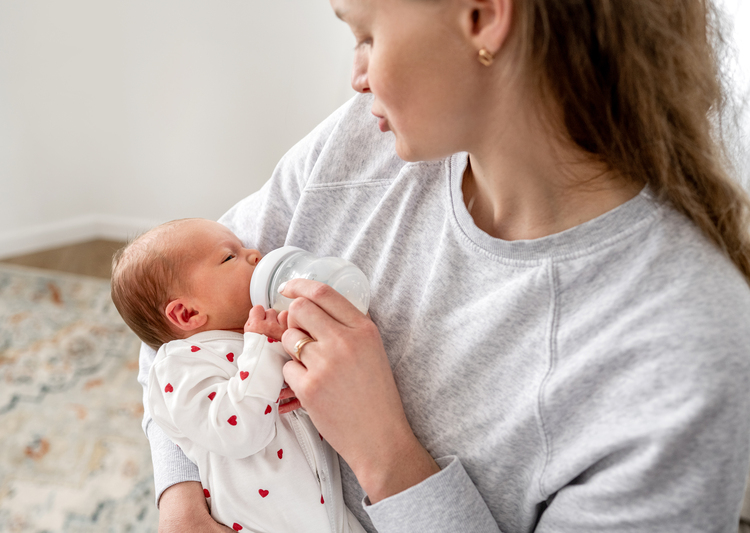
Your baby shows early bonding cues by 4 weeks, preferring your voice, your scent, and gentle touch. The AAP notes that newborns recognize the scent of their own mother's breastmilk. Responding promptly will not spoil your baby; it builds security, as the CDC confirms. Breastfed babies at this age nurse about 8 to 12 times in 24 hours, according to the CDC, and each feed doubles as close-range bonding time.
Signs your baby is connecting with you:
Calms when hearing your voice
Turns toward your familiar scent
Relaxes during skin-to-skin contact
Crying patterns at 4 weeks
Crying is your baby's main communication tool at this age. Short, rhythmic cries often signal hunger, a sudden sharp cry may mean discomfort, and a whimpery on-and-off fuss usually points to tiredness. Learning these unique signals takes time, and placing your baby safely in their crib for a brief pause is perfectly fine when you need a moment.

Simple ways to support your 4 week old's development
Everyday interactions like feeding, diaper changes, and face-to-face time already give your 4 week old the stimulation they need. A few focused activities can build on that foundation.
Tummy time basics
Supervised tummy time builds neck and shoulder strength from the first weeks. The CDC recommends placing your baby on their tummy while awake with toys at eye level. Even a few minutes a day adds up. If your baby fusses on the floor, tummy-to-chest time while you recline works just as well, as the AAP points out.
Talking, singing, and skin-to-skin contact
Talking, singing, and skin-to-skin contact all support your baby's brain development and early bonding. Narrating routines or humming at bedtime exposes your baby to speech patterns, while skin-to-skin helps regulate temperature. You can follow these routines alongside your baby's weekly developmental steps in a month-by-month development guide.
Safe play and stimulation ideas
Play at 4 weeks works best when it is gentle, brief, and focused on close-range senses.
Hold a black-and-white card about 25 cm (10 in) away and move it slowly
Shake a soft rattle gently to one side and watch for a head turn
Let your baby grip your finger through the palmar grasp reflex
Watch for overstimulation cues like turning away or arching, and offer a calm break. In Yuppo, you can enter your baby's date of birth and receive weekly play suggestions matched to this exact age.

Common concerns versus typical 1 month old behavior
Many behaviors that worry new parents during 4 week old newborn development fall well within the expected range. Knowing the difference can ease your mind.
Variations that are usually normal
Several patterns that concern new parents are typical at 4 weeks and tend to resolve on their own:
Occasional eye crossing that comes and goes
A slightly uneven head shape from sleeping position
Frequent hiccups, sneezing, or small chin tremors
Sleep stretches of about 2 to 4 hours around the clock
Signs worth mentioning to your pediatrician
Most variations at this age are harmless, but a few observations are worth raising at your next visit:
The Moro or tonic neck reflex appears noticeably stronger or weaker on one side, which the AAP recommends reporting
No reaction to loud sounds or voices
Eyes remain constantly crossed with no sign of improvement
Feeding consistently falls well below 8 sessions in 24 hours alongside signs of poor weight gain
These are conversation starters for your pediatrician, not reasons to worry.
Summary and Next Steps
Brief head lifts and active reflexes are the main physical markers at 4 weeks; even a few minutes of tummy time a day supports emerging neck strength.
Your face and voice are your baby's favorite stimuli, so close-range interaction during feeds does double duty for bonding and sensory growth.
Responding warmly to cries and cues builds secure attachment and will not spoil your baby.
Consistent progress along your baby's own growth curve matters more than matching any single number at a checkup.
Around 6 to 8 weeks, true social smiles and smoother head control begin to emerge, giving you a whole new way to connect.
This content is for information only; always consult your pediatrician for diagnosis and treatment.
Sorting through growth patterns while running on broken sleep can feel overwhelming. In Yuppo, you can log your baby's height and weight after each checkup and view their percentile curve over time, making steady progress easy to spot at a glance.
Frequently Asked Questions
Most 1 month olds sleep roughly 14 to 17 hours in 24 hours, broken into stretches of about 2 to 4 hours. A consistent day-night rhythm has not developed yet, so irregular wake-ups are expected. Keeping the room dim during nighttime feeds can gently encourage longer stretches over the coming weeks.
Intentional social smiles usually appear between about 6 and 8 weeks. The grins you see at 4 weeks are most likely reflexive, often showing up during drowsy moments or right after a feed. Once true social smiles arrive, they tend to come in direct response to your face or voice.
Steady head control is not expected at 1 month. Most 4 week olds lift their head only briefly during tummy time before lowering it. Sustained control typically develops around 3 to 4 months, so a wobbly head is perfectly normal right now.
A 4 week old sees most clearly within about 20 to 30 cm (8 to 12 in), roughly the distance to your face during feeding. Objects farther away still look blurry. High-contrast patterns and your face are the most captivating things in their visual field.
Breastfed 4 week olds typically nurse about 8 to 12 times in 24 hours, roughly every 2 to 4 hours, according to the CDC. Cluster feeding, where your baby nurses every hour for a time, is also normal and most common in the evening.