Key Takeaways
By 8 weeks, most babies briefly lift their head during tummy time, smile when you talk to them, and begin soft cooing sounds like "aah" and "ooh."
Your baby focuses most clearly at about 20–30 cm (8–12 in), roughly the distance between your faces during feeding.
Newborn reflexes like the Moro reflex are gradually fading as smoother, more deliberate arm and hand movements take over.
Steady upward weight gain across visits is what your pediatrician watches for during this fast-growth phase.
Wondering what your 8-week-old should be doing right now? At this age, your baby is likely lifting their head for a few seconds on their tummy, working toward a first genuine smile, and testing out tiny vowel sounds. These shifts in baby development at 8 weeks mark a real turning point: automatic reflexes are loosening their grip while purposeful movement and social connection step in.
If your baby already stares intently at your face during feedings or has just started cooing back at you, those are exactly the kinds of changes this stage brings. Below you'll find a breakdown of eight-week-old baby milestones across physical, social, and cognitive areas, along with guidance on feeding, sleep, and daily routines. For a broader view of how skills build over time, see the month-by-month baby development overview.

8-week milestone checklist by developmental area
Your 8-week-old is likely reaching milestones across movement, social response, and early cognition all at once. The Centers for Disease Control and Prevention (CDC) defines developmental milestones as things 75% or more of children can do by a certain age, so think of them as a flexible guide rather than a rigid deadline.
The table below organizes common 2-month milestones so you can scan at a glance.
| Developmental area | What to look for | Typical age range |
|---|---|---|
| Head control | Lifts head briefly on tummy | 1–3 months |
| Social smile | Smiles in response to your voice or face | 6–12 weeks |
| Cooing | Soft vowel sounds ("aah," "ooh") | About 2–3 months |
| Visual tracking | Follows a slow-moving object | 2–3 months |
| Hand awareness | Opens hands briefly, watches own fingers | 2–3 months |
These align with the CDC checklist for the 2-month mark. Your baby may already show some and still be working toward others; it's common to track objects with the eyes before smiling socially. For more on the full second month, see the 2-month-old development milestones guide.
Physical milestones at 8 weeks: head control, reflexes, and growth
Your baby's body is changing quickly at 8 weeks, building neck strength, gaining weight, and trading automatic reflexes for intentional movement. Both the CDC and the American Academy of Pediatrics (AAP) describe these shifts in their 2-month guidance.
Head and neck strength during tummy time
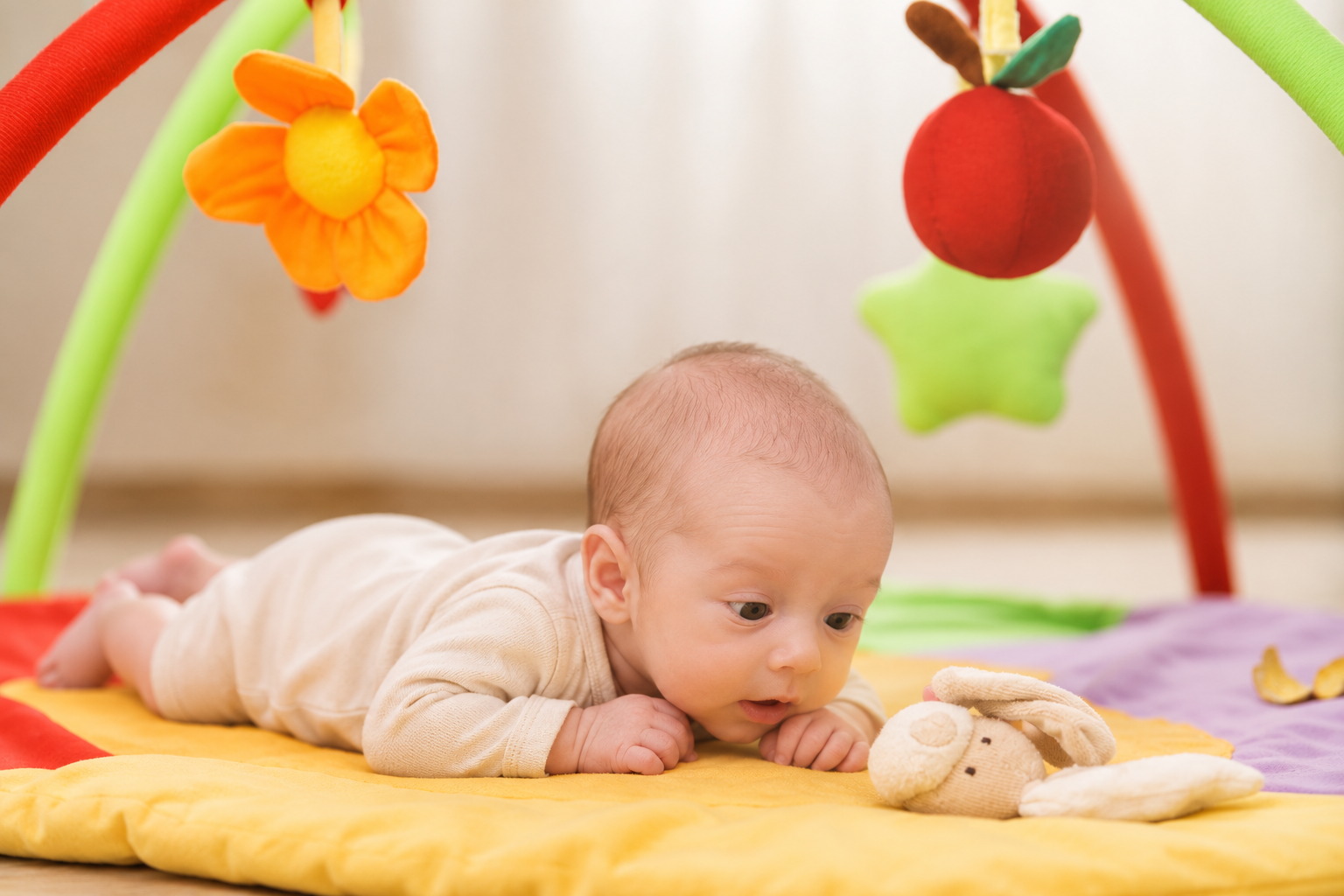
Most babies can hold their head up when placed on their tummy by about 2 months, according to the CDC. During a session you might see your baby raise their head at roughly a 45-degree angle for several seconds before gently lowering it. Those few seconds of effort build the upper-body strength needed for rolling and sitting later on.
Typical weight and length gain
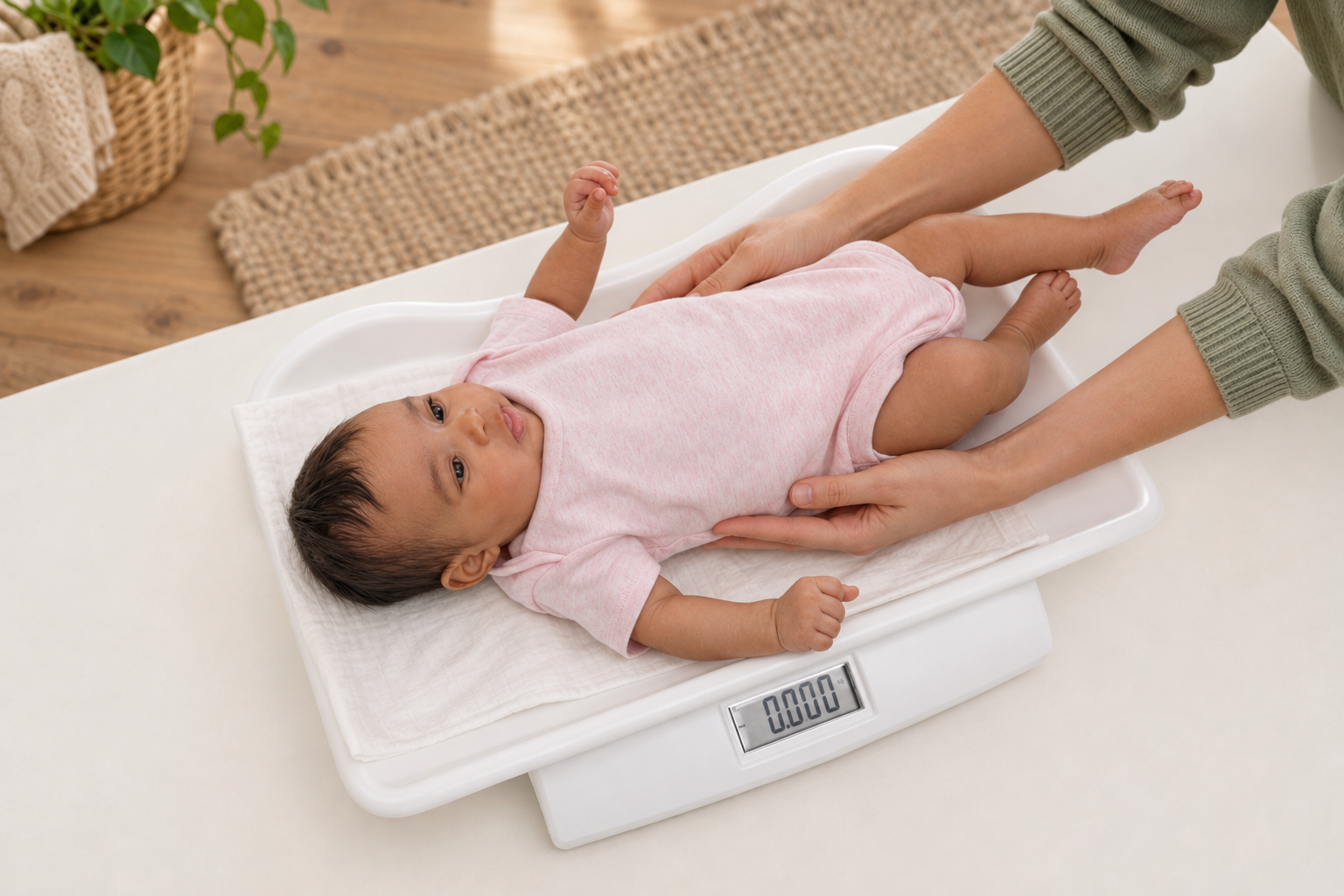
Your 2-month-old baby's growth is in its fastest phase; babies gain weight most rapidly during the first six months, according to the National Health Service (NHS). Steady upward gain across appointments is one of the signs your baby is feeding well. Your pediatrician plots these numbers on a growth percentile chart, and between visits you can follow trends with the percentile calculator.
Fading newborn reflexes
Certain newborn reflexes, including the Moro (startle) reflex, begin giving way to voluntary motions by the second month, as the AAP explains. Movement becomes more fluid: you may notice your baby waving their arms when excited or trying to move their hands where they can see them. After many tries, some babies manage to guide a hand to their mouth, an early sign of coordinated control.
Brief head lifts during tummy time
Arms waving more energetically when excited
Hands opening and closing, sometimes reaching toward the face
Social smiles, cooing, and early cognitive gains at 8 weeks
Around 8 weeks, your baby's social smile, first vowel sounds, and sharper visual tracking often emerge close together, reflecting a brain rapidly wiring itself for connection.
The social smile and what it signals
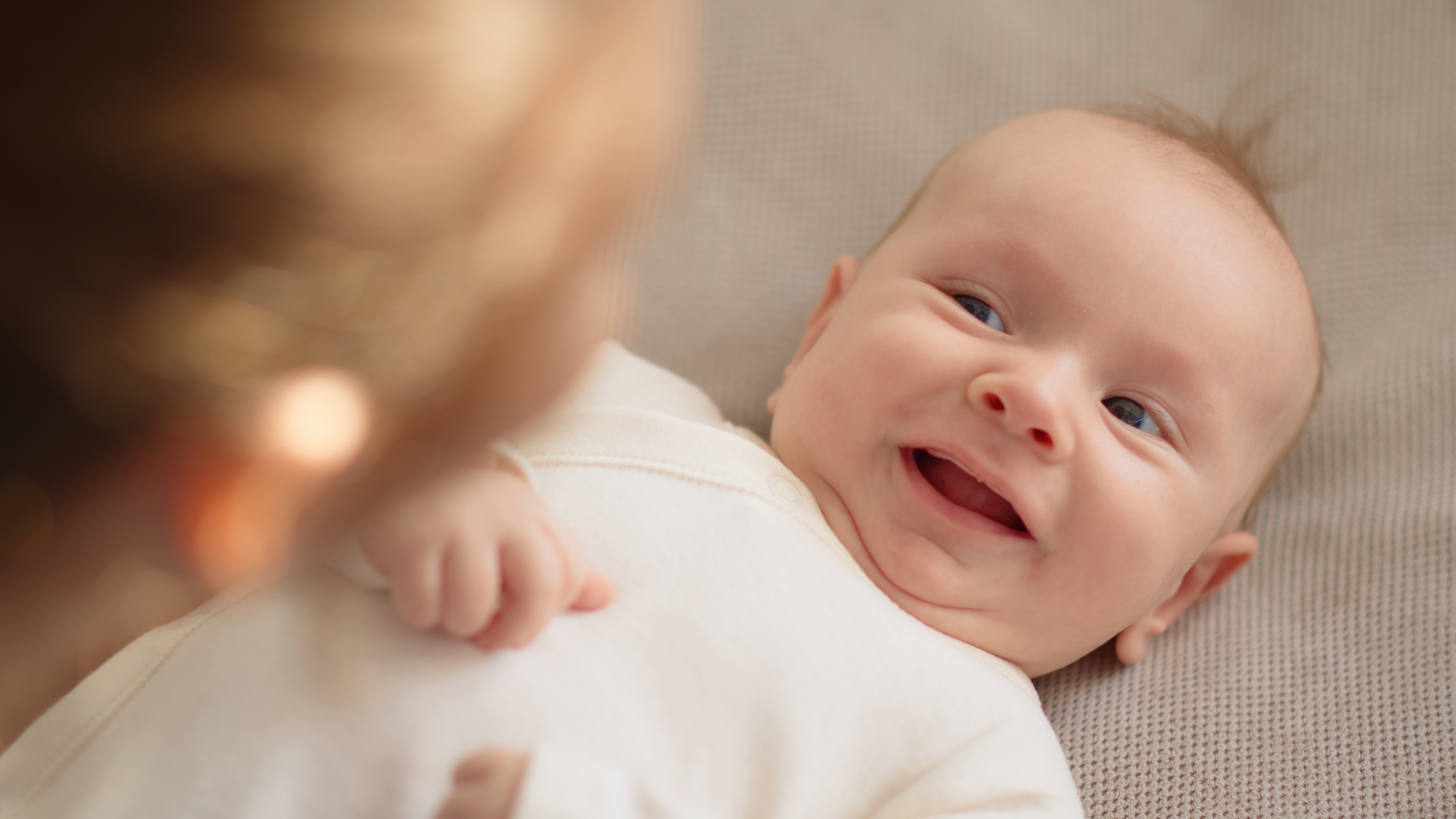
The first true social smile generally surfaces around the sixth week as a genuine gesture of affection, according to the AAP, with development continuing through about 12 weeks. By the second month, early expressions begin turning into genuine signals of pleasure and friendliness (AAP). Picture your baby breaking into a wide gummy grin the moment they hear your voice from across the room. If that grin hasn't arrived yet, there is still plenty of time.
First vowel sounds and cooing
Around 2 months, your baby may begin cooing and repeating soft vowel sounds like "aah" and "ooh," as the AAP describes. Between about 1 and 3 months, babies also start turning their head toward sound and smiling at familiar voices. You might catch your baby making drawn-out vowel sounds while locking eyes with you during a diaper change. Those early coos are the first building blocks of back-and-forth conversation, gradually building toward the babbling explored in the baby development at 4 months guide.
Visual tracking and attention span
Visual tracking at 8 weeks centers on a sharp zone of about 20–30 cm (8–12 in), roughly the distance between your faces during a feeding. The AAP notes that random eye wandering typically fades by 2–3 months, and by 3 months most babies follow a moving object more smoothly.
You may already see your baby track a bright rattle as you slowly move it past the midline of their gaze. The CDC confirms that by 2 months most babies watch you as you move and look at a toy for several seconds.
Smiling when you talk or make eye contact
Soft vowel coos during calm, alert moments
Turning head toward a familiar voice
Following a slow-moving object with their eyes
Feeding and sleep: what should your 8-week-old's day look like?
At 8 weeks your baby still gets all nutrition from breast milk or formula, and sleep follows loose rhythms rather than a fixed timetable.
Feeding frequency and volume
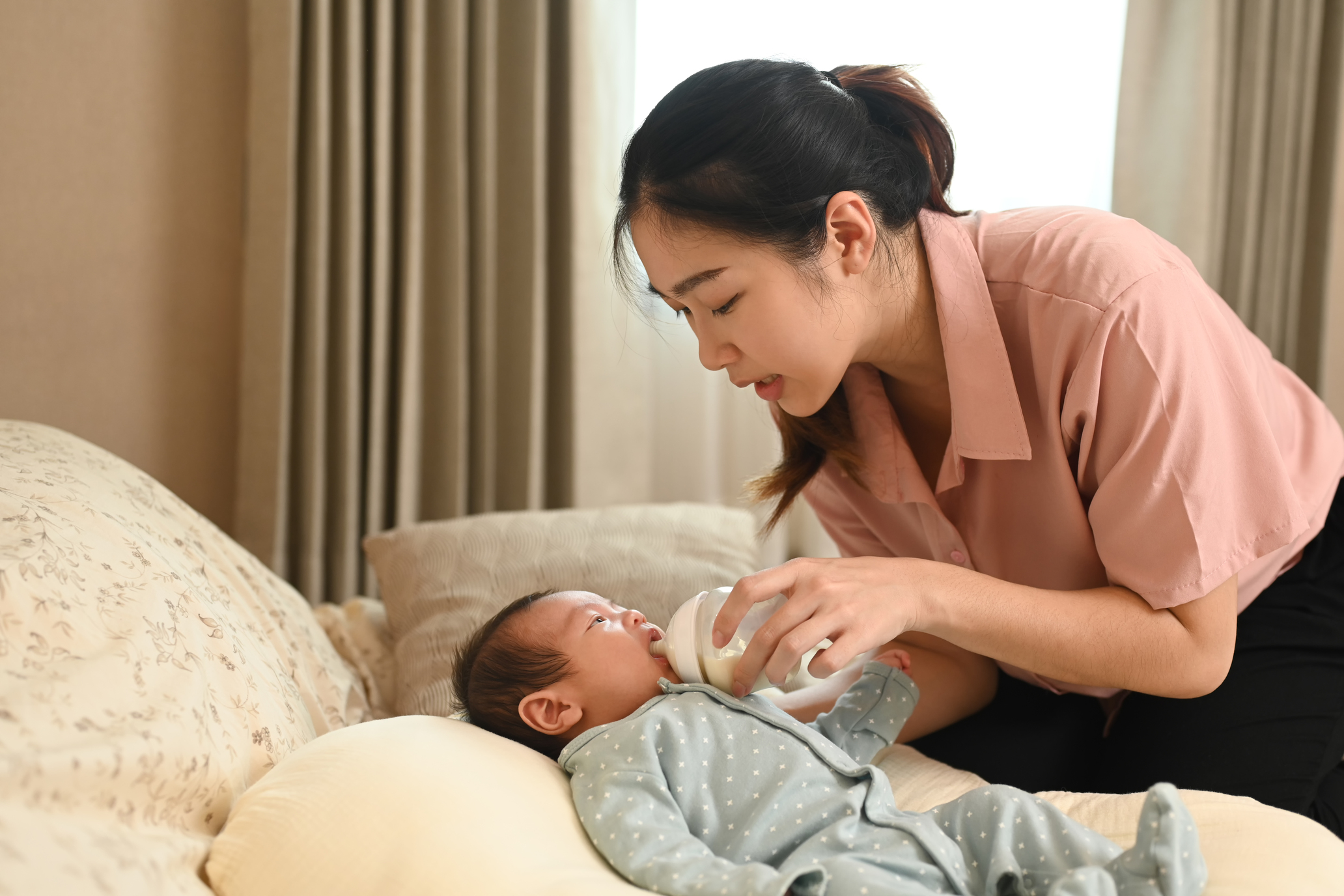
By the end of the first month, most bottle-fed babies already take at least 90–120 ml (3–4 oz) per feeding about every 3–4 hours, as the AAP notes; by 8 weeks intake often edges upward. Only breast milk or formula is recommended for about the first 6 months, according to the CDC. Some babies prefer smaller, more frequent feeds while others take slightly more per session.
Sleep totals and emerging longer stretches
A predictable sleep schedule at 8 weeks is unlikely, but you may notice one slightly longer stretch forming at night. Keeping your baby a bit more engaged during daytime play can help shift longer sleep toward nighttime hours, as the AAP suggests. A simple evening cue, like dimming the lights about 30 minutes before the last feed, can signal the wind-down.
Many 8-week-olds still wake multiple times overnight, and that is entirely expected at this stage. Over the coming weeks sleep often consolidates further; the guide on what's ahead at 3 months covers the next shift.
What should you do to support your 8-week-old's development?
Your face and your voice are the most effective development tools for your 8-week-old, and they cost nothing.
Tummy time and movement play
Short, supervised tummy-time sessions of about 1–5 minutes help your baby build the neck strength needed for future milestones. The CDC suggests placing toys at eye level in front of your baby to encourage head lifting. Aim for several brief sessions throughout the day, working toward a daily total of roughly 15–20 minutes.
Place a bright toy or small mirror at eye level
Start sessions after diaper changes when your baby is alert
Try chest-to-chest tummy time if the floor causes fussing
Gradually increase session length as comfort grows
Talking, singing, and face-to-face interaction
Responding to your baby's coos with animated smiles and words teaches the turn-taking rhythm behind conversation. The CDC recommends acting excited and talking back when your baby makes sounds, along with reading and singing to build early language understanding. In Yuppo, you can enter your baby's date of birth and browse age-matched activity suggestions, from simple face-to-face games to sensory play ideas suited to this exact week.

Mention to your pediatrician if, by roughly 2–3 months, your baby:
Does not respond to loud sounds
Has not smiled socially
Does not move both arms and both legs
Does not watch you as you move
Summary and Next Steps
Brief head lifts, social grins, and soft coos generally emerge between about 6 weeks and 3 months, and 8 weeks sits right in the heart of that window.
Growth trends matter more than single numbers: your pediatrician tracks the upward curve across multiple visits, not any one weigh-in.
Add a few extra tummy-time minutes this week: even one or two more minutes per session strengthens neck muscles without overwhelming your baby.
Your voice powers early language: narrating routines, singing, and echoing your baby's coos lays groundwork that builds month by month.
Expect gradual forward motion: over the next several weeks head control will steady, coos will stretch longer, and smiles will come faster.
This content is for information only; always consult your pediatrician for diagnosis and treatment.
Nights at 8 weeks can still blur together, making it hard to tell whether sleep stretches are actually lengthening. In Yuppo, you can record your baby's naps and nighttime sleep, then review the logged pattern to see how those stretches are gradually shifting.
Frequently Asked Questions
Your baby sees most sharply at close range, roughly the distance between your faces during a feeding. Try holding a high-contrast toy about 25 cm (10 in) away and moving it slowly to the side; you'll likely notice early tracking. Any occasional eye wandering usually resolves by around 3 months.
Many babies flash their first social smile around 6 weeks, though some take closer to 3 months to get there. Keep making eye contact and smiling at your baby. If no social response appears by around 3 months, mention it at your next well-child visit.
Several short sessions of about 1–5 minutes spread throughout the day work well, building toward a combined daily total of roughly 15–20 minutes. Chest-to-chest tummy time on your lap is a gentle alternative if the floor causes fussing.
A fixed schedule is unlikely at 8 weeks because your baby's internal clock is still maturing. You may notice one slightly longer overnight stretch beginning to form. Gentle cues like a quieter room and dimmed lights before the last feed can encourage that emerging pattern.
Babies gain weight most rapidly during the first six months, and your pediatrician watches the overall upward trend on the growth chart rather than any single weekly figure. Consistent forward movement along your baby's own curve is the reassuring pattern to look for.
Centers for Disease Control and Prevention. (2025). Milestones by 2 months. CDC.
American Academy of Pediatrics. (2020). Movement milestones: Birth to 3 months. HealthyChildren.org.
American Academy of Pediatrics. (2024). Getting your baby to sleep. HealthyChildren.org.
National Health Service. (2023). Your baby's weight and height. NHS.