10-Month Sleep Regression: Signs, Duration, and ways to Steady Your Baby's Sleep

This article is approved by Yuppo Lab Sleep Expert
Published: 15 October, 2026
Updated: 17 October, 2026

At a Glance
The 10 month sleep regression is a popular label for sleep changes that may occur during the broader 8-to-12-month developmental period.
Research has observed a possible disruption near 9 months, although the change did not appear across every measure of infant sleep.
Common signs include bedtime resistance, more night wakings, increased reassurance-seeking, and temporarily less predictable naps.
Consistent routines, responsive reassurance, and carefully observed schedule adjustments can help you navigate this phase without expecting instant results.
Around 10 months, separation anxiety and other developmental changes may coincide with disrupted sleep, but there is no fixed pattern or timeline. The term “10 month sleep regression” is a popular parenting framework, not a formal diagnosis.
If your baby suddenly cries when you leave, wakes looking for you, or resists a familiar nap, the change can be exhausting and confusing. You will learn how to recognize the likely pattern, respond to 10 month night wakings, and distinguish developmental changes from teething or a schedule mismatch. You can also find more age-specific guidance in the Sleep collection.


What is the 10-month sleep regression, and why does it happen?
The 10-month sleep regression describes a temporary change in sleep that may overlap with emotional development during the first year. Several factors can appear together, and one explanation rarely accounts for every difficult night.
Developmental changes around 8 to 12 months
Developmental changes may coincide with different settling behaviors, although they do not disrupt every baby’s sleep in the same way. A first-year infant sleep study titled Night waking, sleep-wake organization, and self-soothing, available through the National Library of Medicine (NLM), observed a slight disruption near 9 months that was not evident across all sleep measures.
New movement may also appear at bedtime without necessarily causing the sleep change. For example, your baby might pull to stand in the crib and become frustrated when getting back down is harder. Related changes may begin earlier, as described in the 8 month sleep regression guide.
Separation anxiety and object permanence
Separation anxiety and object permanence can make your absence more noticeable at bedtime and overnight. A developmental review available through the NLM connects object permanence with attachment, separation anxiety, and night waking around this stage.
The American Academy of Pediatrics (AAP) notes that separation anxiety between 8 and 12 months can appear as bedtime refusal or waking to search for you. The phrase “10 month sleep regression separation anxiety” usually points to this pattern, not deliberate misbehavior.
Shifting sleep pressure and daily routines
Daily timing can reveal whether a recurring nap or bedtime pattern is adding to the difficulty. Look for relationships rather than drawing conclusions from one night:
A long first nap followed by repeated second-nap resistance
A late afternoon nap followed by difficulty settling at bedtime
Strong protests beginning specifically when you leave
Similar waking times across several nights
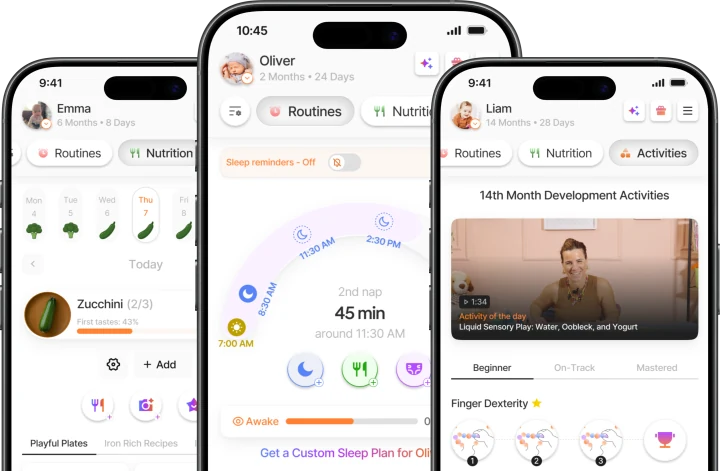
Labels such as baby growth spurts may help organize your observations, but they do not predict precisely how your baby will sleep. In Yuppo, you can enter your baby’s birth date and follow expert-prepared developmental steps week by week.
What are the signs of a 10-month sleep regression?
The clearest 10 month sleep regression signs are noticeable changes in nights, naps, or bedtime compared with your baby’s recent pattern. A single unsettled evening usually provides too little information.
Nighttime signs
Nighttime signs may include more waking, calling for you, standing in the crib, or taking longer to resettle. You might notice that your baby wakes at unfamiliar times or needs more reassurance than they recently did.
A 10-month-old not sleeping through the night does not automatically indicate a regression. The more useful clue is a clear change from your baby’s own rhythm.
Nap and bedtime signs
Nap and bedtime signs can include stronger protests, unpredictable settling, or temporarily shorter naps. Your baby may appear tired but cry as soon as the routine reaches the point where you leave.
A baby who cries when you exit may settle more calmly after hearing the same short goodnight phrase and receiving a familiar response. Predictability does not guarantee sleep, but it makes your actions easier to recognize.

Changes that may have another cause
Developmental clues center on separation and reassurance, teething clues involve the gums and mouth, and schedule clues repeat around a particular sleep period. Tender gums and chewing differ from resistance that consistently follows a long nap.
These distinctions are not perfect, and more than one factor may be present. Focus on the surrounding pattern rather than forcing every difficult sleep into one category.
When does the 10-month sleep regression start, and how long does it last?
Changes called a 10-month sleep regression may arise within the 8-to-12-month period, but they have no universal start date or duration. Development does not follow exact monthly boundaries.
Common timing range
The relevant timing range extends from approximately 8 to 12 months because separation-related sleep behavior may become noticeable then. The AAP describes bedtime refusal and searching for a caregiver across this period.
Earlier regressions are not a timetable for later ones. Your experience with the 4 month sleep regression may therefore look different from what happens now.
Typical duration and individual variation
A 10-month sleep disruption has no established duration that applies to all babies. It may be brief, fluctuate, or continue while separation anxiety and routine changes overlap.
Possible signs of improvement include easier settling, fewer intense protests, or naps becoming predictable before nights improve. Progress can be uneven without meaning that your response has failed.
Sleep needs and nap patterns around 10 months
Sleep needs and nap timing around 10 months vary considerably between babies. Compare your baby with their recent pattern rather than another family’s schedule.
The National Health Service (NHS) emphasizes that babies differ in both how much and when they sleep. This makes any sample schedule a starting point, not a target.
How might two naps fit the 10-month sleep regression?
A two-nap pattern can provide a practical reference during the 10-month sleep regression, provided you treat it as illustrative rather than prescriptive. Your baby’s actual times may differ substantially.
One illustrative two-nap pattern
This two-nap schedule shows one fictional baby’s range across three relatively settled days, not recommended sleep targets.
Sleep period | Approximate start-time range | Typical duration range | Wake window before sleep |
|---|---|---|---|
Morning nap | 9:30 to 9:45 a.m. | 60 to 75 minutes | 2 hours 45 minutes to 3 hours |
Afternoon nap | 2:00 to 2:15 p.m. | 60 to 75 minutes | 3 hours to 3 hours 15 minutes |
Night sleep | 7:15 to 7:30 p.m. | 10.5 to 11.5 hours | 3 hours 30 minutes to 4 hours |
The useful comparison is not the clock time itself, but how each sleep period relates to the one before it.
How to interpret repeated nap resistance
Repeated nap resistance is more informative than one refused nap. If your baby resists the second nap after a long first nap for several days, observe the pattern before changing the schedule.
You might then shift the second nap by 15 minutes while leaving the rest of the day unchanged. This small test helps you see whether timing matters without immediately dropping a nap.

What can you do during the 10-month sleep regression?
During the 10-month sleep regression, predictable cues, responsive reassurance, and gradual timing changes can make the disruption easier to manage. Choose actions you can repeat even when you are tired.
Keep bedtime and morning wake time predictable
Predictable morning and bedtime cues help your baby recognize the rhythm of the day. The AAP recommends doing the same activities in the same order at naps and bedtime.
Your sequence could include dimming the room, changing clothes, cuddling, and repeating one phrase. A familiar song can also provide a consistent cue, and these baby lullaby ideas offer simple options.
Adjust wake windows and naps gradually
Gradual schedule adjustments make it easier to identify which timing relationship matters. Use a short sleep log and change only one part at a time:
Record nap starts, nap endings, bedtime, and wakings.
Identify the sleep period that is repeatedly difficult.
Adjust that timing slightly.
Observe several days before making another change.
Respond consistently to separation anxiety
A consistent response to separation anxiety gives your baby a familiar experience without requiring you to ignore their calls. You might use one phrase, offer brief reassurance, and repeat the same settling sequence.
Leaving your baby to cry is not the only option. Wirral Community Health and Care NHS Foundation Trust advises against cry-based sleep modification methods for babies between 6 and 12 months.

Protect safe sleep during new mobility
Safe sleep during new mobility still includes placing your baby in their own sleep space while drowsy rather than waiting until fully asleep. The AAP specifically recommends drowsy placement as an opportunity to practice settling.
Finish the familiar routine, place your baby down while drowsy, and follow your pediatrician’s current safe sleep guidance for the sleep space. Drowsy placement is a practice opportunity, not a test your baby must pass.
Is it a sleep regression, teething, or a schedule mismatch?
Sleep regression, teething, and a schedule mismatch can look similar, but their surrounding clues often differ. More than one contributor can occur at the same time.
Clues that fit a developmental sleep regression
A developmental pattern fits best when sleep changes accompany stronger reactions to separation or searching for you. Your baby may otherwise appear comfortable and engaged during the day.
Common contextual clues include bedtime protests when you leave, reassurance-seeking overnight, and repeated checking that you are nearby.
Clues that fit teething or illness
Teething is more likely when disrupted sleep accompanies tender or swollen gums, mild fussiness, drooling, chewing, or a localized facial rash. These are the clues described by the AAP.
The AAP also states that fever, diarrhea, diaper rash, and a runny nose should not automatically be attributed to teething. Symptoms beyond typical teething clues deserve separate assessment.

Clues that fit too much or too little sleep pressure
A schedule mismatch becomes more plausible when difficulty repeatedly centers on the same nap or bedtime. For example, your baby may resist the second nap after a long morning nap but settle comfortably at other times.
Review several days rather than reacting to one unusual sleep. Consistency in the pattern matters more than one difficult afternoon.
Sleep changes that warrant pediatric guidance
Persistent sleep problems or unusually intense fussiness deserve individualized pediatric guidance rather than an assumed regression.
Occasional frustration may accompany unsettled sleep, but extreme and consistent fussiness should be discussed with your pediatrician, according to the AAP.
A short disruption may settle with time, but ongoing sleep problems or difficulty establishing a workable routine are reasons to seek professional guidance, according to the NHS.
Summary and Next Steps
The most useful next step is to identify the pattern before deciding how to respond.
Name the likely context: Notice whether separation, tender gums, or one recurring sleep period surrounds the change.
Keep cues recognizable: Use the same short sequence before naps and bedtime.
Choose a responsive approach: Decide how you will reassure your baby during protests and night wakings.
Track this week: Record sleep times for several days, then adjust only the repeatedly difficult period.
Expect uneven progress: Bedtime, naps, and night waking may improve at different rates.
This content is for information only; always consult your pediatrician for diagnosis and treatment.
Remembering nap timing and night wakings is difficult when tired days blur together. In Yuppo, you can record your baby’s sleep and review the tracked pattern in one place.
Frequently Asked Questions
How long does the 10 month sleep regression last?
The 10 month sleep regression has no fixed duration that applies to every baby. The disruption may be brief or fluctuate while separation anxiety and daily routines overlap. If sleep remains persistently difficult or your baby is consistently extremely fussy, ask your pediatrician to help assess the pattern.
Why is my 10 month old suddenly waking at night?
Your 10-month-old may suddenly wake because separation feels more noticeable, sleep timing has shifted, or discomfort is present. Look at what surrounds each waking, such as searching for you, chewing frequently, or struggling after a particular nap. That context is more informative than the waking alone.
Can separation anxiety cause sleep problems at 10 months?
Separation anxiety can contribute to bedtime protests and more calling for you overnight around 10 months. Object permanence means your baby can remember you when you are out of sight and may search for you. A short goodnight phrase and predictable response can make repeated separations more familiar.
Does the 10 month sleep regression affect naps?
A 10 month sleep regression can coincide with naps becoming harder to start, temporarily shorter, or less predictable. Separation reactions can appear at naptime as well as bedtime. Continue familiar nap cues and observe several days before interpreting one refused or unusually brief nap as a lasting schedule change.
Should a 10 month old transition to one nap?
Usually not; one refused nap does not show that your 10-month-old is ready for a one-nap schedule. Around this age, two nap opportunities may still fit the day, although their timing and duration vary. First examine whether a long first nap or changed timing is affecting the second.
Do I need to use cry it out during the 10 month sleep regression?
You do not need to use cry it out during the 10 month sleep regression. You can use a consistent, responsive approach that fits your family, such as a familiar phrase, brief reassurance, and the same settling sequence. The aim is to make your response recognizable, not to eliminate your baby’s need for you.
References
National Health Service. (n.d.). Your baby’s sleep patterns. NHS.
National Health Service. (2025). Helping your baby to sleep. NHS.
American Academy of Pediatrics. (n.d.). Teething. HealthyChildren.org.
American Academy of Pediatrics. (2024). Getting your baby to sleep. HealthyChildren.org.
American Academy of Pediatrics. (2013). A lullaby for good health. HealthyChildren.org.

Yuppo Lab
Sleep Expert

Sleep
Learn 6 month sleep regression signs, likely duration, and practical ways to respond. Navigate your baby's changing sleep with Yuppo.

Sleep
Discover when sleep regressions strike and what to do at each stage, from 4 months to 2 years. Track your baby's sleep milestones with Yuppo.

Sleep
Learn why sleep regression strikes around 20 months and what you can do to help your toddler rest again. Track your toddler's sleep patterns with Yuppo.