5-Month Sleep Regression: Signs, Causes, and What You Can Do

This article is approved by Yuppo Lab Sleep Expert
Published: 15 October, 2026
Updated: 15 October, 2026

At a Glance
The 5-month sleep regression is a temporary disruption driven by maturing sleep cycles, and most babies settle within two to four weeks.
Frequent nighttime waking at this age is developmentally normal, not a sign that something is wrong.
Common signs include more wake-ups at night, shorter or refused naps, and extra fussiness around sleep transitions.
Teething can overlap with the regression, but the two leave distinct physical and behavioral clues.
Consistent routines, well-timed wake windows, and calm nighttime responses are your most effective tools.
Your baby was finally sleeping longer stretches, and now the wake-ups are back. If your 5-month-old's sleep has taken a sharp turn, you're likely seeing a sleep regression. This temporary phase happens as your baby's brain reorganizes how it moves through sleep stages, a process that generally begins around 4 months and can peak or resurface near the fifth month. Below you'll learn what causes the 5 month sleep regression, how to recognize the signs, how to tell it apart from teething, and what you can do to help the whole household rest better.


What is the 5-month sleep regression
A sleep regression at 5 months is a stretch of noticeably disrupted sleep that follows a period of more predictable rest. Your baby isn't losing ground. Their brain is shifting from a simple newborn sleep pattern into multi-stage cycles that include lighter phases, which means more chances to wake. According to the American Academy of Pediatrics (AAP), babies do not develop regular sleep cycles until approximately 4 to 6 months of age.
In practice, the regression often shows up as:
Bedtime settling that takes noticeably longer than before
Longer night stretches breaking into shorter segments
A baby who seems fully alert during nighttime wake-ups
Because this shift is gradual, many families who went through the 4-month sleep regression notice a second wave a few weeks later.

Why your baby's sleep changes around 5 months
Maturing sleep cycles, emerging motor skills, and expanding wake windows all converge near month five to reshape your baby's rest.
Maturing sleep-cycle architecture
Your baby's sleep cycles are shifting from a two-stage newborn pattern to a multi-stage cycle that includes lighter periods of REM sleep. During those lighter phases your baby is far more likely to surface briefly. The AAP notes that even at around 6 months, babies still do not have fully consolidated sleep cycles, so disruptions in the 4 to 6 month window are developmentally expected.
New motor and cognitive milestones
Around 5 months many babies are learning to roll, reach, and track objects that disappear, an early step toward object permanence. A baby who just figured out how to flip onto her stomach may keep practicing in the crib, startling herself awake in a position she can't yet reverse.
Shifting wake-window needs
Your baby's circadian rhythm is becoming more defined, and the awake time needed between naps is growing. When wake windows are too short or too long, settling becomes a struggle. For a broader view of everything changing at this stage, see our guide to 5-month-old development.

Signs of a sleep regression at 5 months
More frequent night waking, shorter naps, and fussiness at bedtime are the hallmarks of a 5 month sleep regression.
Frequent nighttime wake-ups
Your baby may go from one or two feeds a night to waking three or more times. A baby who recently dropped to two night feeds might start waking again around 3 a.m. and only resettle after being held upright. The AAP explains that a "good sleeper" at this age is actually a baby who wakes frequently but can get back to sleep, not one who sleeps without waking for 10 hours.
Shorter or refused naps
A 5-month-old fighting naps, especially the late-afternoon catnap, is one of the most common regression complaints. When that third nap vanishes entirely, your baby may become overtired by 6 p.m., triggering meltdowns and rougher nights.
Increased fussiness at sleep times
A baby who used to settle easily may now cry the moment you place them in the crib, needing several minutes of patting before drifting off. This often reflects growing awareness, as your baby notices more of the world and protests the shift to sleep.

Sleep regression or teething at 5 months: how to tell the difference
Both sleep regression and teething can surface around the same time, but each leaves distinct clues.
Key symptom differences
Teething usually begins between 4 and 7 months, with the first teeth most often appearing around 6 months, according to the AAP. The NHS lists teething symptoms such as sore, red gums, extra drooling, gnawing on objects, and a slightly raised temperature below 38 °C (100.4 °F). A sleep regression shows no physical mouth changes and disrupts naps as much as nighttime sleep.
| Sign | Sleep Regression | Teething |
|---|---|---|
| Night waking | Multiple wake-ups across the night | Often peaks in the first half |
| Naps | Shorter or refused, especially late nap | May shorten, rarely disappear |
| Daytime mood | Fussy mainly at sleep transitions | Fretful throughout the day |
| Drooling / gums | No change | Extra drool, red or swollen gums |
| Duration | About 2 to 4 weeks | Few days per tooth |
The NHS adds that teething discomfort is usually mild and lasts only a few days, while a regression tends to persist for several weeks.
What to do when both overlap
When teething and a regression happen at once, address the gum discomfort first with a chilled teething ring or gentle gum massage. Once the physical irritation eases, your usual sleep strategies become more effective. For more on soothing sore gums, see our guide to baby teething symptoms.
How long the 5-month sleep regression lasts
Most families see the toughest stretch of a five month old sleep regression ease within two to four weeks, though some babies pass through with only minor changes in settling time. The NHS notes that all babies change their sleep patterns and that growth spurts, teething, and illness can all influence how a baby sleeps.
Several factors shape the timeline:
Sleep-environment consistency: Keeping light, noise, and routine steady helps your baby adapt faster.
Milestone timing: A baby mastering rolling while sleep cycles reorganize may need a bit longer.
Individual temperament: Some babies adjust more quickly to change than others.
Every baby moves through this phase at their own pace. If disruptions return closer to 8 months, that is typically a separate developmental shift.

Practical tips to help your baby through the 5-month sleep regression
You can't fast-forward through the regression, but consistent routines and calm responses can make the ride smoother.
Adjust wake windows and nap timing
As your baby's alertness grows, the gap between naps usually needs to stretch by about 10 to 15 minutes. The AAP recommends paying attention to sleepy cues early, because settling a baby before overtiredness sets in is much easier.
Common cues to watch for:
Eye rubbing or pulling at ears
Yawning or looking away from you
Becoming quieter or less interested in play
If the late-afternoon nap is a battle, a short motion-assisted catnap in a stroller can bridge the gap to bedtime.
Keep a calming pre-sleep routine
A predictable bedtime sequence signals to your baby that sleep is coming and eases the transition. The AAP notes that keeping regular daily routines, including the same waking time, mealtimes, and nap time, helps a young child feel secure. During nighttime feeds or changes, speak softly and keep the room dim so your baby learns the difference between day and night, as the AAP also advises.

Offer comfort without building new sleep associations
Brief reassurance while your baby stays in the crib helps them resettle without creating a new dependency. The AAP suggests putting babies to bed when drowsy but not yet asleep, because this helps them learn to fall asleep on their own. Rocking fully to sleep each time may make self-settling harder after nighttime wake-ups.
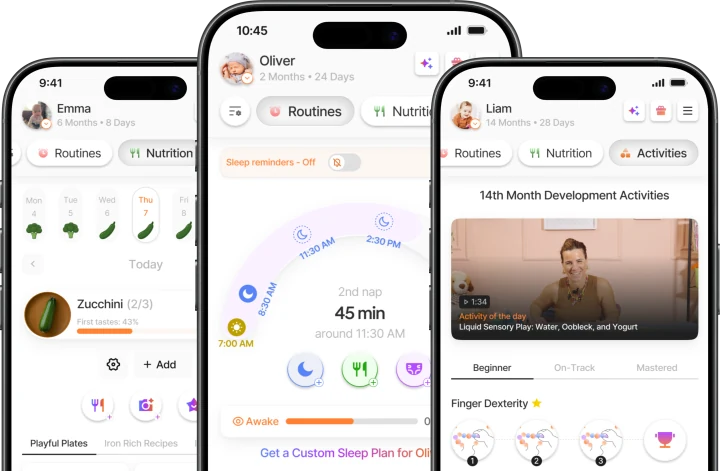
In Yuppo, you can log each nap and nighttime sleep session and then review the pattern over several days to spot whether wake windows or bedtime need adjusting.
If your baby's sleep disruption persists well beyond four weeks, or you notice persistent difficulty breathing during sleep, prolonged refusal to eat, or unusual daytime lethargy, reach out to your pediatrician.
Summary and Next Steps
A few targeted actions can help you and your baby move through this phase with less stress.
The disruption is temporary. Your baby's brain is building more mature sleep cycles, and the process generally settles within two to four weeks.
Track patterns, not single nights. A consistent shift in nap length and nighttime waking over several days is a stronger signal than one rough night.
Stretch the hardest wake window this week. Add 10 to 15 minutes of awake time before the toughest nap and note whether settling improves.
Check for teething clues. Red, swollen gums and extra drooling suggest teething; if those are absent, the disruption is more likely developmental.
Keep nighttime responses low-key. Dim lights, a soft voice, and minimal stimulation protect the day-night distinction your baby is still building.
This content is for information only; always consult your pediatrician for diagnosis and treatment.
Piecing together whether last night's rough patch followed an early bedtime or a skipped nap is hard on broken sleep. In Yuppo, you can enter your baby's birth date and follow week-by-week developmental milestones prepared by experts, so you see exactly which skills are emerging alongside the sleep changes.
Frequently Asked Questions
Is there really a separate sleep regression at 5 months?
Many babies experience it as a continuation of the sleep-cycle shift that began around 4 months, with the roughest nights sometimes peaking near 5 months. A parent's firsthand account of the 4-month regression describes a strikingly similar arc, which is why the two phases often feel connected.
How much total sleep does a 5-month-old need?
Most 5-month-olds need roughly 12 to 15 hours in a 24-hour period, typically split into about 10 to 11 hours at night and 3 to 4 hours across two to three naps. Your baby's needs may fall at either end of that range.
Should I start sleep training during the 5-month regression?
Waiting until the regression settles, usually around 5.5 to 6 months, provides a more stable starting point. During the regression itself, consistent routines and gentle responses tend to be more effective than introducing a new method.
Why does my 5-month-old fight the third nap of the day?
Growing wake windows and increasing alertness make the late-afternoon nap the hardest to land. A short motion-assisted catnap in a stroller or car seat can bridge the gap to bedtime, helping prevent the overtired cycle that worsens nighttime sleep.
Will night feeds increase during the regression?
Some babies request an extra feed for comfort. Offering a full feed in a dimly lit room meets the need without encouraging frequent brief wakings. If the extra feed persists after the regression passes, you can phase it out gradually.
Does the 5-month sleep regression affect every baby?
Not every baby shows noticeable disruption. Some pass through with only a slight change in settling time or nap length, while others have several tough weeks. Both responses are normal and say nothing about long-term sleep habits.
References
American Academy of Pediatrics. (2024). Getting Your Baby to Sleep. HealthyChildren.org.
American Academy of Pediatrics. (n.d.). Sleep. HealthyChildren.org.
American Academy of Pediatrics. (2013). Sleeping Through the Night. HealthyChildren.org.
American Academy of Pediatrics. (n.d.). Teething & Tooth Care. HealthyChildren.org.

Yuppo Lab
Sleep Expert

Sleep
Learn 6 month sleep regression signs, likely duration, and practical ways to respond. Navigate your baby's changing sleep with Yuppo.

Sleep
Discover when sleep regressions strike and what to do at each stage, from 4 months to 2 years. Track your baby's sleep milestones with Yuppo.

Sleep
Learn why sleep regression strikes around 20 months and what you can do to help your toddler rest again. Track your toddler's sleep patterns with Yuppo.