Signs of Learning Disabilities in Children: Early Detection Guide for Preschoolers

This article is approved by Yuppo Lab Developmental Psychologist
Published: 31 July, 2026
Updated: 31 July, 2026

At a Glance
Signs of learning disabilities in children usually appear between ages 3 and 6 as persistent differences in language development, following directions, and motor skills compared to peers.
These traits are not related to your child's intelligence; they are the result of a neurobiological difference in how the brain processes information.
Struggles with phonological awareness in early childhood can be a strong indicator of early dyslexia signs.
Rather than viewing struggles as a lack of interest, supporting your child's potential at their own pace through early intervention programs is the best approach.
When parents hear about childhood learning disability symptoms, they often think of reading and writing challenges in elementary school. However, neurodevelopmental clues can appear during the preschool years as well. When guiding your child, the goal is not to see these signs as a cause for anxiety, but as a compassionate opportunity to understand how they perceive the world and process information.


What Is a Learning Disability and How Does It Appear in Preschoolers?
A learning disability is a neurodevelopmental difference that affects how children process, understand, and use information in daily life. In preschool, it often shows up as persistent struggles in language skills, motor coordination, or following instructions. This does not mean your child does not understand the world around them; rather, it indicates that their learning style differs from traditional methods.
According to the American Psychiatric Association's DSM-5 criteria and guidelines from the American Academy of Pediatrics (AAP), children with specific learning disabilities have average or above-average intelligence. However, due to structural processing differences in the brain, they may perform differently than expected in specific areas. During the preschool years, as children explore through play, their brains rapidly build new neural connections. In this process, some children may need more time to memorize nursery rhymes, retain new vocabulary, or draw simple geometric shapes. Because every child has a unique developmental timeline, identifying developmental red flags for learning comes from gently observing persistent struggles in everyday skills.

What Are the Early Indicators of Learning Disorders by Age Group?
Early indicators of learning disorders evolve across preschool stages. They might begin with slow vocabulary acquisition in early childhood and progress to difficulties with letter-sound connections or confusing basic concepts by ages 5 to 6. Because the timeline for reaching developmental milestones spans a broad range, it is healthier to focus on overall skill trends rather than a single month.
If you notice persistent differences in your child's general language skills, learning when to seek expert guidance for speech delays can be helpful. Similarly, when monitoring preschool development, understanding attention deficit symptoms in young children helps provide a clearer picture of co-occurring conditions.
Critical Signs at Ages 3–4
Critical signs at ages 3 to 4 often include difficulty learning nursery rhymes, slow vocabulary acquisition, and noticeable differences in fine motor skills such as buttoning clothes compared to peers. Most children between ages 3 and 4 begin to recognize and play with simple rhyming words (such as cat-hat or ball-wall). However, grasping this language rhythm may require significantly more time and repetition for some children.
During this stage, children may occasionally mispronounce words or pause briefly to find the right word they want to express. To follow your child's developmental window gently and receive age-appropriate play ideas, you can use the personalized tracking and activity planning features of the Yuppo app.
Warning Signs During the Ages 5–6 School Transition
Warning signs during the ages 5 to 6 school transition include trouble recalling the days of the week in order, difficulty recognizing letters in their own name, and constantly confusing basic directional concepts like right and left. During this period, phonological awareness—the ability to recognize and mentally manipulate sounds within words—develops rapidly.
Children at this age can typically summarize the beginning, middle, and end of a simple story or arrange sequential events. If your child consistently struggles with narrative sequences, close observation is valuable. To assess whether your child is ready for this transition, exploring indicators of school readiness can offer additional guidance.
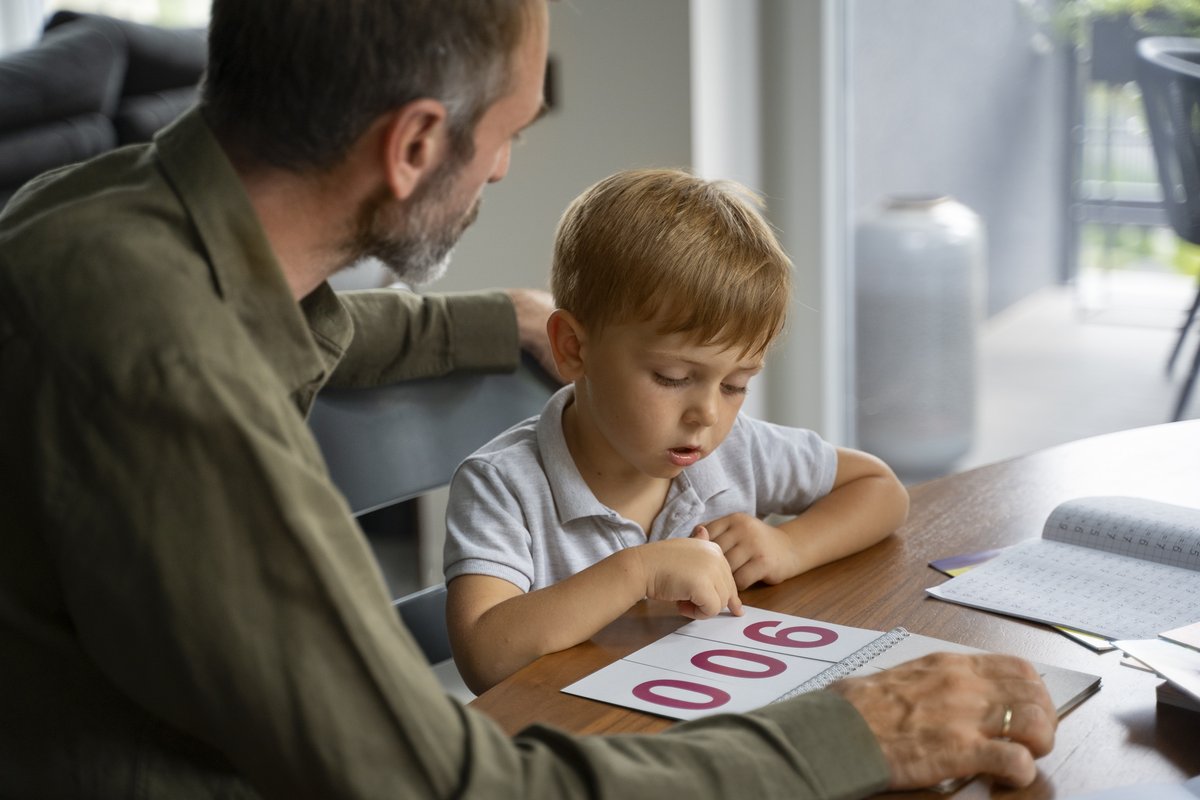
What Is the Difference Between Dyslexia, Dysgraphia, and Dyscalculia?
Dyslexia affects reading and language processing, dysgraphia impacts writing and fine motor coordination, and dyscalculia influences numerical concepts and mathematical reasoning. While these learning differences can occur individually, some children may experience a combination of them.
The table below summarizes how these three core differences may present in daily preschool life:
Type of Learning Disability | Primary Area Affected | Possible Preschool Sign |
|---|---|---|
Dyslexia | Language processing, phonological awareness | Significant difficulty finding or producing rhyming words around ages 4–5 |
Dysgraphia | Fine motor skills, writing | Inability to hold a pencil correctly and steadily at an age-appropriate stage (usually ages 4–5), uncontrolled scribbling |
Dyscalculia | Numerical perception, spatial logic | Difficulty with number conservation and quantity awareness (e.g., struggling to match 3 apples on a table to their quantity at ages 4–5, even if counting by rote) |
The examples in this table are not diagnostic criteria on their own. Experiencing one of these situations occasionally does not necessarily indicate a disability, but it provides a helpful framework for long-term observation.
Common Misconceptions About Preschool Learning Disabilities
Common misconceptions about preschool learning disabilities include assuming learning differences stem from low intelligence or laziness, or waiting until elementary school instead of seeking early intervention. Families often hope that challenges will resolve on their own as the child grows.
However, as highlighted in child development resources from the United Kingdom National Health Service (NHS), early detection of neurodevelopmental differences opens a critical developmental window for helping children reach their full potential. Assuming a child is intentionally "not listening" or "refusing to try" can harm your bond and undermine the child's self-esteem. A child with a learning disability is not lacking effort; they are navigating a unique path and are open to supportive guidance.

How to Identify Learning Struggles and When to Consult a Specialist
You should consult a specialist when learning struggles consistently interfere with your child's daily routines and skills, and when noticeable progress is not seen despite supportive efforts at home.
Parental intuition is often the most reliable guide. If you notice your child consistently encountering obstacles during play, peer interaction, or simple age-appropriate tasks—leading to frustration—seeking an evaluation from a pediatric specialist or child development expert can alleviate stress for both you and your child.
Summary and Next Steps
Observe progress: Compare your child's growth against their own past development rather than comparing them to peers.
Trust early support: If concerns persist, seek information about early intervention programs and professional evaluations rather than taking a "wait and see" approach.
Use play as a learning tool: Children showing early signs of dyslexia or dyscalculia often benefit significantly from visual and tactile games.
Avoid self-blame: Your role is not to diagnose your child at home, but to recognize their unique needs and connect them with compassionate support.
When to See a Doctor
If you consistently observe any of the following signs beyond an expected age, consult your pediatrician, a developmental-behavioral pediatrician, or a child psychiatrist for a thorough evaluation:
By age 4 (48 months), a child's speech should be understandable to unfamiliar listeners almost 100% of the time; if severe articulation difficulties cause frequent communication breakdowns.
By age 5 (60 months), the child demonstrates significant difficulty or working memory challenges learning basic colors, shapes, or days of the week despite repeated exposure.
Between ages 5 and 6, poor hand-eye coordination or delayed lateralization (lack of an established dominant hand) affects fine motor tasks like holding a pencil, buttoning clothes, or placing puzzle pieces.
Between ages 4 and 5, the child routinely confuses the order of simple two-step instructions (e.g., "get your shoes and bring them to the door") or experiences persistent difficulty following directions.
Structural difficulties in these areas cause intense frustration, temper tantrums, or complete avoidance of activities like coloring or playing with dough.
This content is for informational purposes only; always consult your pediatrician for diagnosis and treatment.
Supporting your preschooler's learning journey and helping them learn at their own pace without stress is a meaningful part of parenting. You do not have to navigate this path alone.
To track developmental milestones weekly with expert-backed guidelines and discover age-specific activities tailored to your child's learning style, you can try the free Yuppo app.
Frequently Asked Questions
At what age do learning disabilities become noticeable?
Learning disabilities often become clearer in first grade with formal reading and writing instruction. However, early indicators in language, motor skills, and working memory can be identified by specialists and attentive parents between ages 3 and 5.
Are children with learning disabilities intelligent?
Yes. Children with learning disabilities typically have average or above-average intelligence. A learning disability reflects a structural difference in how the brain receives, processes, and expresses information, rather than a lack of cognitive capacity.
Do learning disabilities go away on their own?
No. Learning disabilities are lifelong neurobiological differences and do not disappear over time. However, with targeted strategies, early intervention, and tailored support, children learn to navigate challenges and leverage their strengths in school and daily life.
Can dyslexia be diagnosed in preschool?
A formal diagnosis of dyslexia is usually not given in preschool because diagnosis requires evaluating formal reading skills. However, risk factors such as phonological awareness struggles can be identified early to begin preventive support immediately.
What type of doctor evaluates learning disabilities?
If a learning disability is suspected, a child psychiatrist or developmental-behavioral pediatrician conducts formal evaluations. Depending on the child's needs, pediatric neurologists, child psychologists, and special education specialists may also participate in assessment and intervention.
References
American Academy of Pediatrics. (2024). Learning Disabilities & Differences: What Parents Need To Know. HealthyChildren.org.
American Psychiatric Association. (2022). What are specific learning disorders? Psychiatry.org.
Mayo Clinic. Learning disorders: Know the signs, how to help.
NHS Bedfordshire and Luton Children's Health. Neurodevelopmental Assessment and Diagnosis Process.
Yuppo Lab
Developmental Psychologist