16 Month Sleep Regression: Signs, Causes, and What You Can Do

This article is approved by Yuppo Lab Sleep Expert
Published: 16 October, 2026
Updated: 16 October, 2026

At a Glance
The 16 month sleep regression is a temporary phase, usually lasting 2 to 6 weeks, triggered by leaps in walking, language, and independence.
After their first birthday, toddlers generally need around 12 to 15 hours of total sleep in a 24-hour period, including naps.
Bedtime resistance, new night wakings, and nap refusal are the most common signs.
A consistent bedtime routine and gradual nap-schedule adjustments help the whole household ride it out.
Every toddler moves through sleep disruptions at their own pace; a rough stretch now does not signal a lasting problem.
A sleep regression at 16 months is a temporary disruption that usually lasts 2 to 6 weeks, driven by leaps in walking, language, and independence. It is a common developmental pattern, not a sign that something has gone wrong with your toddler's sleep skills. If bedtime has suddenly become an extended negotiation and 3 a.m. wake-ups are back, you are likely in the middle of this phase right now. Here you will learn why it happens, how to spot the signs, how to tell it apart from teething or separation anxiety, and practical steps to help your household sleep better.


What is the 16 month sleep regression?
A sleep regression around 15 to 18 months temporarily disrupts your toddler's established sleep as rapid brain development competes with wind-down time. It is not a medical condition; it is a widely recognized pattern that appears when a previously good sleeper suddenly resists bedtime, wakes more at night, or refuses naps.
As the NHS notes, all babies change their sleep patterns, and growth spurts, teething, and new developmental stages can all affect how a child sleeps. If you went through an earlier regression around 4 months, this one follows a similar arc but with different triggers.
Despite how it feels at 3 a.m., this regression is not:
A sign your toddler has lost the sleep skills they already built.
A permanent change in their sleep needs.
Something that requires a complete overhaul of your routine.

Why does sleep regression happen at 16 months?
Multiple developmental changes peak around 16 months, creating the conditions for a sleep regression.
Developmental leaps in walking and language
Your toddler's walking and language skills are advancing rapidly, and the brain activity behind those gains often spills into sleep time. According to the American Academy of Pediatrics (AAP), early in the second year toddlers undergo a major language comprehension leap, suddenly seeming to understand everything said to them. Meanwhile, many are refining their walking and climbing. You may find your child pulling up and cruising along the crib rail at bedtime instead of lying down.
Growing separation awareness and independence
Separation awareness grows sharply during the second year as your toddler begins to grasp that they are a person apart from you. The AAP describes how toddlers swing between fierce independence and clinging to caregivers because they are not yet comfortable with this understanding. Their developing sense of object permanence, the knowledge that you still exist after you leave the room, can make bedtime goodbyes harder.

Nap transition pressure from two naps to one
The shift from two naps to one commonly falls between 14 and 18 months, and when it overlaps with a sleep regression, nights can get rougher. Factors that feed this overlap include:
Overtiredness when the second nap disappears before bedtime adjusts.
A circadian rhythm resetting to a new daytime schedule.
Day-to-day inconsistency as your toddler needs two naps one day and refuses the second the next.
Understanding how growth spurts interact with schedule changes can help you make sense of the fluctuations.
Signs your 16 month old is going through a sleep regression
Sleep regression symptoms at 16 months typically show up in three areas: bedtime, the middle of the night, and naps.
Bedtime resistance and stalling
Bedtime resistance at this age often looks like your toddler suddenly fighting a routine that used to work. Common stalling tactics include:
Asking for one more book or song.
Crying the moment they are placed in the crib.
Insisting on being held until fully asleep.
A 10-minute bedtime can stretch to 45 minutes. This resistance usually reflects new independence, not defiance.
New or increased nighttime waking
Nighttime waking during the 16 month sleep regression often involves a fully alert toddler rather than a crying one. Your child may wake at 3 a.m. and want to babble, flip through board books, or practice words for 30 to 45 minutes before settling again. Melatonin production continues as usual; the issue is an overstimulated brain, not a hormonal shift.
Nap refusal or drastically shorter naps
Nap refusal, especially of the afternoon nap, is frequently one of the first regression signals. Some toddlers skip a nap entirely; others take two very short naps that leave them overtired by evening. If your child also went through a sleep disruption around 8 months, this nap trouble may look familiar even though the underlying cause is different.

How long does the 16 month sleep regression last?
Most 16 month sleep regressions resolve within 2 to 6 weeks when routines stay consistent. Some toddlers bounce back in roughly a week; others, especially those also dropping a nap, may need closer to six weeks.
The AAP notes that toddlers may appear mature for several whole days before suddenly regressing, which is a normal part of emotional development. You might see a few great nights followed by a rough stretch. Factors that influence the timeline include:
Whether your toddler is also transitioning from two naps to one.
The intensity of physical milestones such as walking or climbing.
How consistently you are able to maintain the pre-regression routine.
This zigzag does not mean the regression is starting over. If you have been through a sleep regression before, you know consistency pays off, and one parent's account of the 4 month regression shows the same principle at work.
Sleep regression, separation anxiety, or teething: how to tell the difference
Sleep disruptions at 16 months can stem from a regression, separation anxiety, or teething, and checking a few specific clues helps you respond accurately.
Sleep regression vs. separation anxiety
Separation anxiety focuses on the moment you leave, while a sleep regression affects multiple sleep windows throughout the day and night. The AAP notes that toddlers in their second year may fuss when a parent leaves, even briefly. If your child cries mainly at the goodbye but settles relatively quickly once comforted, separation anxiety is probably the primary driver rather than a broader regression.
Sleep regression vs. teething discomfort
Teething discomfort usually produces visible physical signs that a sleep regression alone does not. Canine teeth typically emerge around 18 months, according to the NHS, so the timing can overlap with disruptions you see at 16 months. Teething symptoms are often mild and usually last only a few days per tooth. If you notice red, swollen gums, extra drooling, and increased gnawing alongside the sleep disruption, teething is likely contributing.
The table below highlights how the three causes tend to differ.
| Sign | Sleep Regression | Separation Anxiety | Teething |
|---|---|---|---|
| Night wakings | Common across many nights | Mainly at the moment you leave | Comes and goes over a few days |
| Bedtime resistance | Strong, with stalling tactics | Intense crying when you leave | Mild fussiness, eased by gum comfort |
| Nap refusal | One or both naps affected | Nap start may be hard, length often normal | Naps may shorten slightly |
| Daytime clinginess | Intermittent, tied to new skills | Persistent around departures | Usually limited to active teething days |
| Red or swollen gums | Not present | Not present | Visible on inspection |
In many cases two or all three factors overlap, so you may notice a combination of signals.
How to help your toddler through the 16 month sleep regression
A predictable routine and calm, brief responses are your most effective tools during a sleep regression at 16 months.
Keep a consistent bedtime routine
A consistent bedtime routine signals your toddler's body that sleep is coming, even on tough nights. The NHS notes that a simple, soothing sequence helps toddlers settle and doubles as one-on-one time. A typical sequence might include:
A warm bath.
Putting on pajamas.
Reading one short book.
A calm, repeated goodnight phrase.
The AAP also recommends turning off all screens at least 60 minutes before bedtime.
Adjust the nap schedule gradually
Adjusting the nap schedule in small increments prevents the overtiredness that worsens nighttime sleep. If your toddler refuses the second nap most days, push the morning nap later by about 15 minutes every few days until it lands around noon to 1:00 p.m. On single-nap days, moving bedtime 30 minutes earlier helps prevent an overtired meltdown. A sleep schedule guide by age can help you map the transition.
Offer comfort without creating new sleep associations
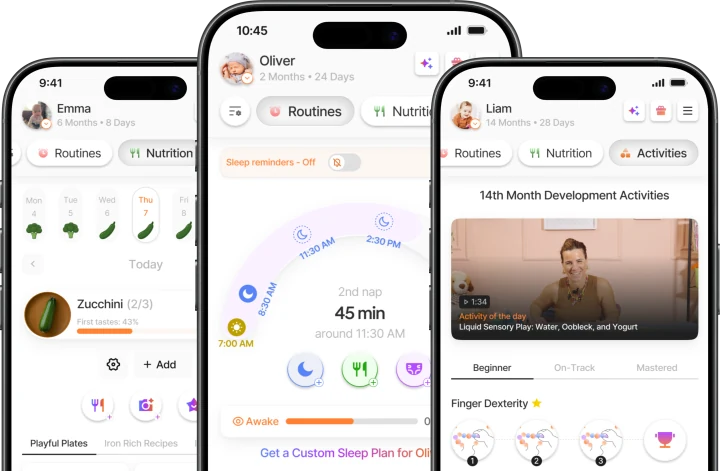
Comforting your toddler at night without introducing new sleep associations helps keep a short regression from turning into a longer-term habit. The AAP advises giving attention and reassurance rather than expecting a toddler to simply "tough it out." A quiet pat and a few calm words during a brief check-in are usually enough. Avoid starting habits you will need to undo later, like bringing your toddler into your bed for the first time. In Yuppo, you can log each night waking alongside nap times to spot whether a pattern is forming or disruptions are already fading.
Give extra practice time for new skills during the day
Practicing new walking and language skills during the day channels energy away from bedtime. Let your toddler walk, climb, and explore while awake, and narrate daily activities to feed the language explosion happening in their brain. Brief, predictable separations during the day also build confidence that you always come back, as the AAP suggests.
If sleep disruptions continue beyond six weeks with no improvement, or if your toddler consistently snores or gasps during sleep, check in with your pediatrician.

Summary and Next Steps
The regression is temporary. Most toddlers return to their previous sleep pattern within 2 to 6 weeks when routines stay steady.
Total sleep still counts. After their first birthday, toddlers generally need around 12 to 15 hours in 24 hours, including naps.
Look before you act. Check for teething signs, separation cues, and nap readiness so your response matches what is actually going on.
Try one change this week. If your toddler is fighting the second nap, push the morning nap 15 minutes later for three days and note the effect on bedtime.
Comfort without overriding their skills. Brief check-ins at night protect the self-settling ability your toddler has already built.
This content is for information only; always consult your pediatrician for diagnosis and treatment.
Tracking nap times, wake windows, and bedtime changes is hard when every night feels different. In Yuppo, you can enter your child's birth date and follow each week's expert-prepared developmental milestones alongside age-matched activity suggestions, putting the brain leaps behind these restless nights into context.
Frequently Asked Questions
Should I let my 16 month old cry it out during a sleep regression?
Cry-it-out is not required during a sleep regression. Brief check-ins, where you return to offer a quiet pat and reassuring words, can comfort your toddler while giving them a chance to resettle on their own. Choose an approach that feels sustainable for your family and stay consistent.
Can the 16 month sleep regression affect daytime naps?
Nap disruption is one of the earliest and most common regression signs. Many toddlers refuse or significantly shorten one or both naps during this phase. If the second nap is consistently disappearing, your toddler may be ready to shift to a single midday nap.
Is it okay to drop to one nap during the 16 month sleep regression?
Most toddlers transition to one nap between roughly 14 and 18 months, and a regression can speed up that shift. If your child has refused the second nap for about two weeks, consolidating to one longer midday nap is generally a reasonable step.
How much total sleep does a 16 month old need?
A 16 month old generally needs around 12 to 15 hours of total sleep in a 24-hour period, including naps. Individual needs vary, so your child's mood and energy during the day are useful guides alongside the clock.
Will the 16 month sleep regression go away on its own?
Most regressions resolve within 2 to 6 weeks without major interventions, provided routines remain consistent. The brain simply needs time to integrate new skills. If disruptions persist well beyond six weeks, a conversation with your pediatrician can help rule out other factors.
References

Yuppo Lab
Sleep Expert

Sleep
Learn 6 month sleep regression signs, likely duration, and practical ways to respond. Navigate your baby's changing sleep with Yuppo.

Sleep
Discover when sleep regressions strike and what to do at each stage, from 4 months to 2 years. Track your baby's sleep milestones with Yuppo.

Sleep
Learn why sleep regression strikes around 20 months and what you can do to help your toddler rest again. Track your toddler's sleep patterns with Yuppo.