
Key Takeaways
By the end of the first month, most formula-fed babies take at least 90 to 120 mL (3 to 4 oz) per feeding, roughly every 3 to 4 hours.
Breastfed newborns nurse on demand, averaging every 2 to 4 hours, with some cluster-feeding sessions closer together.
Lip-licking, rooting, and hand-to-mouth movements are early hunger cues that signal it is time to feed.
After the first 4 to 5 days of life, at least 5 to 6 wet diapers per day indicates your baby is getting enough.
Per-feeding volume generally rises between week 4 and week 8 as stomach capacity grows.
How much should a newborn eat depends on feeding method and shifts week by week. At 1 to 2 months, formula-fed babies typically take around 720 to 960 mL (24 to 32 oz) across a full day, while breastfed babies nurse on demand with intake guided by hunger cues. If you are up in the middle of the night wondering whether that last feeding was enough, you are not alone.
Below you will find per-feeding amounts, how often to feed your newborn, sample schedules, and practical ways to confirm your baby's nutrition is on track.

How Much Should a Newborn Eat per Feeding at 1 to 2 Months
Your 1 to 2 month old generally needs about 60 to 120 mL (2 to 4 oz) per feeding, depending on method and individual appetite. Every baby is a little different, so treat these figures as a starting guide.
Breast Milk Amounts per Feeding
Breastfed babies regulate their own intake at the breast, so per-session volume varies. The World Health Organization (WHO) recommends exclusive breastfeeding on demand for the first 6 months, nursing whenever your baby shows hunger cues. As the National Health Service (NHS) explains, a newborn's stomach is very small, so responsive feeding ensures they get what they need. If you have been searching for a chart showing how much breastmilk a newborn should eat, diaper output and weight gain are more reliable gauges than exact milliliters.
Formula Amounts per Feeding
Knowing how much formula to feed your newborn is easier to track by the bottle. In the first days, offer about 30 to 60 mL (1 to 2 oz) every 2 to 3 hours; by the end of the first month most babies take at least 90 to 120 mL (3 to 4 oz) per feeding, according to the American Academy of Pediatrics (AAP).
The table below compares estimated feeding patterns; breast milk amounts reflect expressed bottle feeds, since volume at the breast varies.
| Age & Method | Amount per Feeding | Feedings per 24 h | Approx. Daily Intake |
|---|---|---|---|
| 1 month, breast milk | ~60–120 mL (2–4 oz) if expressed | 8–12 | ~600–900 mL (20–30 oz) |
| 1 month, formula | 90–120 mL (3–4 oz) | 6–8 | ~720–960 mL (24–32 oz) |
| 2 months, breast milk | ~90–120 mL (3–4 oz) if expressed | 8–10 | ~720–960 mL (24–32 oz) |
| 2 months, formula | ~120 mL (4 oz) or more | 6–8 | ~720–960 mL (24–32 oz) |
Per-session volume rises while feeding count gradually drops as your baby approaches 2 months.

How Often Should a Newborn Eat at 1 to 2 Months
Most 1 to 2 month olds eat between 8 and 12 times in a full day, with intervals depending on feeding method and your baby's own rhythm.
Daytime Feeding Frequency
Breastfed newborns typically eat more often than formula-fed babies during the day. The Centers for Disease Control and Prevention (CDC) notes that breastfed infants nurse every 2 to 4 hours on average, and some cluster feed as often as every hour at certain times. Formula-fed infants settle into slightly wider intervals, as the CDC describes.
Breastfed: roughly every 2 to 4 hours, with possible cluster feeding
Formula-fed: roughly every 3 to 4 hours
Combined total: usually 8 to 12 sessions in 24 hours
Nighttime Feeds and When to Wake Your Baby
You may need to wake your baby for a nighttime feed if they sleep longer than 4 to 5 hours in the first few weeks, as the AAP advises. Between 2 and 4 months (or above roughly 5.4 kg / 12 lb), most formula-fed babies no longer need a middle-of-the-night feed because stomach capacity has increased, per the AAP.
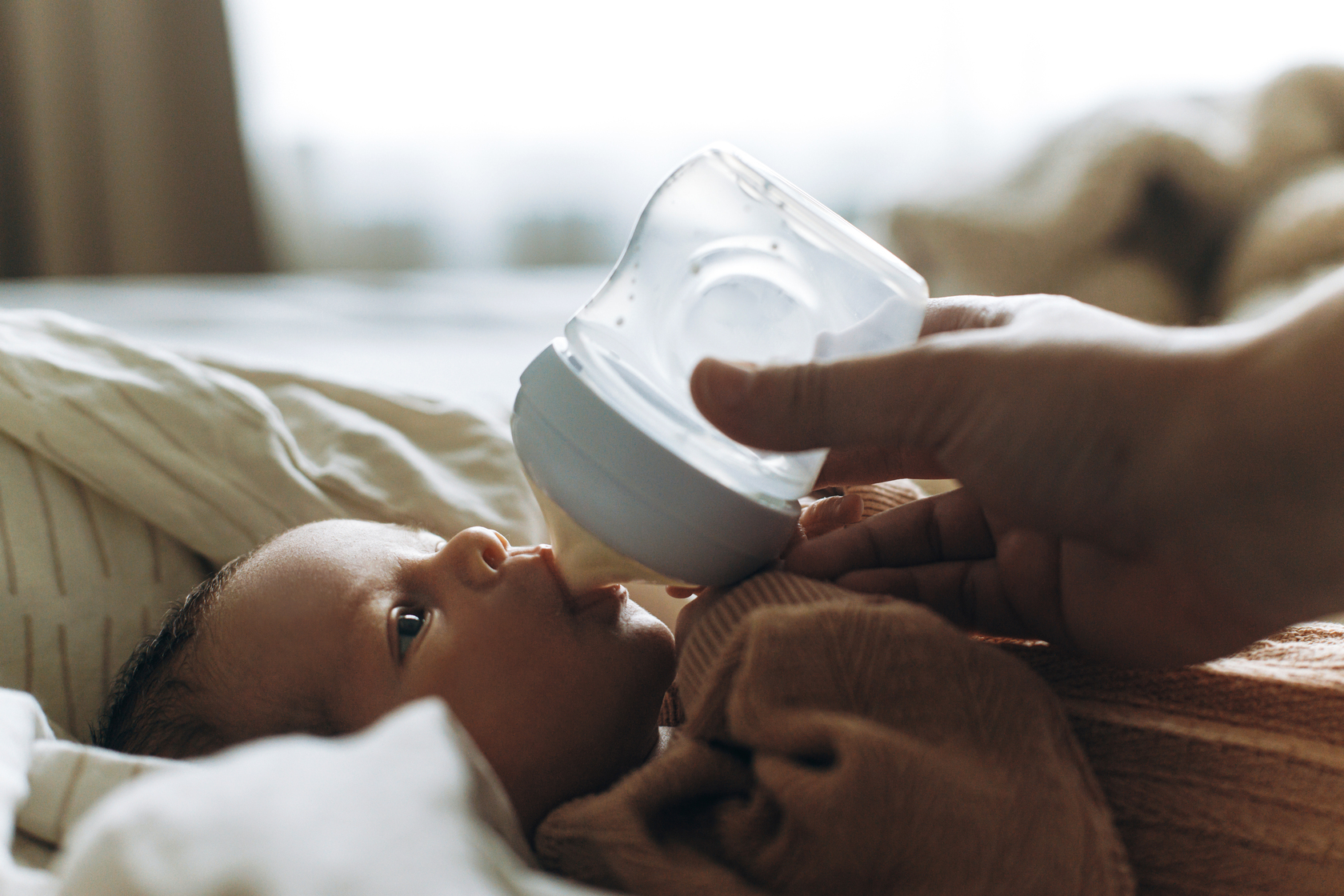
How Feeding Amounts Change from Week 4 to Week 8
Per-feeding intake rises steadily between week 4 and week 8 as your baby's stomach grows. How much a 1 month old should eat and what that same baby needs at 2 months can look noticeably different.
Week-by-Week Intake Progression
Your baby's per-feeding volume roughly doubles during the first month of life. The AAP notes that bottle-fed babies progress from about 30 to 60 mL (1 to 2 oz) in the first days to at least 90 to 120 mL (3 to 4 oz) by week 4.
A typical progression looks like this:
Weeks 1–2: ~30–60 mL (1–2 oz) per feed, 8–12 feeds daily
Weeks 3–4: ~90–120 mL (3–4 oz) per feed, 7–10 feeds daily
Weeks 5–8: ~120 mL (4 oz) or more per feed, 6–8 feeds daily
A 2-month-old who takes 120 mL (4 oz) per feeding as daily sessions drop from 10 to 8 is on a typical track. You can check whether weight gain keeps pace with a percentile calculator, and our 2-month-old baby development guide covers sleep and motor milestones during this same stretch.
Growth Spurts and Temporary Increases
Growth spurts can temporarily boost your baby's appetite for a day or two before intake levels off. Many parents notice these surges around weeks 2 to 3 and again near week 6, though exact timing varies.
Your baby may want to eat hourly during a spurt, which is perfectly normal and helps increase milk supply if you are breastfeeding. For common timing and signs, see our growth spurts guide.

Sample Feeding Schedule for a 1 to 2 Month Old
A typical feeding day follows hunger cues rather than a strict clock, whether your baby is breastfed or formula-fed.
Sample Breastfeeding Day
A breastfed 5-week-old might nurse every 2 to 3 hours during the day and cluster feed every 45 minutes each evening. That cluster often leads to a longer 3- to 4-hour sleep stretch afterward. Over 24 hours it adds up to about 10 to 12 sessions, consistent with patterns the CDC describes.
Morning through afternoon: nurse roughly every 2 to 3 hours
Evening: cluster feeds every 45 to 60 minutes
Night: one longer stretch, then back to shorter intervals
Sample Formula Feeding Day
A 7-week-old formula-fed baby might take about 90 mL (3 oz) every 3 hours during the day and stretch to 4-hour gaps at night, totaling about 7 to 8 feedings. The CDC notes you may need to gently wake a sleepy baby to keep feedings on track.

How to Tell Your Baby Is Getting Enough Milk
Diaper count and steady weight gain are the two most reliable signs your baby is eating enough.
Hunger and Fullness Cues to Watch For
Hunger cues like lip-licking, rooting, and bringing hands to the mouth appear well before your baby starts crying. The AAP lists these signals, and the CDC adds that clenched fists often mean hunger while relaxed open hands suggest fullness.
Hunger: lip-licking, rooting, hands to mouth, fussiness
Fullness: closed mouth, head turning away, relaxed hands
Diaper Output and Weight Gain Benchmarks
Your newborn should produce at least 5 to 6 wet diapers every 24 hours after the first 4 to 5 days, according to the AAP. Breastfed newborns should lose no more than about 8 to 10 percent of birth weight in the first few days and show at least 6 wet diapers daily by day 5 to 7, as the AAP breastfeeding guidance describes. The NHS adds that at least 2 soft yellow stools daily from day 4 and steady weight gain are also reassuring.
If a breastfed 6-week-old's wet diaper count drops from six to three over two days, contact your pediatrician to evaluate latch and feeding frequency. You can log your baby's weight after each checkup and view their percentile curve in Yuppo, making it easier to spot steady growth at a glance.

Common Newborn Feeding Mistakes to Avoid
The most common newborn feeding mistake is following a rigid schedule instead of your baby's hunger signals. Cue-based feeding works better for both breast and bottle.
Bottle-fed babies can take in milk faster than they register fullness, making overfeeding more likely. The AAP notes that overfed babies may have stomach discomfort, gas, or excess spitting up. Paced bottle feeding, where you hold the bottle more horizontally and pause every few minutes, helps match intake to actual hunger. The responsive cue-reading you practice now carries forward when your baby eventually starts complementary foods.
Avoid these common pitfalls:
Forcing your baby to finish a bottle when they show fullness cues
Dropping nighttime feeds before your pediatrician confirms steady weight gain
Waiting for crying instead of watching for early hunger signals
Comparing your baby's intake to another baby's; every baby has a unique rhythm
If your baby seems unusually sleepy or diaper output drops, contact your pediatrician for a quick assessment.
Summary and Next Steps
Watch for hunger cues before crying. Lip-licking, rooting, and hands to mouth are your earliest signals to start a feeding.
Expect daily intake to reach roughly 720 to 960 mL (24 to 32 oz) by 2 months, whether breast milk or formula, spread across fewer but larger sessions than at 1 month.
Track diaper output each day. Five or more wet diapers after the first few days confirms adequate intake.
Let growth spurts run their course. A day or two of extra-hungry feedings is normal and resolves on its own.
Schedule regular weight checks. Monitoring growth at pediatric visits gives the clearest confirmation that feeding is on track.
This content is for information only; always consult your pediatrician for diagnosis and treatment.
Tracking each feeding between checkups is tough on broken sleep. In Yuppo, you enter your baby's birth date and follow each week's expert-prepared developmental steps, so feeding shifts fit into the bigger picture of your baby's growth.
Frequently Asked Questions
In the first few weeks, wake your baby if they sleep longer than 4 to 5 hours, especially before birth weight is regained. Once your pediatrician confirms steady weight gain, most healthy newborns can sleep until they wake on their own.
A slight drop in feeding frequency around 2 months is common because your baby's stomach holds more per session. Your baby is simply becoming more efficient. As long as weight gain and diaper output stay steady, fewer but larger feedings are a healthy progression.
At least six wet diapers a day after the first week and steady weight gain at checkups together confirm adequate breast milk intake. Your baby should also appear alert when awake. If either measure concerns you, your pediatrician can do a quick feeding assessment.
Overfeeding is possible because drinking from a bottle takes less effort than nursing. Overfed babies may experience stomach discomfort, gas, or excess spitting up. Paced bottle feeding and watching fullness cues like head turning or relaxed hands help you match each feeding to actual hunger.
Cluster feeding, especially in the evening, is a normal pattern at this age that helps support milk supply. Many babies who cluster feed then enjoy a longer sleep stretch afterward, so daily intake usually balances out. These bursts typically ease within a few weeks.
Most 2 month olds consume roughly 720 to 960 mL (24 to 32 oz) of formula per day, spread across about 6 to 8 feedings. Your baby's exact needs depend on weight and appetite, so hunger cues remain the best daily guide.
Centers for Disease Control and Prevention. (2026). How much and how often to breastfeed. CDC.gov.
Centers for Disease Control and Prevention. (2026). Signs your child is hungry or full. CDC.gov.
National Health Service. (2023). Your breastfeeding questions answered. NHS.uk.
National Health Service. (2026). Breastfeeding: Is my baby getting enough milk? NHS.uk.