Play in Child Development: Benefits and Stages

This article is approved by Çiğdem İrem İleri
Published: 08 April, 2026
Updated: 13 August, 2026

At a Glance
Play in child development is more than fun; it is one of the most important tools for building brain development and social skills.
Sensory exploration games generally stand out from ages 0–3, while symbolic and rule-based games become more prominent between ages 3 and 6.
The American Academy of Pediatrics (AAP) recommends at least 1 hour of free play a day for healthy development.
Following your child’s lead instead of directing play supports independent problem-solving skills.
The importance of play in child development reflects a deeper developmental need than simply keeping children busy. Although many adults see it as a break for fun, play is how babies and children understand the world, solve problems, and express emotions. In this article, we cover the stages of play for parents who find it difficult to set up play at home or wonder whether they are offering the right stimulation. You’ll learn how play affects mental skills and social awareness, what to expect at different ages, and how you can support the process as a parent.


What is play in children, and why is it a basic need?
Play is not just entertainment; it is a basic developmental need that children initiate to explore the world, process emotions, and try new skills. According to the World Health Organization (WHO), play that includes physical and mental activity is essential for healthy brain development in early childhood, and an average of 180 minutes of varied activities a day is recommended. Like nutrition, different types of play are among the main stimuli that support the nervous system.
Babies figure out physical rules by putting objects in their mouths or dropping them and listening to the sound they make. Free play is especially important during this process; moments that are not bound by parental rules allow children to take initiative. The answer to the question of what different types of play are and why they matter is that play is a child’s first channel of communication with the outside world. Every attempt and mistake helps build self-confidence.
Benefits of play for children and developmental gains
Playing is a comprehensive way to prepare children for life by engaging language, motor, cognitive, and emotional development at the same time. From infancy, reaching for objects or putting simple blocks together naturally develops fine motor skills and hand-eye coordination. Gross motor muscles become stronger through physical play such as climbing and running.
Strengthening mental and cognitive skills
Mental and cognitive skills become stronger during play through trial and error, making cause-and-effect connections, and developing strategies. Developmental psychologist Jean Piaget argued that children organize the experiences they gain while playing in their minds and turn them into schemas. For example, when an average 9- to 12-month-old baby drops the same toy repeatedly, this is not stubbornness. It is an early “action-reaction” experience: the baby notices that the movement has an effect, the toy falls and makes a sound, and you bring it back.
The benefits of educational games include longer attention spans and the ability to consider different variables together. These simple cognitive games lay the foundation for academic learning later on. Since every child processes these concepts at their own pace, focusing on the process rather than the outcome supports development.
Developing social and emotional awareness
Social and emotional awareness develops as children take on different roles during play, express themselves, and understand other people’s feelings. Developmental theorist Lev Vygotsky described play as the strongest social setting for moving a child’s current developmental potential to the next level and building empathy.
When children create pretend home or grocery-shopping scenarios, they safely revisit events they have witnessed in everyday life. They learn to wait their turn, share, cope with disappointment, and read another person’s emotional response in the middle of social play. Their first conflict-solving strategies are tested on the play mat.
Stages of play development by age
Children generally move step by step from simple sensory exploration to group games that involve complex social rules. It is important to remember that every baby develops at their own pace; variation in developmental milestones is part of the normal range.
Age Range | Dominant Type of Play | Parent’s Role |
|---|---|---|
0–12 months | Motor exploration and sensory-focused play | Provide a safe space and engage through facial expressions and sounds |
1–3 years | Independent and parallel play | Set safe boundaries, observe from a distance, and stay involved in the process |
3–6 years | Symbolic and rule-based play | Encourage peer communication and respect imaginative scenarios |
These stages can help parents adjust expectations and avoid pressuring children.
0–3 years: The exploration and sensory play stage
During the exploration and sensory play stage from 0 to 3 years, babies learn physical rules by experiencing sounds, textures, and tastes in their surroundings through their five senses. Bringing objects to the mouth and dropping them become more frequent around 4–8 months, while sensory play practices become more noticeable around 12–18 months.
Playing with water or painting with yogurt stimulates the brain’s synaptic connections. Play development in babies does not require expensive toys; plastic containers in the kitchen can be excellent tools for exploration. As they approach age 2, children show creativity by using objects in ways other than their intended purpose.
3–6 years: The symbolic and rule-based play stage
During the symbolic and rule-based play stage from 3 to 6 years, children create imaginary scenarios in which objects represent different things and move toward systems that require taking turns. Around age 3, children often begin pretend play scenarios and take on roles such as feeding a toy.
As emphasized by the Montessori educational philosophy, offering open-ended materials during this period supports adaptation. From around ages 4–5, rules begin to accompany imaginative scenarios. Children start moving toward games such as hide-and-seek and board games, which require waiting their turn and tolerating losing.
Common mistakes parents make when playing with their child
When playing with your child, avoid constantly directing the process, imposing rigid rules, or trying to turn every moment into an educational lesson. Many parents take control because they believe play must be “productive,” which can prevent children from finding their own solutions. In reality, the parent’s role in play is less that of a teacher and more that of a guide visiting the world the child has created.
Filling the room with too many stimuli or offering toys that are not age-appropriate can quickly lead children to lose interest. Following your child’s lead instead of interfering with their imagination supports independence. When you are unsure what materials to offer at home, Yuppo’s developmental analysis can identify the level at which your child is performing skills and add activity suggestions suited to that specific level, using simple household items, to your routine.
When should you consult a professional about play skills or lack of interest?
If your child does not play or seems uninterested in toys, this is usually an individual developmental difference; however, some communication gaps may require an expert assessment. It can take children months to move into certain stages of play, and that is normal. Still, bringing you a toy or looking in the direction you are looking (joint attention) is a foundation of healthy communication.
The American Academy of Pediatrics (AAP) considers not playing with toys according to their function by age 2, or making repetitive movements with only one part of a toy, a sign that should receive a comprehensive evaluation. When you notice signals like these, asking your doctor for advice without becoming alarmed is a reliable next step.
Summary and next steps
Make room for free play for children: Give your child space for an average of 30–45 minutes a day to play without intervention and set their own rules.
Let your child lead: This week, try not to direct one of your play sessions; simply follow the scenario your child starts.
Add more open-ended materials: Instead of expensive toys, place items such as plastic containers, cardboard boxes, or homemade dough where your child can reach them.
Keep expectations flexible: Remember that every game does not have to teach something; even laughing together on the floor is a wonderful developmental step.
When should you call the doctor?
Every child develops at a different pace, but you should consider speaking with your child’s pediatrician in the following situations:
Between 12 and 15 months: Your child does not respond to interactive and imitation games such as peekaboo (this interest generally begins between 6 and 9 months).
By 18 months: Your child does not engage in simple pretend play, such as pretending to drink from an empty cup.
In children older than 24 months: Your child shows a persistent, intense interest in only one part of a toy, such as a spinning wheel, rather than playing with the toy as a whole.
By 36 months: Your child shows no interest in other children or their play, including parallel play in the same setting, or rejects attempts to communicate.
This content is for informational purposes only; always consult your child’s pediatrician for diagnosis and treatment.
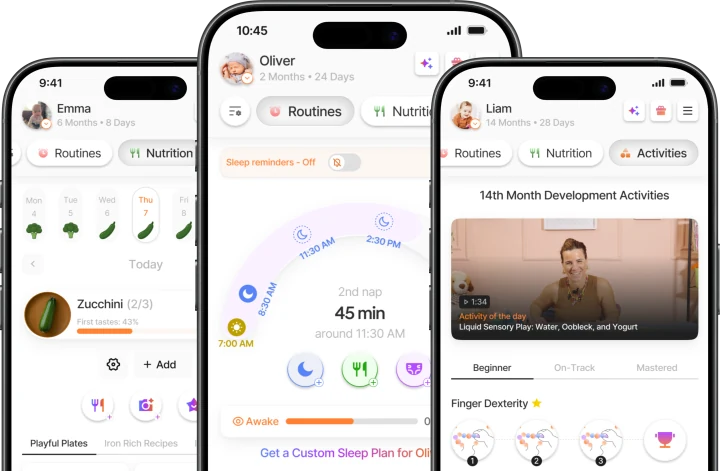
If you want to regularly track your baby’s play habits, changing interests month by month, and development so you can prepare an environment suited to their current level, you can try the Yuppo app for free.
In Yuppo’s activity module, you can record not only whether your child can perform a skill but also the level at which they achieve it. You can then start using practical play plans created specifically for that level and built around materials that are easy to find at home.
Frequently Asked Questions
When do babies start playing intentionally?
Babies usually begin intentionally interacting with toys and their surroundings between 3 and 6 months. Discovering their hands and bringing objects to their mouths are early steps in play. As the months pass, these interactions develop into an understanding of cause and effect.
Why does my child want to play the same game over and over?
Wanting to repeat the same game comes from the brain’s need to strengthen a skill and build a sense of security. These repetitions are common during developmental stages and help newly learned concepts become lasting mental schemas.
How does free play support child development?
Free play lets children create their own rules and strengthens independent problem-solving skills. Time spent without adult restrictions supports cognitive areas such as initiative, creativity, and self-confidence.
Can play development be supported without toys?
Yes. Facial expressions, your tone of voice, and safe kitchen items can support play development without toys. Especially during infancy, social games with a parent, such as peekaboo, can offer more benefit than expensive materials.
Is it normal for a child to play alone?
It is normal and beneficial for a child to spend time alone and create play independently; this can strengthen their attention span. Until around ages 2–3, many children may prefer parallel play alongside others without directly interacting with them.
References

Dr. Çiğdem İrem İleri
Developmental Psychologist
After graduating from Koç University in 2019 with a double major in Psychology and Media and Visual Arts, alongside track programs in Design, Gender Studies, and Media and Management, Çiğdem İrem İleri began her integrated doctoral studies in Developmental Psychology at the same institution that same year.