Playing With Your Child: Benefits, Ideas, and Bonding Tips

This article is approved by Yuppo Lab Play Therapist
Published: 18 August, 2026
Updated: 18 August, 2026

Highlights
Playing with your child is one of the most important ways they safely explore the world and build a strong bond with their parents.
Most babies begin creating symbolic and pretend play between 18 and 24 months. During this process, parental involvement gives their cognitive development a boost.
A child-led play approach nurtures both confidence and independent problem-solving skills by following the child's lead.
When parents remain engaged companions rather than constantly directing play, they expand children's opportunities for free exploration.
The importance of playing with your child lies in how it deepens your relationship while supporting physical and emotional development. Sitting on the floor after a tiring day and lining up the same blocks again and again can feel challenging for many parents. Still, play is your child's primary language for communicating with you. In this article for parents of children ages 0-6, you'll learn about the developmental impact of play, child-led play strategies, and ways to connect even when you have limited time at home.


In Brief: The Power of Play in the Parent-Child Relationship
The main benefits of play for children include encouraging secure attachment, reducing daily stress, and supporting social-emotional skills that typically accelerate between ages 3 and 5. Play gives children a safe space where they can practice navigating a complex world while staying in control. From interactive games like peekaboo in infancy to rich pretend scenarios in the preschool years, each step strengthens trust between parent and child. According to the World Health Organization (WHO), responsive and interactive play practices help build the foundations for lifelong mental health. Even when your busy schedule leaves you feeling low on energy, setting aside 15-20 minutes of uninterrupted play during the day can be enough to repair and keep your relationship strong.

Why Does a Parent's Role in Play Matter?
When mothers and fathers actively participate in play, children feel safe trying new things and are often better able to build a strong foundation for developmental milestones. Children use their parents' facial expressions and reactions like a mirror to understand the world. When you join the play they have created, you validate their efforts and show in a concrete way that you value their inner world.
Building Social and Emotional Skills
Playing with a parent directly supports essential social and emotional skills, including emotional regulation, empathy, and coping with frustration. Children between ages 2 and 4 often have difficulty expressing complex emotions in words, and play provides an ideal setting for expressing those feelings safely. For example, comforting a fallen stuffed bear lets them experience compassion and cooperation. Small disagreements during play and attempts to wait for a turn are also early steps toward the social adjustment they will need at school. You can learn more about these topics in our article on emotional intelligence development.
Growing Language and Cognitive Skills
Rich conversations from a parent who joins in play, along with gentle problem-solving prompts, can significantly expand a child's vocabulary and cognitive skills. Describing actions during play or asking open-ended questions such as “Where do you think this car is going?” encourages language development naturally. The American Academy of Pediatrics (AAP) emphasizes that free play helps children develop higher-level cognitive skills such as problem-solving, flexible thinking, and creativity. Giving your child a chance to solve a challenge independently is one of the most effective ways to support mental resilience.
How Can Playing With Your Child Build a Strong Bond?
To strengthen your connection during play, remove distractions, get down to your child's physical level, and follow their cues. The effect of time together depends less on how many hours it lasts than on the quality of your interaction in that moment. Short periods with your phone left in another room and your full attention on eye contact clearly tell your child, “I'm here, I see you, and I'm interested.”
A Child-Led Play Approach
Child-led play is an approach in which parents step away from the role of teacher or rule-maker and fully adapt to the materials their child chooses and the direction they set. The goal is not to teach a particular skill but to share the moment and have fun. Parents often want to show how to complete a puzzle correctly. If a child prefers to use a puzzle piece as a dinner plate, however, following their lead supports their sense of autonomy. When you let them take control of the toys, you also get a closer look at their inner world.
Active Listening and Joint Attention
Focusing on the object or event that interests your child and responding sensitively to their verbal or nonverbal messages builds joint attention and active listening during play. Beginning in infancy, pointing and focusing on the same object—usually around 9 to 12 months—form the foundation of joint attention. When your child excitedly shows you a rock, sharing that feeling by saying, “Yes, what a shiny, smooth rock!” helps them feel understood and strengthens your bond.

What Play Strategies Support Child Development?
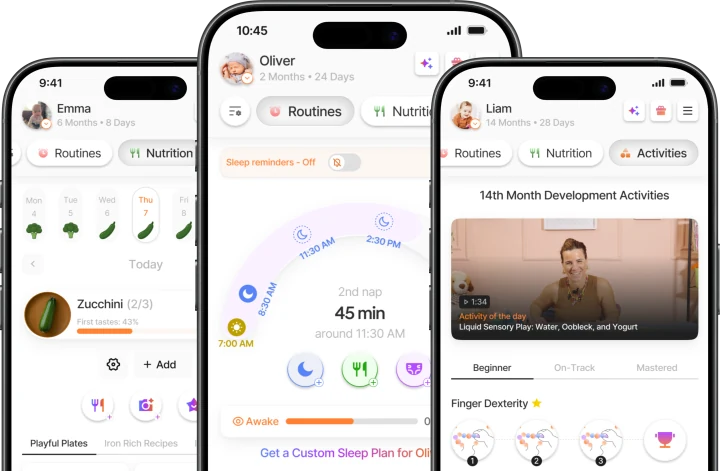
To better support development, choose play methods that allow age-appropriate free exploration, use open-ended materials, and praise the process rather than the result. Play activities for child development have no single correct answer and grow with a child's imagination. If you're having trouble choosing activities suited to your baby's potential and developmental stage, Yuppo's developmental analysis can assess your child's cognitive and motor skills not only by whether they can perform a skill, but also by their level of performance. Based on the results, you can receive a plan of expert-approved activities prepared with materials that are easy to find at home.
The table below summarizes the play strategies children generally tend toward at different ages and the areas of development these activities support:
Age Range | Recommended Play Strategy | Developmental Area Supported |
|---|---|---|
0-12 months | Face-to-face peekaboo, exploring safe textured objects | Secure attachment, sensory integration |
1-3 years | Building towers with empty boxes, stacking blocks, pouring water | Fine motor skills, cause-and-effect relationships |
3-6 years | Pretend play (doctor, house), open-ended art activities | Social-emotional development, empathy, and language skills |
Although the age ranges in this table reflect general expectations, remembering that every baby and child develops at their own pace is key to supporting development without stress. For more information, see our article on different types of play.
Common Mistakes to Avoid During Play
Common mistakes when playing with your child include trying to direct the play constantly, using competitive language, and insisting on teaching a lesson at every opportunity. Play is rooted in freedom. When parents well-meaningly interrupt with comments such as, “No, that piece doesn't go there. Look, this is how you fit it,” they take away the chance to solve problems through trial and error. Likewise, repeatedly asking questions such as “What color is this?” or “How many cars are here?” instead of joining the child's play can turn it into a test. Describing what your child is doing in a neutral but engaged tone is much more supportive.
When Should You Consult a Professional About Social and Emotional Development?
Extreme withdrawal during play, rigid attachment to routines, or consistently using toys in repetitive ways unrelated to their intended function are behaviors that generally warrant professional evaluation. Every child approaches play differently. Some children enjoy playing alone for long periods, while others seek constant interaction. However, prolonged indifference to invitations to play from peers or parents may make it helpful to speak with a child development professional early on. For more comprehensive information about child development red flags, see our article on early signs of autism.
Summary and Next Steps
Play as a way to connect: Play is the most natural way to communicate with your child. This week, try putting your phone away and joining a child-initiated game for at least 15 minutes once a day.
Let your child lead: Follow rather than direct the play. During your next playtime, let your child set all the rules to support autonomy and problem-solving skills.
Loosen expectations: Play does not always have to be educational or tidy. Enjoy the process by making room for mess and scenarios that may seem illogical.
Developmental differences: Avoid comparing the way your child plays with other children. Remember that every child has their own interests and pace of development, and accept them as they are.

When Should You Call the Doctor?
If you notice clear regression in your child's social, emotional, or motor development or prolonged breaks in communication, contact your pediatrician for an evaluation. Although every child develops at their own pace, it is important to consult your doctor if you observe any of the following:
Not responding when called by name or completely avoiding eye contact with a parent after passing the average 12-15-month range.
Sudden and lasting loss of previously acquired social skills, such as playing peekaboo, waving, pointing, or using words.
Spending hours making repetitive, restricted movements, such as only spinning a toy car's wheels instead of using toys as intended, such as driving the car.
Showing no attempt to participate in simple pretend or shared play with a parent or peers by 18-24 months.
This content is for informational purposes only. Always consult your child's pediatrician for diagnosis and treatment.
Making the most of playtime with your child in a way that suits their developmental stage can sometimes become a process where you need guidance. In the Yuppo app, you can track your baby's developmental milestones weekly and view activity suggestions prepared by experts for their current skill level. To make your time together richer with activities you can easily do using simple materials at home, try the Yuppo app for free.
Frequently Asked Questions
How much playtime does my child need each day?
There is no set amount of time you must play with your child each day, but uninterrupted, fully focused periods of about 15-20 minutes are generally considered enough to support secure attachment. Focusing on quality rather than quantity helps your child receive the attention they need while helping you manage feelings of exhaustion.
How can I join in when my child's game feels boring?
To join a game that feels boring to you, add small roles that you also find entertaining or set a time limit from the start to manage your expectations. Saying, “I'll play house with you for 15 minutes, then I need to rest,” while respecting your own limits is honest and healthy for the relationship.
Is it normal for my child to always want to win?
Always wanting to win is quite common, especially for children ages 3 to 5, as part of healthy ego development and testing boundaries. Sometimes letting your child win, and sometimes gently modeling that losing is a normal experience, can help you find a healthy balance.
Should I direct my child's play or simply observe?
Rather than constantly directing play, parents are generally encouraged to remain active participants or interested observers who follow the child's lead. Giving your child control helps develop problem-solving skills while allowing you to be a secure base who offers support when needed.
When can I start playing with my baby?
You can start interactive play in the first weeks after birth with simple activities such as copying facial expressions and talking gently. Around 3-6 months, babies usually become more active participants as they reach for objects and respond to interactions such as peekaboo with giggles.
References
Yuppo Lab
Play Therapist