
Key Takeaways
Your 2-week-old can focus about 20 to 30 cm (8 to 12 in) away and already prefers high-contrast patterns and human faces.
Reflexes like rooting, Moro, and palmar grasp are fully active during week 2 and fade gradually over the coming months.
Breastfed newborns generally nurse around 10 to 12 times in 24 hours, while bottle-fed babies typically eat every 2 to 3 hours.
Your baby spends much of the day and night asleep, waking in short stretches of a few hours at a time.
Cluster feeding in the evening, brief fussy periods, and jerky limb movements are all typical during the second week.
Most of your 2-week-old baby's development right now centers on regaining birth weight, relying on built-in reflexes, and beginning to process the world through still-maturing senses. Each tiny response, from gripping your finger to turning toward your voice, signals a brain growing at a remarkable pace.
If you're cycling between feedings on very little sleep, those quiet moments of holding and gazing at your baby matter more than they may feel like at 3 a.m. Below you'll find what to expect from your 2-week-old baby in terms of physical changes, reflexes, feeding patterns, sleep rhythms, and simple activities that shape your newborn's second week. Every baby moves at their own pace, so treat the ranges here as guideposts, not deadlines.

Baby growth in week 2: weight, head shape, and fontanelle
Your baby's weight, length, and head shape are all shifting during week 2, and each pediatrician visit helps confirm the overall trend.
Typical weight and length ranges
Most newborns lose some weight in the first days and typically regain their birth weight by around day 10 to 14. From there, growth follows a steady upward curve. According to UNICEF, newborns double their birth weight within the first six months, so every feeding session is fueling real progress.
At the two-week checkup your pediatrician will usually assess:
Weight compared to birth weight
Head circumference
Feeding pattern and diaper output
In Yuppo, you can log weight, height, diaper changes, and feedings, then review the recorded patterns with your doctor. A consistent upward trend matters much more than any single number, and every baby follows a slightly different growth curve.
Head shape, skin changes, and fontanelle
Your baby's head may still look slightly elongated or uneven after a vaginal delivery. The American Academy of Pediatrics (AAP) explains that a newborn's skull is made of soft bony plates that can compress and overlap during birth, a process called molding. The shape typically rounds out over the next several weeks, so don't be surprised if one side still looks a bit different from the other.
You'll also notice one or two soft spots called fontanelles, normal gaps that allow the brain to grow rapidly throughout the next year, as the AAP notes. A tough membrane protects them, so gentle everyday handling is safe.

2 week old baby milestones: reflexes and senses
Your 2-week-old already has a full set of built-in reflexes that support feeding, self-protection, and early bonding with you.
Rooting, sucking, and grasp reflexes
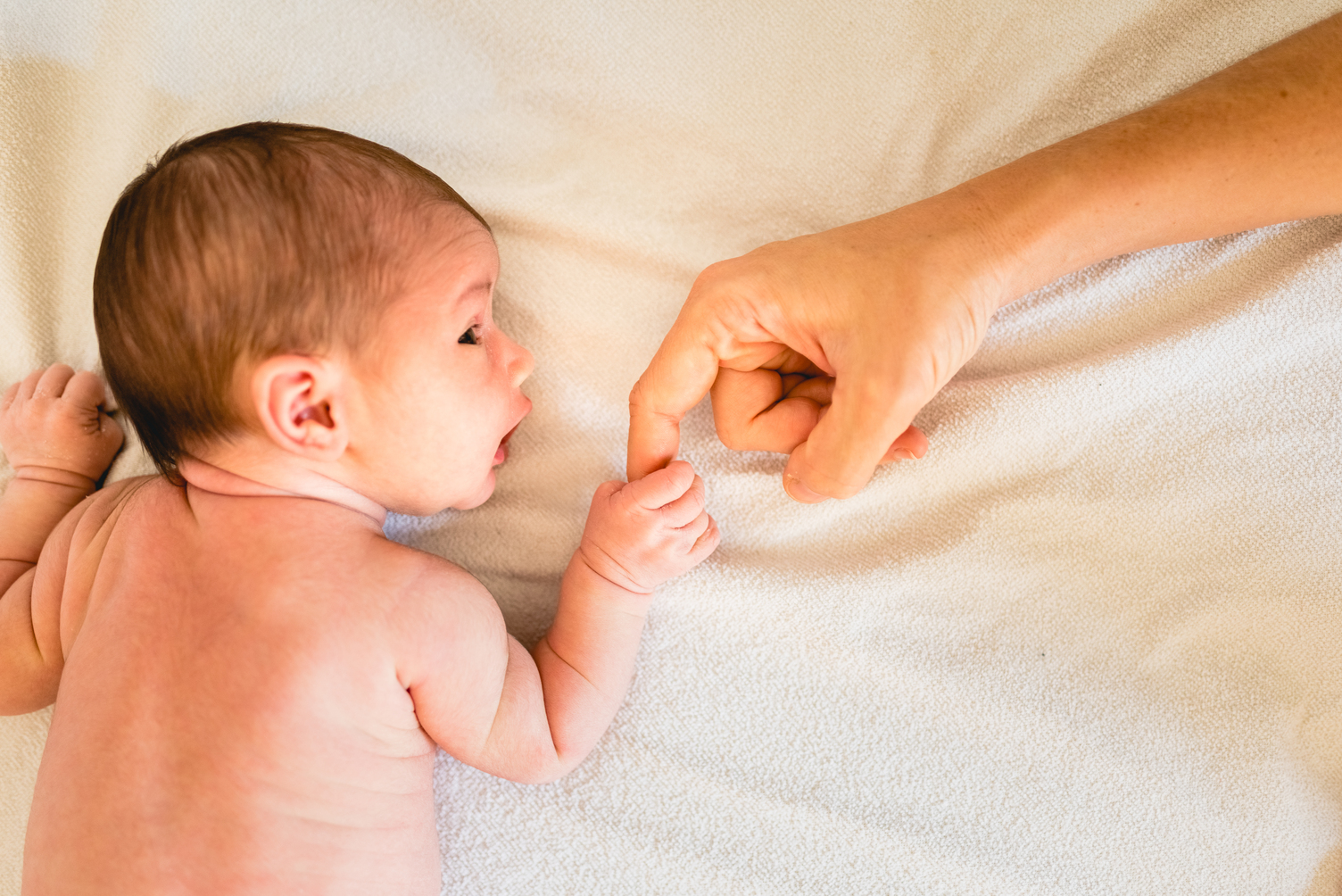
The rooting reflex causes your baby to turn toward a touch on the cheek and open their mouth, guiding them to the breast or bottle. According to the AAP, it appears at birth and generally fades around 4 months. The palmar grasp is closely linked: stroke your baby's palm and their fingers will curl tightly around yours, sometimes with surprising strength.
Moro and stepping reflexes
A sudden noise or shift in head position triggers the Moro reflex, sending arms and legs wide. You may notice your baby startle when a door closes, throwing both arms out before pulling them back in with a brief cry. The AAP notes the Moro reflex peaks during the first month and starts to disappear after about two months. The stepping reflex is also visible: hold your baby upright with feet touching a surface, and they may lift each foot in a walking-like motion.
| Reflex | What You See | When It Typically Fades |
|---|---|---|
| Rooting | Turns toward cheek touch, opens mouth | Around 4 months |
| Palmar grasp | Fingers curl around your finger | Around 5 to 6 months |
| Moro (startle) | Arms and legs extend outward | Around 2 months |
| Stepping | Feet lift in walking motion | Around 2 months |
These reflexes are among the earliest newborn second week milestones and show that the nervous system is responding well.
Vision, hearing, and smell at 2 weeks
Your baby can focus on objects roughly 20 to 30 cm (8 to 12 in) away, about the distance to your face during a feeding. The AAP confirms that newborns prefer black-and-white or high-contrast patterns and human faces. Your baby may briefly lock eyes with you, then look away after a few seconds to rest their visual system. Eyes may occasionally wander or drift, which is typical at this age.
Hearing is already fully mature: your baby can recognize and turn toward familiar voices, according to the AAP. Smell is well-developed too, with newborns preferring sweet scents and recognizing the scent of their own mother's breast milk.
How feeding and sleep shape 2 week old baby development
Feeding and sleep fill nearly every hour of your 2-week-old’s day, both running in short, frequent cycles. Knowing what to expect can help you feel more prepared for this round-the-clock rhythm. Still, keeping track of feeding times and sleep stretches is harder than it sounds when days and nights blur together. With Yuppo, you can log each sleep, feed, and wake window, making it easy to spot your baby’s natural daily rhythms.
Breastfeeding and formula feeding frequency
Breastfed newborns generally nurse about 10 to 12 times in 24 hours, roughly every 2 hours from the start of one feeding to the next, according to the AAP. Bottle-fed newborns typically eat every 2 to 3 hours, with at least 8 sessions recommended per day. Your baby's pediatrician is the best guide for how much to offer at each session.
Breastfed: roughly every 2 hours, about 10 to 12 sessions per day
Bottle-fed: roughly every 2 to 3 hours, at least 8 sessions per day

Sleep totals and short wake windows
Most 2-week-olds spend much of the day and night sleeping, often in stretches of 2 to 3 hours. Your baby doesn't yet distinguish day from night, so wake-ups happen at unpredictable intervals. Wake windows are often only 45 to 60 minutes, meaning sleepy cues tend to appear soon after a feeding ends.
Cluster feeding and growth spurts
Cluster feeding happens when your baby wants to nurse every 30 to 45 minutes for a few hours, most commonly in the evening. Your baby may seem hungry right after a feeding and want to latch again within minutes.
This pattern helps stimulate milk production and is not a sign of low supply. A typical evening episode may last two to three hours before a longer sleep stretch follows. You can learn more about how feeding intensity shifts over time in our guide to baby growth spurts.
Why your 2-week-old seems fussier and what helps
Many babies become noticeably fussier in the second week compared to the sleepy first days at home, and this shift is a normal part of growing alertness.
Common causes of second-week fussiness
Increased alertness paired with an immature digestive system and sensory overload can trigger longer crying bouts. The AAP notes that movements during the first weeks are mostly reflexive and jerky, meaning even a baby's own startles can wake or upset them. A late-day spike in crying is one of the most common patterns at this age.
Soothing techniques that work at this age
Swaddling, white noise, gentle rocking, and non-nutritive sucking can all help calm a fussy 2-week-old. The AAP recommends sounds that mimic the womb, such as a white-noise device or the hum of a fan, along with calming motions like walking with your baby in a carrier.
Swaddle snugly in a thin blanket to recreate the womb's snug feeling.
Play white noise or a heartbeat recording at a low, steady volume.
Rock or walk gently with your baby held against your chest.
Offer a pacifier or help your baby find their fingers for comfort sucking.
Soft lullabies can also become part of a calming evening wind-down. If your baby does not respond to loud sounds, shows no interest in feeding over several consecutive sessions, or becomes unusually difficult to wake, reach out to your pediatrician.

Everyday activities to support 2 week old newborn development
Simple daily interactions like holding, talking, and brief tummy-time sessions are the most effective tools you have for supporting your baby's development right now.
Tummy time and skin-to-skin contact
Supervised tummy time can start from your first days home, even in sessions as short as 1 to 2 minutes. The AAP recommends placing your baby in different positions so they see the world from new angles, and tummy time on your chest counts. During a short session, your baby might lift and turn their head just enough to switch cheeks, an early sign of developing neck strength.
Skin-to-skin contact supports temperature regulation and strengthens your bond. If you're building a newborn essentials checklist, a comfortable spot for skin-to-skin after feedings is one of the simplest additions.
Talking, singing, and eye contact
Your voice is one of the most powerful tools for your 2-week-old's social and language development. The AAP encourages imitating your baby's coos and having back-and-forth "conversations," which form the basis of early social language skills.
Hold your face close during alert moments for brief eye contact.
Imitate any small sounds your baby makes.
Narrate what you're doing during diaper changes or feedings.
As your baby approaches 1 month, you'll notice slightly longer alert periods that make these interactions even more rewarding. You can enter your baby's birth date in Yuppo to see expert-prepared developmental steps for each week, along with age-matched activity ideas for tummy time and face-to-face play.
Summary and Next Steps
Birth weight recovery typically happens by around day 10 to 14, with steady gain afterward showing that feedings are doing their job.
Active reflexes signal healthy progress: rooting, palmar grasp, Moro, and stepping are all visible at 2 weeks and fade on their own schedule.
Follow your baby's feeding cues: roughly 10 to 12 breastfeeding sessions or at least 8 bottle feedings per day, with evening cluster feeding being normal.
Try 1 to 2 minutes of tummy time today, on your chest or a flat surface, to begin building neck and shoulder strength.
Your voice and your face are the best stimulation your baby needs during feedings, diaper changes, and quiet alert windows.
This content is for information only; always consult your pediatrician for diagnosis and treatment.
By the second week, your baby is slowly waking up to the world, but figuring out what’s typical can still feel overwhelming when every day brings something new. With Yuppo, simply enter your baby’s birth date to unlock an expert-crafted, week-by-week guide—so you know exactly which reflexes, sensory changes, and milestones to look for next.
Frequently Asked Questions
Most newborns regain their birth weight by around day 10 to 14, then tend to gain roughly 150 to 200 g (5 to 7 oz) per week. UNICEF notes that babies typically double their birth weight within the first six months. A consistent upward trend matters more than hitting an exact weekly figure.
Your baby can focus on objects about 20 to 30 cm (8 to 12 in) away, roughly the distance to your face while feeding. The AAP notes that newborns prefer high-contrast patterns and human faces, so close face-to-face time is your baby's favorite visual experience right now.
Frequent nighttime feeding is common at this age, especially during cluster-feeding episodes. Breastfed newborns generally nurse about every 2 hours, but shorter bursts are normal and help build milk supply. If your baby is gaining weight and producing enough wet diapers, the pattern usually evens out gradually.
A 2-week-old generally sleeps much of the day and night, often somewhere around 14 to 17 hours total in short stretches. Day-night confusion is typical, so expect wake-ups around the clock. Sleep patterns become more organized over the coming weeks.
Supervised tummy time can begin as soon as your first days home. The AAP suggests placing your baby in different positions early on to support development. Even 1 to 2 minutes on your chest or a flat surface helps build early neck and shoulder strength.
American Academy of Pediatrics. (2019). Newborn Reflexes. HealthyChildren.org.
American Academy of Pediatrics. (2020). Your Baby's Head. HealthyChildren.org.
American Academy of Pediatrics. (2019). Movement Milestones: Birth to 3 Months. HealthyChildren.org.
UNICEF. (n.d.). Your baby's developmental milestones at 2 months. UNICEF Parenting.