
Key Takeaways
Your baby can generally focus on faces from about 20 to 30 cm (8 to 12 in) away during week 3 and is drawn to high-contrast patterns and human faces.
The Moro reflex typically peaks during the first month, and most reflexive movements remain active at 3 weeks.
Breastfed newborns usually nurse about 10 to 12 times in 24 hours, while bottle-fed babies eat roughly every 2 to 3 hours.
Most newborns at this age sleep an estimated 14 to 17 hours in 24 hours, broken into short stretches.
Three weeks in, you may be wondering which 3 week old newborn milestones are actually on track. At this stage most newborns display active reflexes, briefly focus on faces at close range, and respond to familiar voices. Feeding sessions are frequent, sleep still comes in short bursts, and alert windows are slowly stretching. Below you'll find what to expect across reflexes, growth, senses, feeding, and sleep during the newborn period's third week, along with simple ways to support your baby at home.

What 3-week-old newborn milestones should you look for?
Your baby's milestones at three weeks center on reflexes, brief visual focus, and early responses to familiar voices. The AAP notes that many of a baby's movements in the first weeks happen involuntarily, which is a sign that the nervous system is developing well.
| Developmental Area | What You May Notice | Typical Range or Frequency |
|---|---|---|
| Motor / Reflexes | Moro (startle), rooting, stepping, tonic neck | Strong throughout the first month |
| Vision | Brief gaze on faces and high-contrast images | Focus at 20–30 cm (8–12 in) |
| Hearing | Turns toward familiar voice, startles at loud sounds | Fully maturing by one month |
| Feeding | Frequent nursing or bottle sessions | 8–12 feeds per 24 hours |
| Sleep | Short stretches, brief alert windows | Roughly 14–17 hours total |
These newborn milestones at 3 weeks are guides rather than strict deadlines, and each baby moves at their own pace.
Motor responses and newborn reflexes
Reflexes drive nearly all of your 3-week-old's movement right now. The Moro reflex, that dramatic startle where both arms fling outward, peaks during the first month and starts to fade after about two months, per the AAP. You may notice it when you lower your baby quickly into the bassinet or a sudden noise catches them off guard.
Other active reflexes at this age:
Tonic neck (fencing) reflex: the head turns to one side and the same-side arm straightens while the opposite arm bends, as the AAP describes.
Stepping reflex: walking-like leg movements when feet touch a flat surface, typically disappearing around two months and returning later as learned walking, per the AAP.
Rooting reflex: turning toward a touch on the cheek to seek the breast.

Early social cues and alertness
Alert periods gradually lengthen during week 3, often reaching roughly 45 to 60 minutes at a stretch. During these windows your baby may briefly lock eyes with you or go quiet at the sound of a familiar voice. The AAP explains that babies prefer the human voice over other sounds, associating the voices they hear most with warmth, food, and comfort.
How much should a 3-week-old weigh and grow?
Most 3-week-olds are on a steady upward growth curve, and your pediatrician tracks the trend at well-baby visits. As your baby approaches 1-month-old development, the curve will continue to shift.
Typical weight and length ranges
Many newborns gain roughly 150 to 200 g (5 to 7 oz) per week at this age, though individual patterns vary with birth weight and feeding method. A practical daily check at home is diaper output: after the first 4 to 5 days of life, your baby should produce at least 5 to 6 wet diapers a day, which signals adequate intake, as the AAP notes.
Signs that feeding is on track:
Consistent wet diapers (5 or more daily after the first few days)
A steady weight trend confirmed at checkups
Your baby settling after feeds
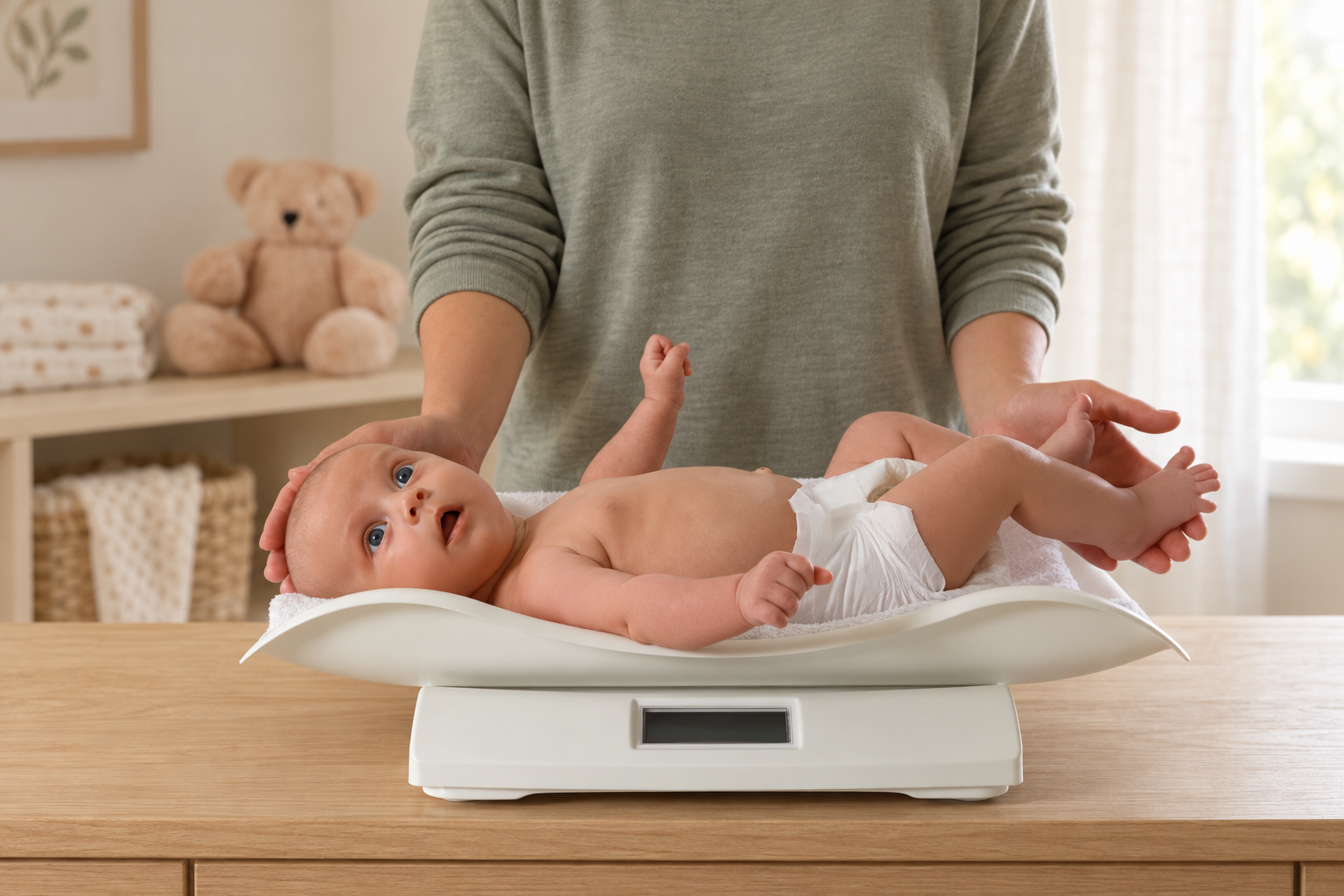
Understanding the 3-week growth spurt
A growth spurt around week 3 is something many parents notice when their baby seems hungrier than usual for a day or two. For breastfeeding parents, responding with on-demand feeds helps signal the body to increase supply. The uptick in appetite generally resolves within a few days, and baby growth spurts tend to recur at predictable intervals throughout the first year.
How your 3-week-old sees, hears, and begins to connect
Your baby's senses sharpen rapidly at three weeks, with vision limited to close range and hearing nearly mature. These developing channels are how your baby starts to piece together who you are.
Vision and focus distance
A baby approaching one month can focus on objects roughly 20 to 30 cm (8 to 12 in) away, per the AAP. That is about the distance between your face and your baby's eyes during a feed. Your baby prefers black-and-white or high-contrast patterns and is especially drawn to human faces, as the AAP notes. Eyes may still wander or occasionally cross, and that is typical.
When you hold a high-contrast card about 25 cm (10 in) away, your baby may fix their gaze on it briefly and track it a few degrees before looking elsewhere.
Sensory highlights during week 3:
Prefers faces and bold black-and-white images
Focus range is roughly 20–30 cm (8–12 in)
Eyes may drift or cross occasionally

Hearing, smell, and early voice recognition
Hearing is approaching full maturity during the third week, and your baby already startles at loud sounds and may turn toward familiar voices, according to the AAP. By one month your baby will likely identify you by voice even from another room, the AAP adds.
Your newborn also recognizes the scent of their own mother's breastmilk and prefers sweet smells, per the AAP. In the first 1,000 days of life a baby's brain develops faster than at any other time, according to UNICEF, so every voice and touch during these weeks feeds rapid neural wiring.
What are normal feeding and sleep patterns at 3 weeks?
Feeding and sleep still shape most of your 3-week-old's day, and both are shifting compared to the first two weeks.
Breastfeeding and formula feeding rhythms
Breastfed newborns typically nurse every 2 hours, averaging 10 to 12 sessions in 24 hours, as the AAP describes. Bottle-fed babies generally eat every 2 to 3 hours, with at least 8 feeds per day. By the end of the first month, most bottle-fed babies consume about 90 to 120 ml (3 to 4 oz) per feeding every 3 to 4 hours, per the AAP.
Breastfed: about 10–12 sessions per day
Bottle-fed: at least 8 sessions per day, working up to 90–120 ml (3–4 oz) per feed by month's end
If you're breastfeeding and considering a pacifier, the AAP recommends waiting until around 3 to 4 weeks, once breastfeeding is well-established. Since week 3 is right at that boundary, your baby's feeding pattern and weight gain can help you decide.
How much sleep a 3-week-old needs
Most 3-week-olds sleep roughly 14 to 17 hours in 24 hours, broken into stretches of about 2 to 4 hours. The AAP endorses the American Academy of Sleep Medicine (AASM) guidelines for age-appropriate sleep totals, which reflect combined daytime and nighttime hours. Gentle cues like dimming lights or soft lullabies before settling can gradually help shape a loose routine.
Cluster feeding and fussy evenings
Cluster feeding is a pattern where your baby feeds in rapid bursts, usually in the evening. Your baby may nurse every 45 minutes for two to three hours and then settle into a longer sleep stretch of 3 to 4 hours. This does not signal low supply; it helps your baby take in extra calories before rest while stimulating milk production for breastfeeding parents.

How can you support 3-week-old baby development?
Small, consistent interactions are the most effective way to support 3-week-old newborn development at home.
Tummy time basics
Short tummy time sessions of about 1 to 2 minutes on a firm surface are safe once the umbilical cord stump has fallen off. Try placing your baby down right after a diaper change when they're calm and awake. After about a minute, your baby may briefly lift their chin off the mat and then turn their head to one side.
Start with 1 to 2 minutes, once or twice a day
Get at floor level and use your voice to encourage engagement
Increase duration gradually as your baby tolerates more
A firm mat and a few high-contrast cards are all you need. For other helpful items, see this newborn essentials checklist.
Talking, singing, and skin-to-skin contact
Early one-sided conversations teach your baby communication basics such as turn-taking, vocal tone, and pacing, as the AAP explains. Narrate what you're doing, hum softly, or hold your baby skin-to-skin. These everyday moments strengthen your bond and feed your baby's rapidly developing brain.
In Yuppo, you can browse personalized activity ideas matched to week 3 and mark the ones you've tried on your baby's timeline.
Contact your pediatrician if your baby:
Consistently refuses feeds over several sessions
Shows no startle response to sudden loud sounds
Produces notably fewer wet diapers than expected after the first few days
Summary and Next Steps
Active reflexes signal healthy development. The Moro, rooting, tonic neck, and stepping reflexes are all typically strong during week 3 and will soften gradually in the coming months.
Frequent feeding fuels steady growth. Whether breastfed or bottle-fed, multiple daily sessions and a weekly gain of roughly 150 to 200 g (5 to 7 oz) keep your baby on track.
Use alert windows for connection. Brief awake stretches are ideal for tummy time, high-contrast cards at feeding distance, or simply talking to your baby.
Count wet diapers this week. Five or more daily after the first few days offers reassurance that intake is adequate.
Expect new changes soon. The 3-week-old baby milestones you see now will gradually give way to longer alert periods, steadier eye contact, and more predictable feeding rhythms.
This content is for information only; always consult your pediatrician for diagnosis and treatment.
Keeping track of feeding shifts, reflex observations, and stretching alert windows is tough when nights blur together. In Yuppo, you can log your baby's weight entries and view them on a percentile chart, making it easier to see how each week's growth fits the bigger picture.
Frequently Asked Questions
Yes, alert stretches gradually extend during the third week, often reaching about 45 to 60 minutes. This is a healthy sign of nervous-system maturation. Use those calm, awake windows for gentle eye contact, soft conversation, or a quick tummy time session on a firm surface.
Steady weight gain of roughly 150 to 200 g (5 to 7 oz) per week, paired with adequate daily wet diapers after the first few days, are two reliable home indicators. Your pediatrician's scale at well visits gives you the most complete picture over time.
Consistent mutual gaze usually develops closer to 6 to 8 weeks. At 3 weeks, brief and inconsistent focus is typical. As long as your baby reacts to light and occasionally fixates on a nearby face or high-contrast object, visual development is progressing well.
Yes, once the umbilical cord stump falls off. Lay your baby on a firm surface for 1 to 2 minutes after a diaper change. Getting down to eye level and holding a high-contrast card nearby can keep their attention a few seconds longer.
Evening cluster feeding helps your baby take in extra calories before a longer rest and, in breastfed babies, boosts milk production. Switching sides when your baby pauses and finding a comfortable feeding position can make these stretches easier on both of you.
Most newborns at this age total roughly 14 to 17 hours spread across short naps and nighttime blocks. Individual totals vary, and consistent patterns haven't formed yet. A brief, repeated pre-sleep routine like swaddling in a dim room can gently introduce structure over time.